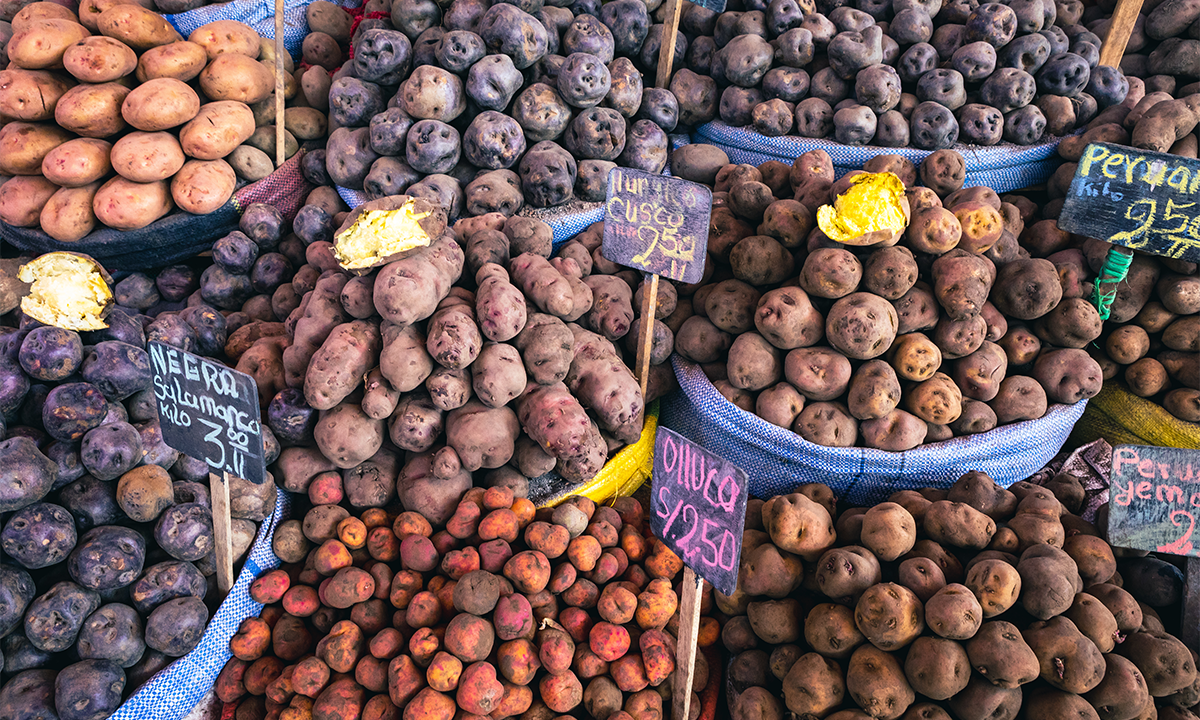
If you chew on a saltine for long enough, it starts to taste sweet. That’s because the amylase enzyme in your saliva breaks down the complex starch into simple sugars. How fast this reaction happens depends on how much of the enzyme you’ve got in your spit, which is determined by the number of copies of the amylase gene you have. And there’s quite a bit of variability in copy number between different populations. Case in point: According to a new study published in Nature Communications, the Quechua people of the Andes have loads of copies, and it’s likely because they were the first to domesticate the humble potato.
To investigate the evolutionary history of the amylase gene, biologists from the University of Buffalo collected DNA from Quechua speakers in the Peruvian Andes and compared it with genomic databases containing samples from thousands of other groups. They found that the Quechua people carry an average of 10 copies of the amylase gene. The Maya people of Mexico, a genetically similar population without Quechua’s long history of potato eating, carry an average of six copies.
Read more: “Beer Domesticated Man”
“Biologists have long suspected that different groups of humans have evolved genetic adaptations in response to their diets, but there are very few cases where the evidence is this strong,” study co-author Omer Gokcumen explained in a statement.
Of course, it’s not the potatoes themselves that are altering our genetics, it was natural selection. The Quechua people domesticated the potato around 10,000 years ago, and in the generations that followed, those with more amylase copies had more offspring. “Evolution is chiseling a sculpture, not constructing a building,” Gokcumen said.
Still, on an evolutionary scale, 10,000 years is a blink of an eye, and these ancient Peruvians seem to have adapted very quickly to their new diet. The researchers argue this points to just how malleable our metabolic genes are in the hands of evolution. “Our metabolic pathways are not simply a product of that Paleolithic past,” study co-author Abigail Bigham said.
In other words, people on the paleo diet can treat themselves to a french fry now and then. 
Enjoying Nautilus? Subscribe to our free newsletter.
Lead image: Curioso.Photography / Adobe Stock