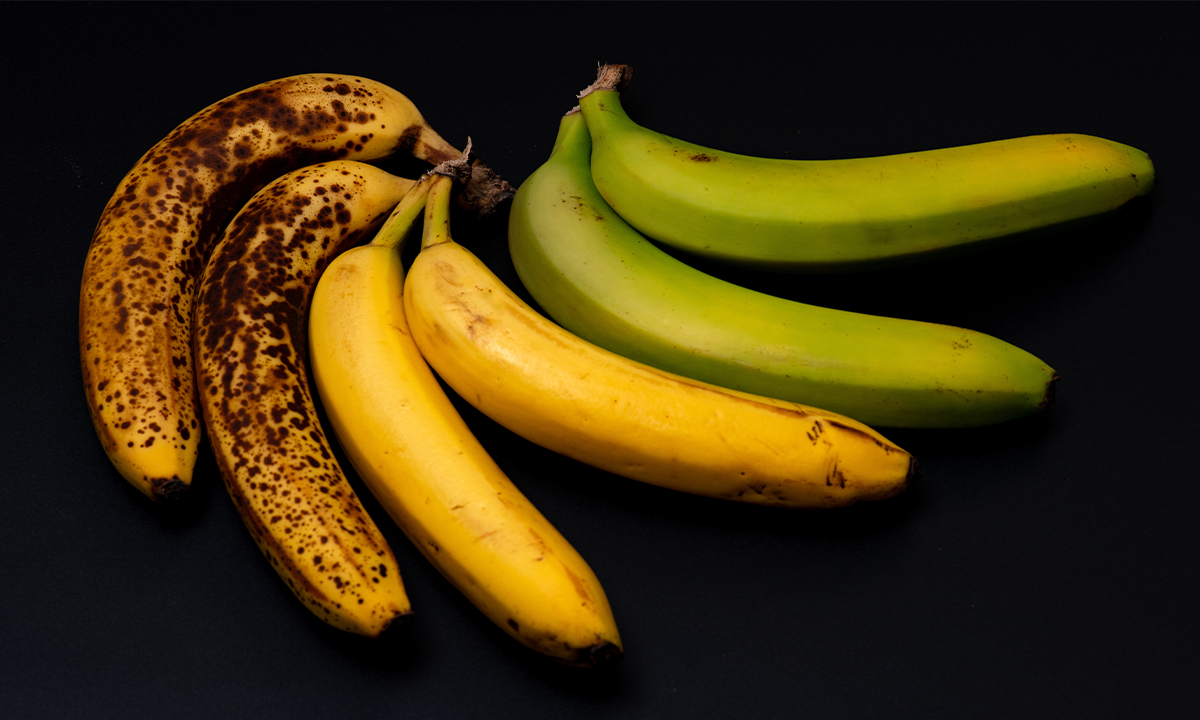
Have you ever wondered why you can get a piece of fruit to ripen faster if you toss it into a paper bag with a banana? It’s because the hormone that induces ripening in fruits is a gas—ethylene. In fact, farmers have been using ethylene to accelerate the ripening process for centuries without knowing it. Orange growers in Florida, for example, used to put their crops in sheds with kerosene lamps, thinking the heat helped them develop their characteristic hue. In reality, it was ethylene, which is a byproduct from burning kerosene.
In plants, ethylene production follows a positive feedback loop where the hormone stimulates the production of more ethylene. Now, new research published in Plant Hormones is shedding light on the genetic machinery behind all of this—with bananas in particular.
There are a number of things that happen when a ripening banana makes the transition from green and unpalatable to yellow and sweet. Ethylene production ramps up, sucrose starts accumulating, and starch and chlorophyll get broken down.
Read more: “The Fast Food Fruit”
Previous research revealed that the transcription factor MaNAC029 binds to and promotes expression of the genes for ethylene while the similarly named MaNAC19 does the same for sucrose production. A team of Chinese agricultural scientists looking at gene expression in bananas ripened with ethylene examined how MaNAC029 and MaNAC19 interact, and it turns out they make quite the team.
They found that expression of these two transcription factors peaks along with the burst of ethylene, suggesting coordinated roles in ripening. They also discovered that these two can each bind to the promoters of the genes the other one was already known to regulate, meaning they both play a role in regulating both genes. These transcription factors bind to each other as well, and the effects of the resulting MaNAC029-MaNAC19 complex is stronger than either transcription factor acting alone.
When the bananas are exposed to ethylene, it stimulates production of MaNAC029 and MaNAC19, which team up to produce more ethylene and sucrose. And voila, a green banana becomes yellow.
But if both these transcription factors can get the job done on their own, why are they pulling double duty? Banana ripening can be disrupted by things like extreme temperatures, and the researchers think this parallel regulatory system helps to stabilize it and make it more efficient.
It's a complicated process, but it’s worth it to get a healthy snack for under a dollar. 
Enjoying Nautilus? Subscribe to our free newsletter.
Lead image: Svitlana / Adobe Stock