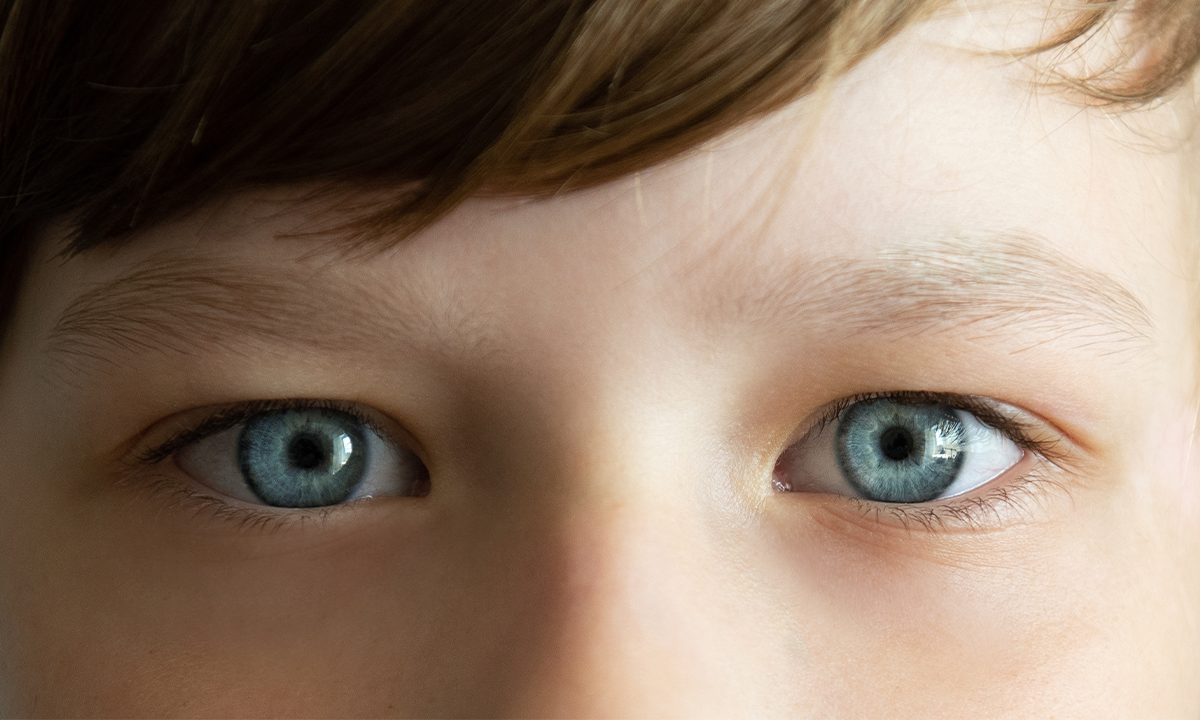
The eyes are the windows to the soul, it is said. They may also betray how much effort we are using to concentrate on our conversation partners. When listening to spoken language requires more effort, we hold the blinks and keep our eyes peeled, a trio of Canadian scientists recently discovered.
“We wanted to know if blinking was impacted by environmental factors and how it related to executive function,” said Pénélope Coupal, a researcher at the Laboratory for Hearing and Cognition at Concordia University in Montreal, in a statement. “For instance, is there a strategic timing of a person’s blinks so they would not miss out on what is being said?” The answer appears to be yes.
Coupal and her colleagues analyzed eye-tracking data from a previous experiment where people listened to spoken sentences in quiet versus noisy environments, counting how many times they blinked before, during, and after the sentences. The participants blinked fewer times during the sentence than before or after it, they found. And the noisier the environment, the less they blinked.
Read more: “How Your Brain Decides Without You”
The scientists also collected blink data from a second experiment that had already been completed using different lighting conditions and found that it had no effect on blinking frequency. This suggested that people were suppressing their blinks due to listening effort, not due to trouble seeing or discomfort with lighting. A potential explanation: Blinking briefly interrupts attention, so the brain may strategically delay blinks when taking in important auditory information, much in the same way it does during visual tasks.
The findings, published in the journal Trends in Hearing, suggest that blink rates could help researchers track cognitive function in the lab and in the real world.
In the study, fewer blinks didn’t translate to less comprehension of one’s conversational partner—it just indicated that someone was putting in greater effort to listen. Blink frequency didn’t appear to have any links to pupil dilation metrics, another method used to measure listening effort. This means blinks could capture a separate aspect of cognitive effort.
The study had a few limitations. The scientists counted blinks manually, which is time-consuming and somewhat subjective. Also, the listening task was pretty simple. Blink counts might change in real-world contexts where conversation is more complex or when the listener suffers from hearing loss, the scientists point out.
But if the results hold up, they suggest that the harder the sentence, the longer the stare. 
Enjoying Nautilus? Subscribe to our free newsletter.
Lead image: Iren_Geo / Shutterstock