Snake venom serves a dual purpose: immobilizing prey and repelling predators. As such, the chemical components of snake venom vary widely, prompting a hypothesis that, because venom is metabolically expensive to produce, the variation reflects the trade-off between targeting prey and predators. Essentially, snake species that feed on easy prey might choose to invest more chemical resources elsewhere.
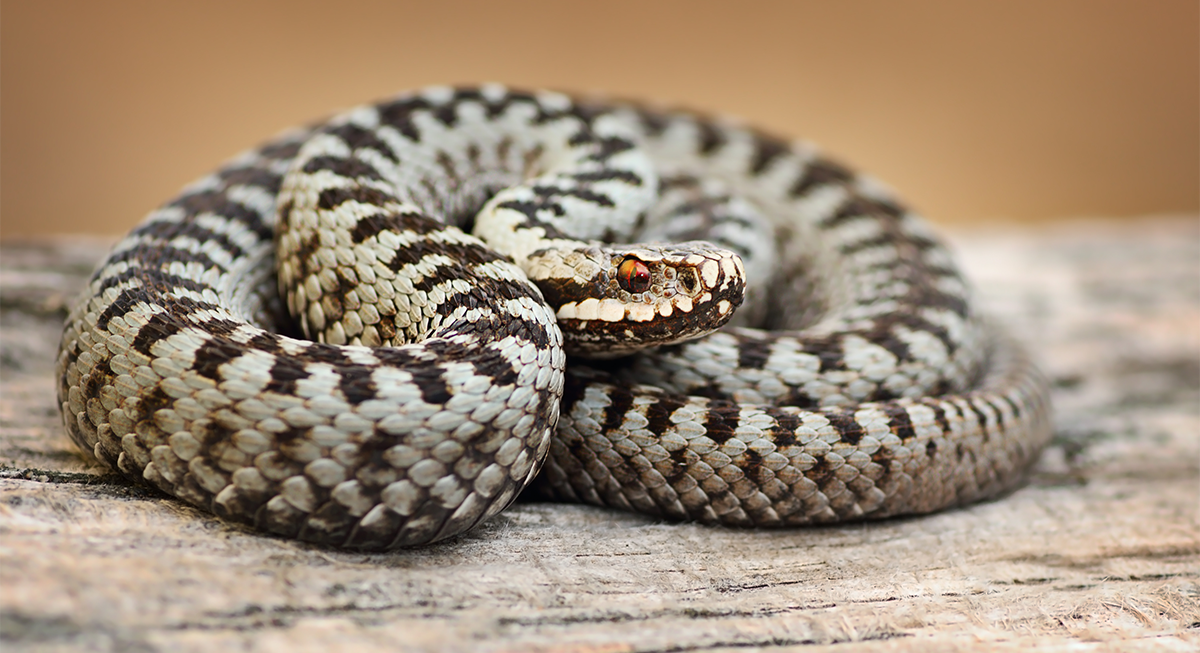
A new study published in the journal Functional Ecology tested this hypothesis by comparing the venom of six European viper species in the genus Viperus. Their diets run the gamut—from insects that require little venom to overwhelm, to vertebrates such as rodents and shrews that could inflict severe damage if not subdued quickly.
Conducted by a team of researchers from Europe and Australia, the study aimed to determine whether venom from vipers that eat defenseless insect prey was more oriented toward predator defense. They had the vipers bite into a plastic tube and then delivered the subsequent venom to a line of cells derived from mice. By looking at the activation of sensory nerve endings (or nociceptors) that convert pain signals into nerve impulses, they scored each venom on pain production.
Read more: “The Secrets of Deadly Snake Bites”
“We expected to find evidence that some vipers had evolved venom components specifically to cause rapid pain as a defensive mechanism,” explained senior author Wolfgang Wüster, a venom evolution expert at Bangor University in the United Kingdom, in a press release.
Instead, despite extensive differences in venom composition across viper species, the team found that none of the venoms activated the pain-sensing receptors in the mouse cells. “This challenges the idea that defensive and predatory functions drive venom evolution in different directions in snakes,” said lead author Bálint Üveges, a research fellow at the Hungarian Research Network. “Our results indicate that prey capture is the dominant force shaping venom composition in these species.”
The findings leave open the question of why such diverse venoms evolved in the first place. The study authors suggest that the variation might stem from how species evolved separately, specialized to eat different types of prey, or lived in regions with different ecological conditions.
This much is certain, though: Viper venom does a great job of keeping humans at a safe distance. 
Enjoying Nautilus? Subscribe to our free newsletter.
Lead image: taviphoto / Adobe Stock