White has a physical purity. White light contains roughly equal amounts of every color in the visual spectrum, and activates all three types of cone cells in our eyes related to color. As a result, we perceive materials that don’t absorb color, and reflect light back to us, as achromatic—white.
The union of white and purity in Western culture may have its first roots in religion. That’s how Kathleen Brown, a historian at the University of Pennsylvania, sees it. “Historically, white is one of the ways men of the cloth signified their calling,” Brown says. Later, this association with religious purity evolved into bodily purity. (“Cleanliness is, indeed, next to godliness,” declared John Wesley in an 18th-century sermon.) Brown’s book, Foul Bodies, chronicles cleanliness in Europe beginning with its colonial expansion, and in early America up to the Civil War. Cleanliness, she says, was signified by a growing profusion of white undergarments, worn against the skin beneath the outer clothes, and then spilling forth in ruffled cuffs and collars. The undergarments were seen as having a cleansing power, the stains they collected a sign that they were drawing dirt from the body.
White became an indicator of class and wealth. The richer you were, the finer, whiter, and more intricate were your linens, and wealthy people changed them every day. White underclothes, sheets, towels, and tablecloths were prized for the very fact that they were so hard to keep clean. “It’s the sheer impracticality and difficulty of maintenance that makes it such a genteel object,” Brown says.
In the 19th and 20th centuries, white was an important color in sanitation movements that swept cities after cholera and influenza outbreaks. Katherine Ashenburg, author of The Dirt on Clean: An Unsanitized History, notes that cleaning products of Westerners changed. “Before that, their soap was really, really disgusting,” she says; it was made of rendered animal fats and came in ugly greens, browns, and grays. Procter & Gamble finally developed an inexpensive white soap that could be sold in bars in 1878. Ashenburg says that Ivory’s white color—which evoked purity and cleanliness—had a lot to do with its success.
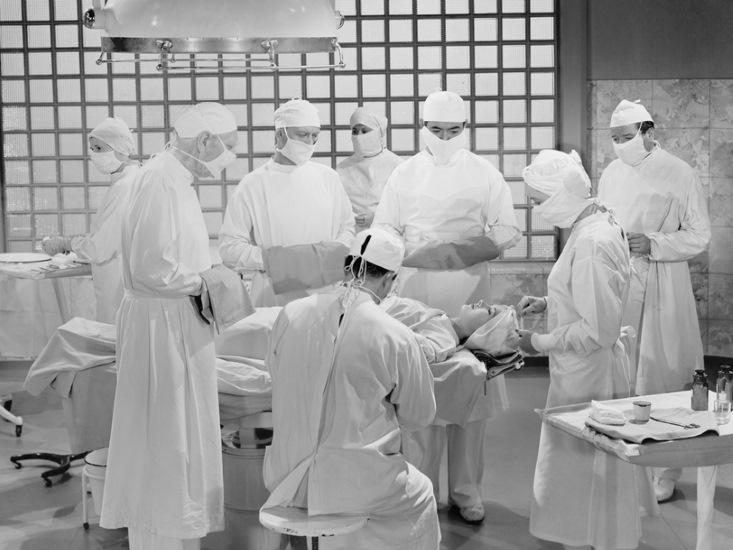
“By the 1920s, white was being used as a hygienic aesthetic,” says Virginia Smith, an independent historian and author of Clean: A History of Personal Hygiene and Purity. Doctors donned white coats, and nurses wore starched white hats. Hospitals and clinics were given white walls and white tile floors. There’s a practical reason: White can offer proof of being clean. But this function became intertwined with layers of meaning it acquired over time, Smith says. In the 20th century, white sports clothing became more commonplace, a symbol of health and vigor.
Eventually, whiteness made its way into homes and objects as outward reflections of personal cleanliness. In 1925, the architect Le Corbusier declared in “The Law of Ripolin” (referring to a popular brand of paint) that whitewashed walls had a spiritual and moral cleansing power. Every citizen, he wrote, should “replace his hangings, his damasks, his wall-papers, his stencils, with a plain coat of white ripolin. His home is made clean … Everything is shown as it is. Then comes inner cleanness.”
White’s powerful symbolism, of course, has darker connotations. Brown points out that as European colonists encountered other groups in America and West Africa, there was “a new interest in whiteness both as an indicator that clothes were clean, but also a racial indicator of a kind of refinement and civility.” In portraits of 17th- and 18th-century European settlers, particularly women, faces “start to glow like weird white ghosts,” Brown says, showing their purity as bearers of civilization. In later years, white’s symbolism was appropriated into ideas of racial purity, manifested in Nazi language like “racial hygiene” and Ku Klux Klan garb.
For more on the great lengths we go to in our pursuit of whiteness, see the rest of Courtney Humphries’s feature story, “Have We Hit Peak Whiteness?”
Courtney Humphries is a writer in Boston who covers science, medicine, architecture, and urban planning.