Most fish on Earth today are ray-finned fishes: minnows, anchovies, catfish, bluefish, groupers, flatfish, bonitos, you name it. But dial back 400 million years ago to the Devonian Period, and heavily armored placoderm fishes dominated Earth’s oceans. In fact, it wasn’t until a massive extinction at the end of the Devonian that placoderms disappeared, giving ray-finned fishes (class Actinopterygii) an opportunity to flourish.
How the family tree of these early ray-finned fishes emerged to ultimately yield the huge variety of species we see today, however, has remained unknown—a mystery that a study published today in Proceedings of the National Academy of Sciences attempts to unravel.
An unusual ray-finned fish fossil was discovered in 319-million-year-old (Carboniferous Period) coalfield deposits in the United Kingdom. From the fish Trawdenia planti, it included the ancient soft tissue of the fish’s brain, a part that’s much less likely to fossilize than the bony tissues. Unlike the sample of other fossilized brains from early fishes, which have been tiny relative to their brain cavities, this one fit snugly inside the endocranium (the inner bony cavity that mirrors the brain’s shape).
Read more: “Fish Can Be Smarter Than Primates”
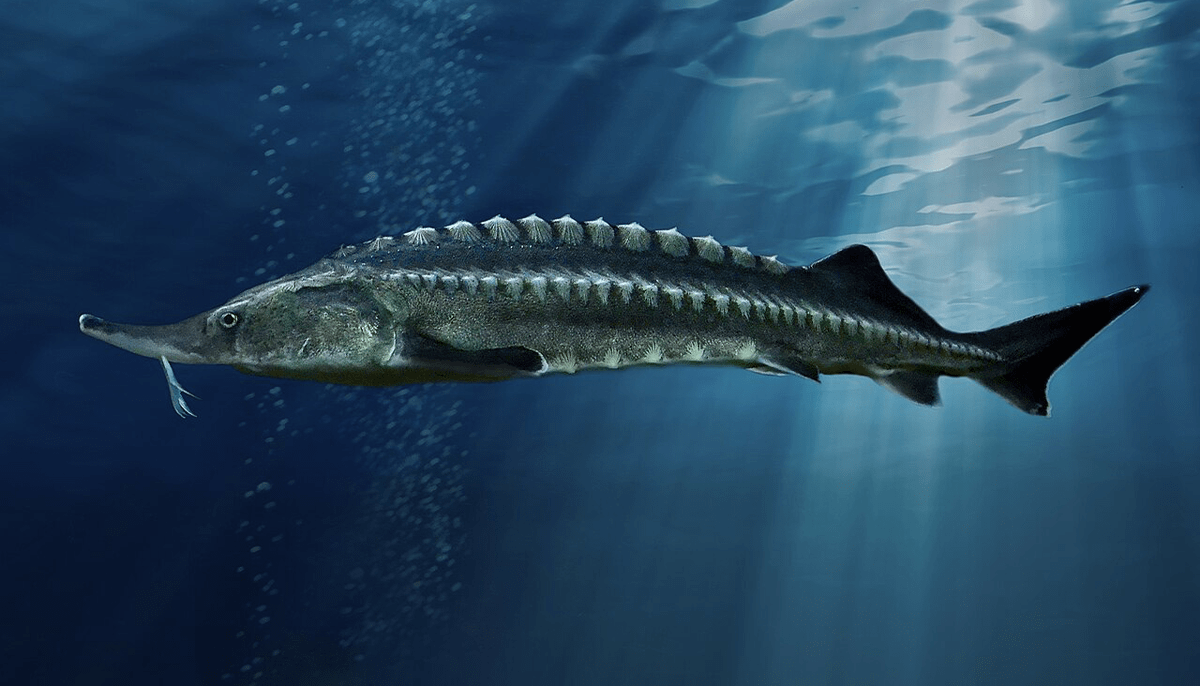
Based on the features of the fossil, a team of researchers from the University of Chicago and the University of Kansas concluded that T. planti was related to the subclass of fishes called “Chondrostei.” They used to be the most abundant bony fishes on Earth until about 150 million years ago, when they were gradually replaced by the teleost fishes, which make up 90 percent of today’s species. Currently, the only Chondrostei remaining on Earth are paddlefishes and sturgeons.
“These data suggest that Trawdenia bridges the gap between early actinopterygians and modern Chondrostei,” wrote the study authors. As such, T. planti may be one of many ray-finned fishes that evolved in the burst of fish diversity after the placoderms went extinct.
The fossil also validated that endocasts (fossils showing the inner surface of the cranium) can be a legit proxy for brain characteristics. Using X-ray microcomputed tomography, the research team examined the T. planti brain tissue to determine the size, shape, and structure of the original, living brain. They found that the structures on the wall of the braincase matched with the contours of the fossil.
The similarity between the T. planti braincase and the shape of the soft neural tissues paves the way for interpreting other fish brains from their braincase contours when there’s no soft tissue.
And what’s inside their heads tells a remarkable evolutionary tale. 
Enjoying Nautilus? Subscribe to our free newsletter.
Lead image: This photo showcases a beluga sturgeon, one of the largest sturgeon species. Sturgeon and paddlefish are the only living Chondrostei remaining on Earth. Credit: Максим Яковлєв / Wikimedia Commons.