
Dinosaur blood may have built the fictional Jurassic Park, but coming across it in the real world has proved to be a little more difficult—until now. In a new study published in Proceedings of the National Academy of Sciences, a team of paleontologists and geochemists announced they’ve struck 115-million-year-old paydirt.
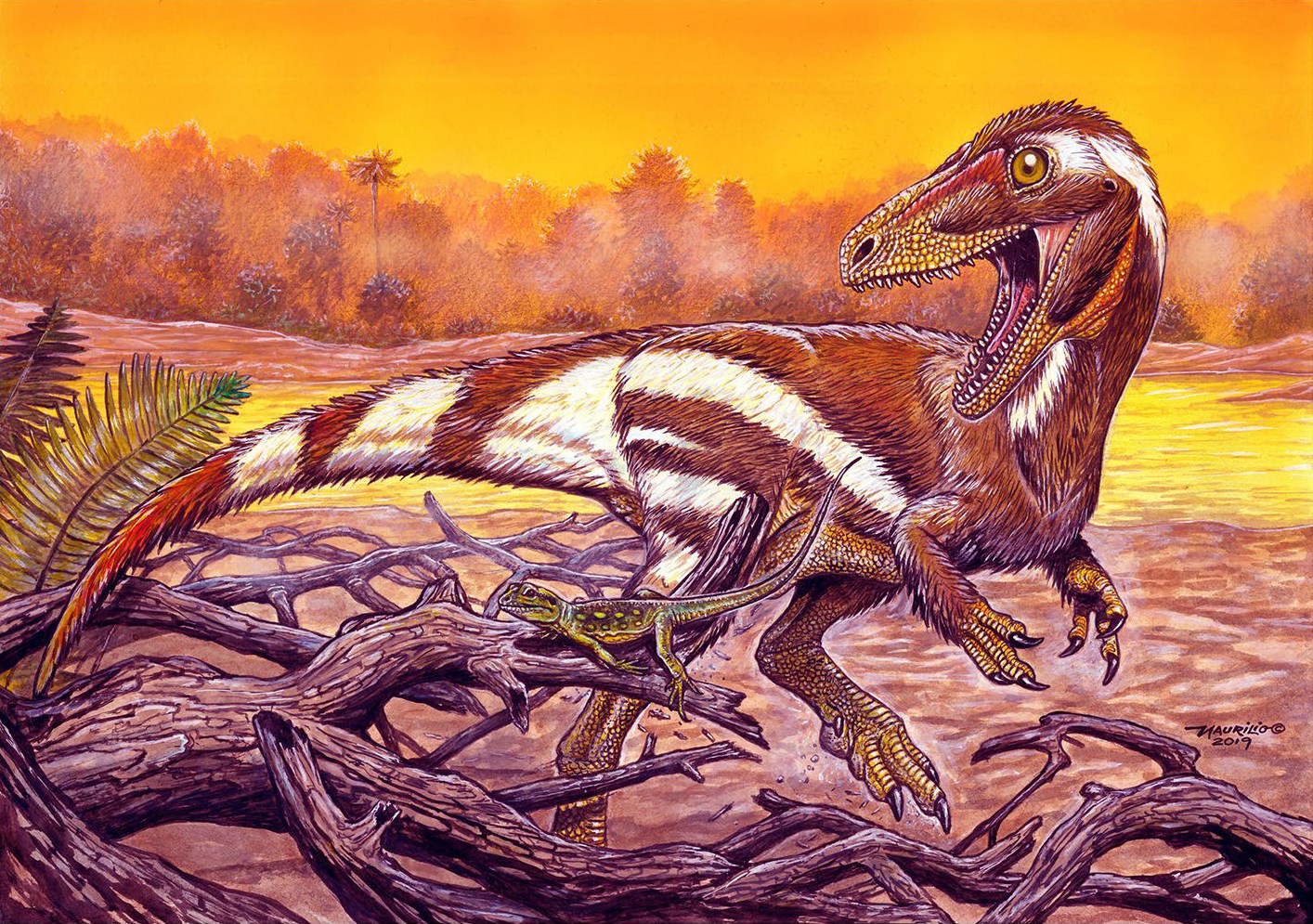
The team found the blood cells in the hind leg bone of a juvenile Cretaceous-era theropod (Aratasaurus museunacionali) excavated from a Brazilian mine in 2008. After taking thin slices of the fossilized bones, chemically treating them, and giving them a thorough inspection under an electron microscope, they discovered round blobs roughly the size of cells. The blobs were localized to vascular channels that would have carried blood vessels when the dinosaur was alive.
Read more: “We Finally Know Tyrannosaurus Rex’s Body Temperature”
It was a strong suggestion that the blood cells had fossilized along with the rest of the dinosaur, but to be certain, they performed chemical analyses on both the bones and the surrounding sediment. Within the fossilized bones, they detected the presence of heme—the ring-shaped iron-bearing molecule found in hemoglobin. The non-dinosaur sediment, on the other hand, had none.
“To detect intact heme-derived molecules in 115-million-year-old red blood cells is astonishing: This really is a landmark discovery,” study author Kliti Grice of Curtin University in Australia said in a statement. “It not only extends the known fossil record of blood, but also offers a direct molecular window into the physiology of long-extinct animals so we may better understand them and the world they lived in.”
Speaking of physiology, the team compared the shapes of blood cells to those from birds and crocodiles. The dinosaur cells were a little more oblong than the cells from their closest living relatives, but it’s unclear what, if any, conclusions can be drawn. According to the team, it’s possible they were simply deformed during a fossilization process that happened fast enough to preserve the cells in the first place.
Of course, the real highlight of the study isn’t the dinosaur’s blood cells per se, it’s that it’s possible for these cells to survive at all. “These findings challenge longstanding assumptions that certain biomolecules such as hemoglobin cannot survive deep time,” Grice explained. “It opens exciting new avenues for molecular-level palaeontology, allowing us to investigate the evolution of blood, metabolism and even activity levels in ancient animals.” 
Enjoying Nautilus? Subscribe to our free newsletter.
Lead Image: Maurilio Oliveira / Wikimedia Commons