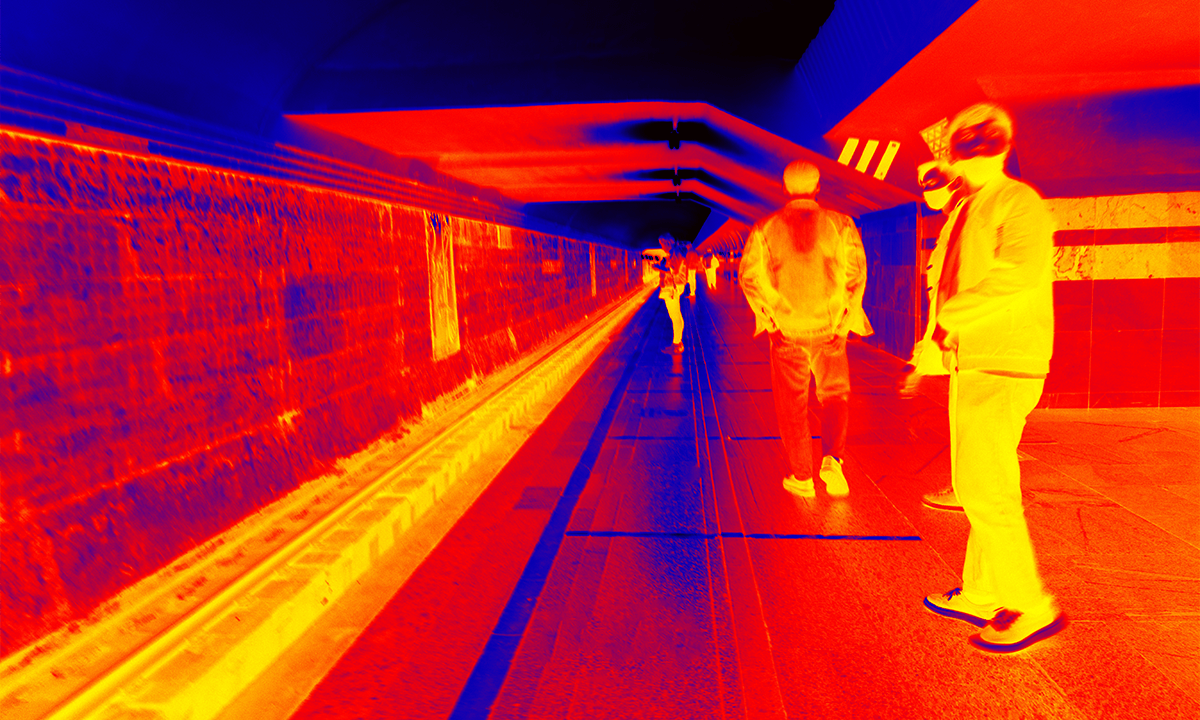
If you’ve ever ridden the New York City subway in the summer, you know it gets sweltering down in the tunnels. It’s not uncommon to see sweat-drenched straphangers fanning themselves, posting up under overhead fans, and edging close to the track to catch the breeze from approaching trains.
That’s because the urban heat island effect—the phenomenon of cities becoming hotter than surrounding areas due to the heat absorption of concrete and asphalt, among other factors—extends underground as well. With the surrounding earth and rock acting as an insulator and poor ventilation, it’s a recipe for a subterranean sauna. In fact, underground temperatures can sometimes exceed surface temps. Now, new research published in Nature Cities finds subway systems are getting even hotter—and people are definitely noticing.
To get a better handle on how we experience the temperature of underground public transit, civil engineers Giorgia Chinazzo and Alessandro F. Rotta Loria of Northwestern University examined more than 85,000 social media posts from commuters in Boston, New York City, and London.
“We focused on these three cities because their transit systems are the oldest and biggest,” Rotta Loria explained. “London has the oldest metro system in the world. In the U.S., Boston has the oldest system, and New York has the largest one.”
Read more: “Seeing a Superhero on the Subway Makes People More Likely to Surrender Their Seats”
Using natural language processing to select posts with keywords like “hot,” “warm,” and “uncomfortable,” while screening out comments unrelated to the heat, the team identified 22,000 temperature-related complaints from a 16-year period. They found that for every 1.8 degree Fahrenheit increase in temperature above 50 degrees Fahrenheit, complaints increased 10 percent in Boston, 12 percent in New York City, and a whopping 27 percent in London.
While summer was (unsurprisingly) the most common season for gripes about the heat, there were still complaints in the winter months, probably due to people dressed more warmly. Complaints peaked at different times of the day as well. In London, beleaguered commuters sounded off in the afternoon; across the pond in Boston and New York City, complaints clustered around noon and 9 p.m. Overall, people were less inclined to vent their frustrations on the weekends, suggesting social factors were at play.
“Thermal conditions are not necessarily better on the weekends, but the metro might be less packed, and people might be dressed more comfortably,” Chinazzo said. “State of mind also matters. For example, a tourist on vacation might be less inclined to complain compared to someone headed to work.”
The researchers hope their work mapping complaint trends will help transit agencies better target their heat-mitigation efforts—for example, strategically running fans during peak complaint times.
“Depending on the metro system under consideration, it may not make sense to cool down the underground environment all day,” Rotta Loria said. “But we could enhance cooling during specific times when we know people are uncomfortable. That means spending less energy and less money.”
Now if we could just figure out how to stop people from trying to board the trains before everyone has gotten off. 
Enjoying Nautilus? Subscribe to our free newsletter.
Lead image: Maximillian cabinet / Shutterstock