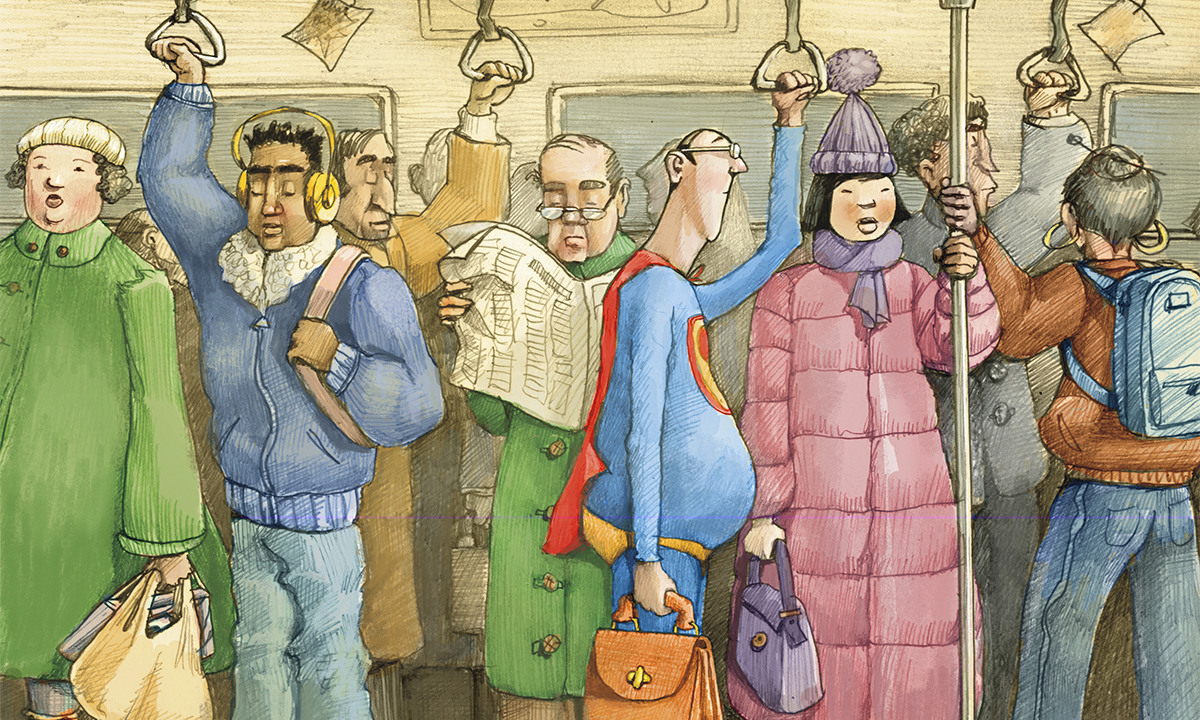
Imagine commuting after a long day of work on a crowded subway. Exhausted, you plop down on the last seat, ready to do a little mindless phone scrolling while the stations that aren’t yours whizz by. Then you notice a pregnant woman standing nearby. Do you give up your seat?
Ok, now imagine Batman is lurking mere feet away, observing the whole scene. Does that change your answer? According to new research by psychologists at the Università Cattolica del Sacro Cuore in Milan, it just might, and for a surprising reason.
Publishing in NPJ Mental Health Research, scientists at the Italian university described an experiment designed to measure the effects of unexpected events on prosocial behavior, or behavior that helps other people or society. In the control trials, a woman wearing a prosthetic belly to appear pregnant entered a packed Milan subway car along with an observer who recorded whether anyone gave the woman their seat. A separate set of trials was identical except for one twist—a second observer dressed like Batman entered from another door on the same subway car.
The researchers found that 38 percent of passengers were altruistic enough to offer up their seats without Batman watching, but that number jumped to over 67 percent when the Caped Crusader was present.
Read more: “The Physics of Crowds”
It’s tempting to conclude that under the watchful eye of the Dark Knight, people were on their best behavior. Indeed, the researchers couldn’t fully rule out that Batman’s presence may have “increased the salience of cultural values, gender roles, and chivalrous helping norms.” But after conducting interviews with the do-gooders who surrendered their seats, the psychologists discovered an interesting wrinkle—44 percent of the seat relinquishers didn’t even spot the Batman on the train.
Instead of inspiring a sense of justice, the researchers hypothesized, the unexpected event of someone dressed in a costume may have made everyone more aware in general. “Disruptions to routine can heighten awareness of one’s surroundings and enhance sensitivity to the needs of others, ultimately promoting prosocial actions,” the authors wrote.
It’s this disruption of routine that may have influenced the 44 percent of people who gave up their seat despite not realizing Batman was riding alongside them. Attention, the researchers pointed out, can be socially transmitted. If you encounter a group of people looking in one direction, you’ll turn to see what all the commotion is about. In the experimental scenario, a general heightened awareness caused by Batman may have spread through the subway car, influencing even those who didn’t see him.
In other words, giving up your subway seat is a kind gesture for one person, but dressing up as a superhero? That just might inspire a train full of people to be more mindful. 
Enjoying Nautilus? Subscribe to our free newsletter.
Lead image: nuvolanevicata / Shutterstock