If the operators of Jurassic Park were going for verisimilitude, they wouldn’t have just included flashy dinosaurs. There were plenty of tiny protomammals scurrying around at the time, as well. Now, paleontologists have unearthed a new kind of mammaliaform—and it’s a (relatively) big one.
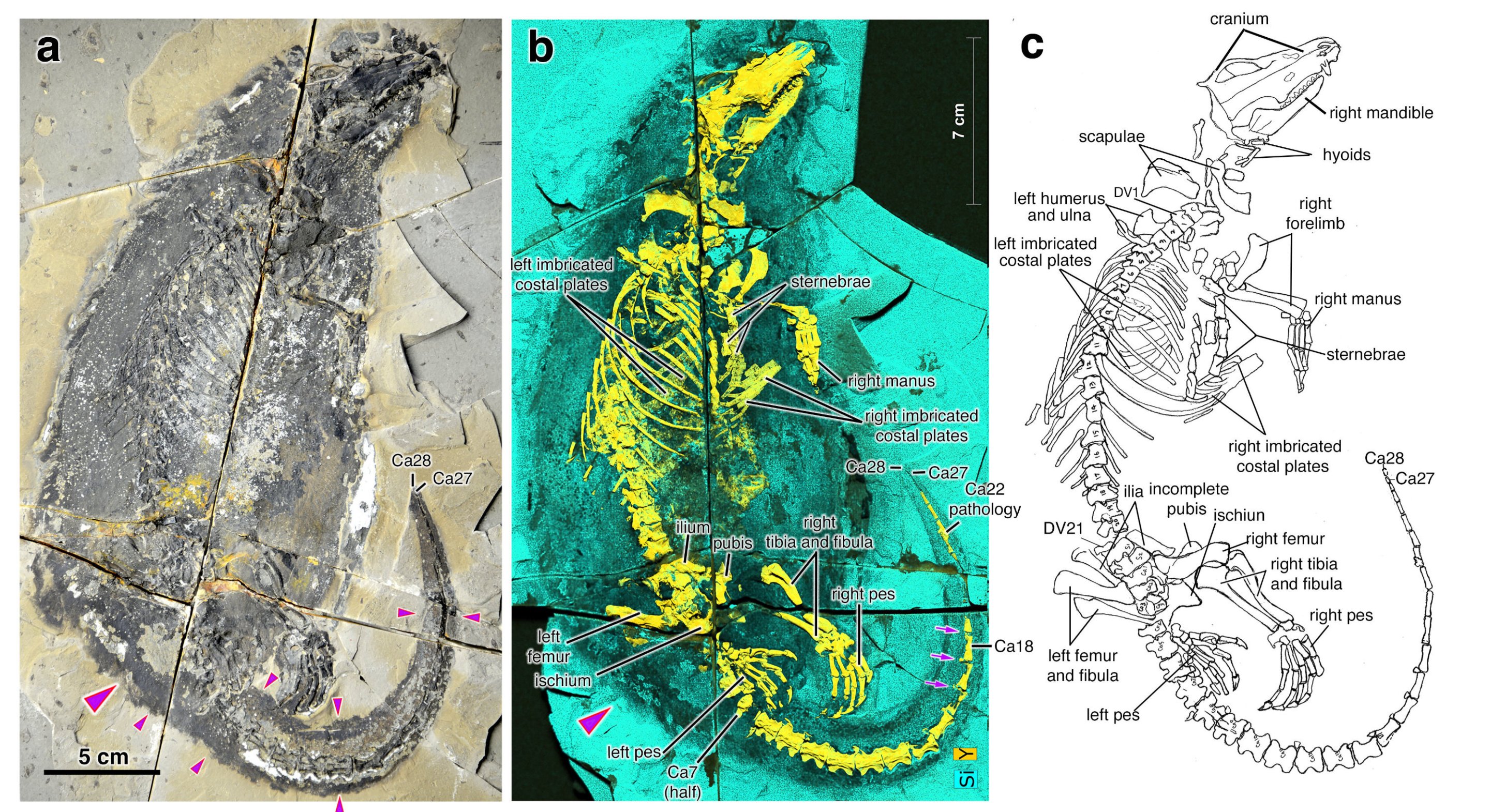
An international team of paleontologists discovered the specimen in the collections of the Paleontological Museum of Liaoning in Shenyang, China, but it originated from a fossil assemblage in Mongolia. After a thorough analysis they published their findings in Nature, naming the mammaliaform Megacauda sungei.
Read more: “How Did Birds Outlive the Other Dinosaurs?”
The genus name is a reference to the critter’s flat, stout tail, which along with its short-haired coat and feet built for paddling, led the team to conclude it lived a semi-aquatic lifestyle. M. sungei’s sharp, curved teeth would have been adept at capturing slippery prey, and at its size, it likely had its pick of food items. M. sungei dwarfed other mammaliaforms living at the time (many of which resembled tiny shrews). It weighed in at over four pounds and was around a foot-and-a-half from snout to tail.
But according to the team, its real innovation was a little more inconspicuous. An analysis of the animal’s throat bones showed it likely had a soft palate separating its mouth from its pharynx that would have let it eat and drink while still breathing.
Crucially, in true mammals like us, the soft palate is also what allows us to suckle milk. “It was this adaptation that made brain development, eventually leading to humans, possible,” study author Thomas Martin of the University of Bonn explained in a statement. “The soft palate and the shaping of the oral cavity and pharynx are directly linked to the evolution of mammals.”
It might not look like much, but this 18-inch swamp rat is family. 
Enjoying Nautilus? Subscribe to our free newsletter.
Lead Image: Li et al., Nature