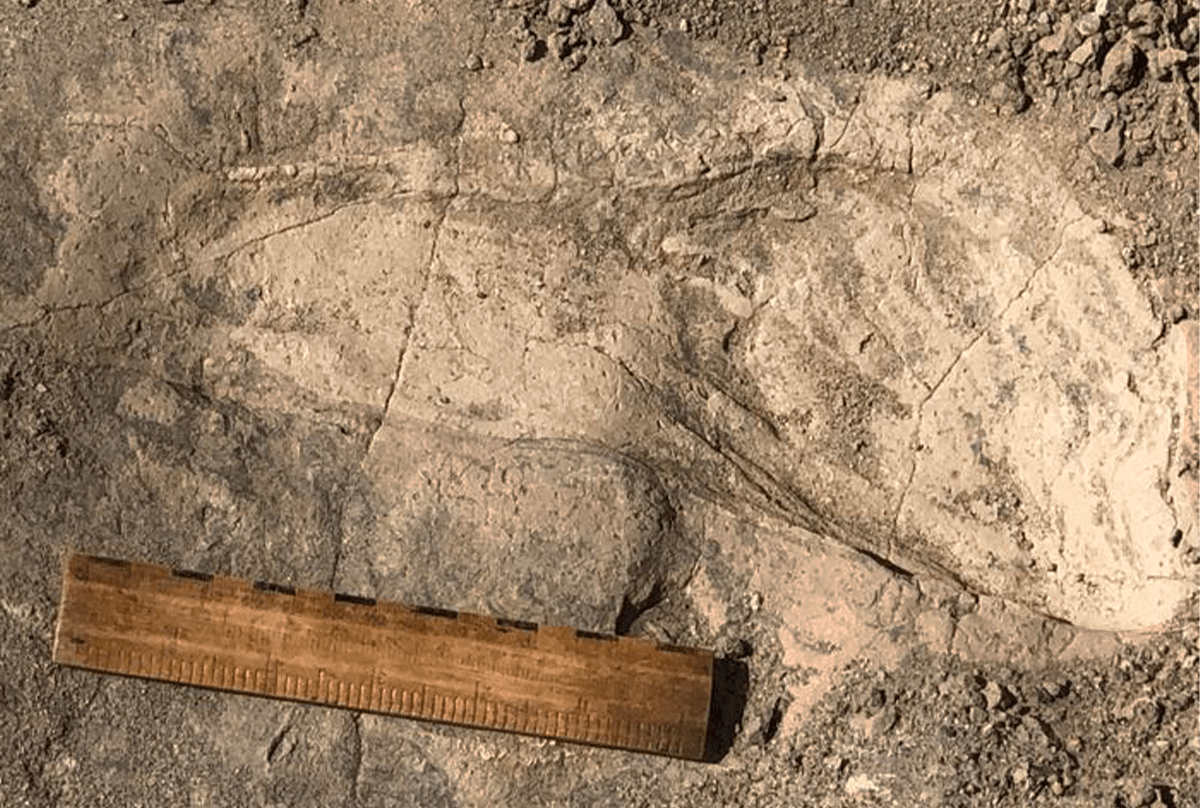
There are a few oddballs hanging around the branches of the human family tree, and one of them is Paranthropus boisei. While these ancient hominins aren’t direct ancestors of modern humans, they did overlap with at least one, Homo erectus, during their time on Earth. In fact, the two species left footprints 1.4 million years ago in the same prehistoric mudflats located in the Lake Turkana basin in what’s Kenya today. Now, new research into those P. boisei footprints published in the Proceedings of the National Academy of Sciences is shedding light on this mysterious relative.
Compared to H. erectus (and modern humans), P. boisei looked a lot more simian. Massive jaw muscles, a pronounced brow ridge, and flared cheekbones gave its face an orangutan-like quality. It also had a more robust build, with an ape-like upper body and thick leg bones. P. boisei was thought to be the shorter of the two species as well, but the findings of this latest study suggest that’s not necessarily the case.
Read more: “Portrait of the Human as a Young Hominin”
According to a detailed analysis of the footprints conducted by an international team of researchers, the hominins were taller and heavier than previously believed. “The sizes of the footprints indicate human-like body sizes—up to 6 feet tall and around 165 pounds,” the study’s lead author Kevin Hatala of Chatham University said in a statement.
The team also determined they belonged to eight distinct P. boisei adults, an important clue to their social dynamics. “The fact that eight, mostly adult, male P. boisei individuals seemingly traveled together as a group, without females or children, hints at a complex social structure in this species,” study co-author Neil Roach of Harvard University explained. “They may have lived in large groups, where males competed for mates, but also tolerated each other at times for safety in a dangerous environment.”
Unfortunately, there’s less information about how they interacted with our forebears, H. erectus. Previous research into the footprints from the same team—including paleontologist Kay Behrensmeyer who helped discover the tracks in 1978—determined they may have been left within hours of one another. Whether their paths ever crossed, metaphorically, is up to their distant relatives to figure out, more than 1 million years later. 
Enjoying Nautilus? Subscribe to our free newsletter.
Lead image: One of the larger hominin footprints with a 6-inch ruler for scale. The tracks were made in soft mud and then filled in with sand by gentle shoreline currents, preserving the impressions. Credit: Kay Behrensmeyer, Smithsonian.