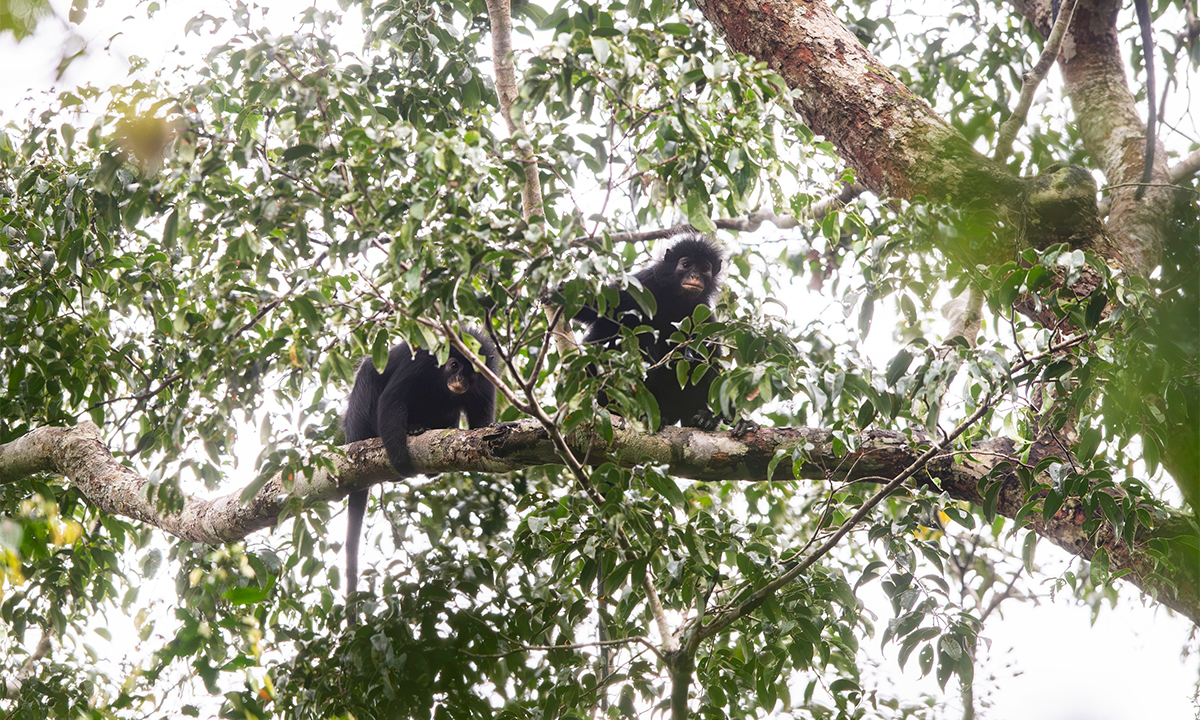
By now, you’d think we’d have a handle on all the other primates sharing the Earth with us. After all, primates tend to be large-bodied, active, and noisy. And yet, a study led by Florida Atlantic University researchers just announced a new species from the east-central region of the Democratic Republic of the Congo: an orange-lipped colobus monkey dubbed Colobus congoensis.
To be fair, inhabitants of the remote Congo basin were aware of the primate, with the Balanga community naming it “Likweli,” and the Mituku community calling it “Kasaba Nkoni” (or “branch shaker”—like other colobus, this one adeptly leaps between trees, causing branches to bow and sway). Still, local people had limited knowledge of the species because of its elusive habits.
In 2008, the monkey appeared in a photo from a Lukuru Foundation research expedition, but it was taken from behind, making species identification impossible. A decade later, a frontal photo revealed distinctive orange markings on its nose and lips, prompting a study to decode its identity. Through 114 additional field observations, plus analysis of specimens that were confiscated by natural resources officials from illegal hunting operations, researchers have fully described the new species for the first time.
“In order to name a new species, you have to be able to prove it,” explained co-author Christopher Gilbert, an anthropology professor with the City University of New York, in a press release. “We used extensive museum collections including specimens housed at the Yale Peabody Museum and the American Museum of Natural History, and comparative datasets to compare the skulls and pelts with known African colobus monkeys.”
C. congoensis is small (15 pounds) with a head framed by a crown of stiff black hair. Its facial colors are unique among colobus monkeys, as is the patch of white fur around its anus. Despite a resonant roaring call, C. congoensis hides high in the canopy, such that it’s rarely seen by humans.
Read more: “How Climate Change Could Starve the Monkeys”
Analysis of mitochondrial DNA confirmed its unique identity. C. congoensis split off from its closest relative—C. santanas, which lives about 750 miles to the west—about 5 million years ago. With its limited range of only 656 square miles, mostly in upland forests, C. congoensis may soon be classified as endangered.
Study authors Kate Detwiler and Junior Amboko said in an interview that they hope to “understand every aspect of Likeweli’s natural history—what it eats, how it behaves, how it moves through the forest … how it reproduces, etc.”
At least they know now what they’re looking for. 
Enjoying Nautilus? Subscribe to our free newsletter.
Lead photo by Daniel Rosengren / Frankfurt Zoological Society