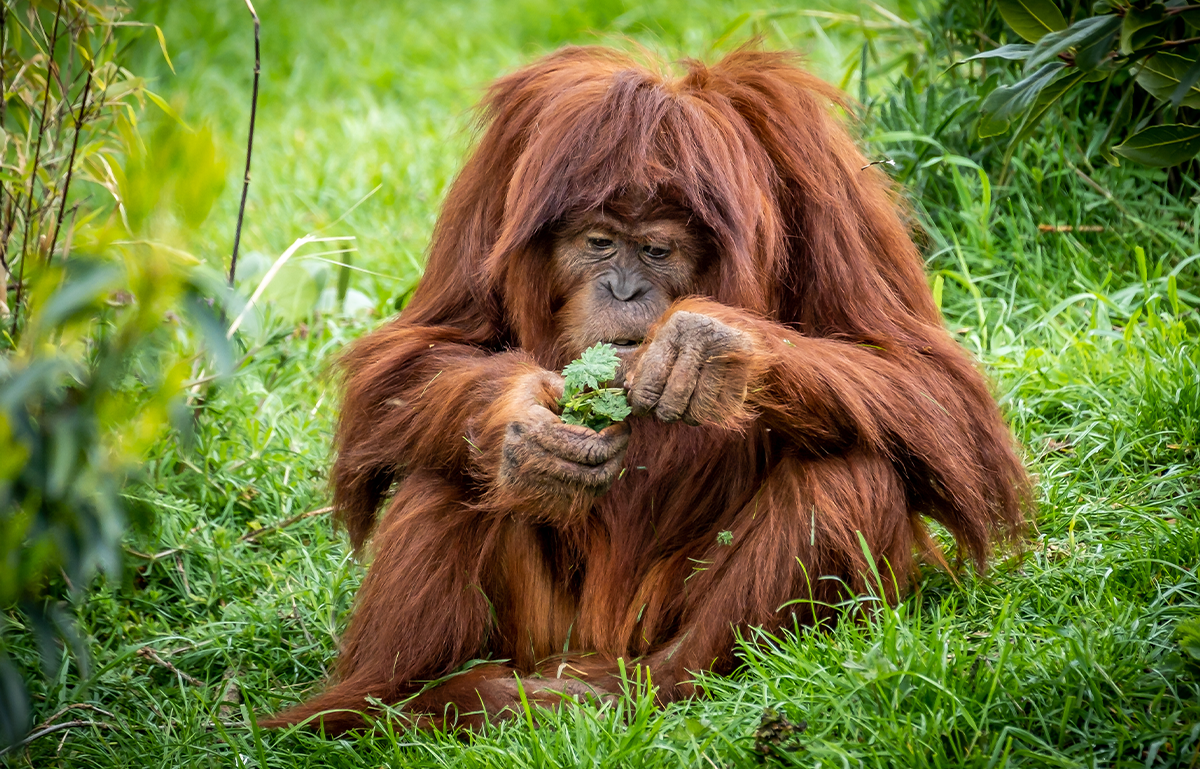
In 2024, biologists reported that a wild Sumatran orangutan named Raku treated his own facial wound with a poultice of chewed-up leaves. They weren’t just any leaves either—Raku selected leaves from a plant vine, Fibraurea tinctoria, known to have medicinal properties, from analgesic pain relief to antibacterial and anti-inflammatory effects.
Now, a recent study in Scientific Reports has found that Raku’s self-medicating moment wasn’t a one-off event, but rather part of a broader suite of orangutan behaviors. Researchers from the United Kingdom and Indonesia collected behavioral data for more than 20 years on a population of about 100 wild Bornean orangutans living in a peat-swamp forest. Observations of feeding included the species of plant as well as the parts eaten, whether fruit, seed, skin, pulp, pith, or bark. Two coauthors local to the study site offered ethnobotanical knowledge about medicinal properties and uses of the plants by humans.
A total of 12,236 feeding events were recorded, yielding 202 distinct plant species. Of those, about 30 percent were recognized as medicinal plants by the Indigenous Dayak communities of the region. Furthermore, orangutan consumption of the medicinal plants was found to be non-random.
Read more: “Learning Medicine from Animals”
“What makes the findings interesting is that some plant species appeared together in the orangutan diet far more often than we would expect by chance,” explained study author Georgia Allen, then a master’s student at the University of Exeter, in a press release. “Importantly, many of these plants aren’t major parts of the orangutan diet overall, suggesting they may be eaten for specific benefits rather than as everyday food sources.”
The orangutans appeared to select combinations of plants in sequences that confer a full complement of pharmacological benefits. Since orangutans don’t have a “medicine man” to prescribe the right concoctions of plant remedies, they’re likely using chemical cues and memory to favor healing species. The study authors hypothesized that botanical knowledge may even be passed down over generations.
Regardless, Allen added, “our findings suggest they selectively consume certain plants with medicinal properties in ways that go beyond simple nutrition.” 
Enjoying Nautilus? Subscribe to our free newsletter.
Lead image: Peter Robinson / Adobe Stock