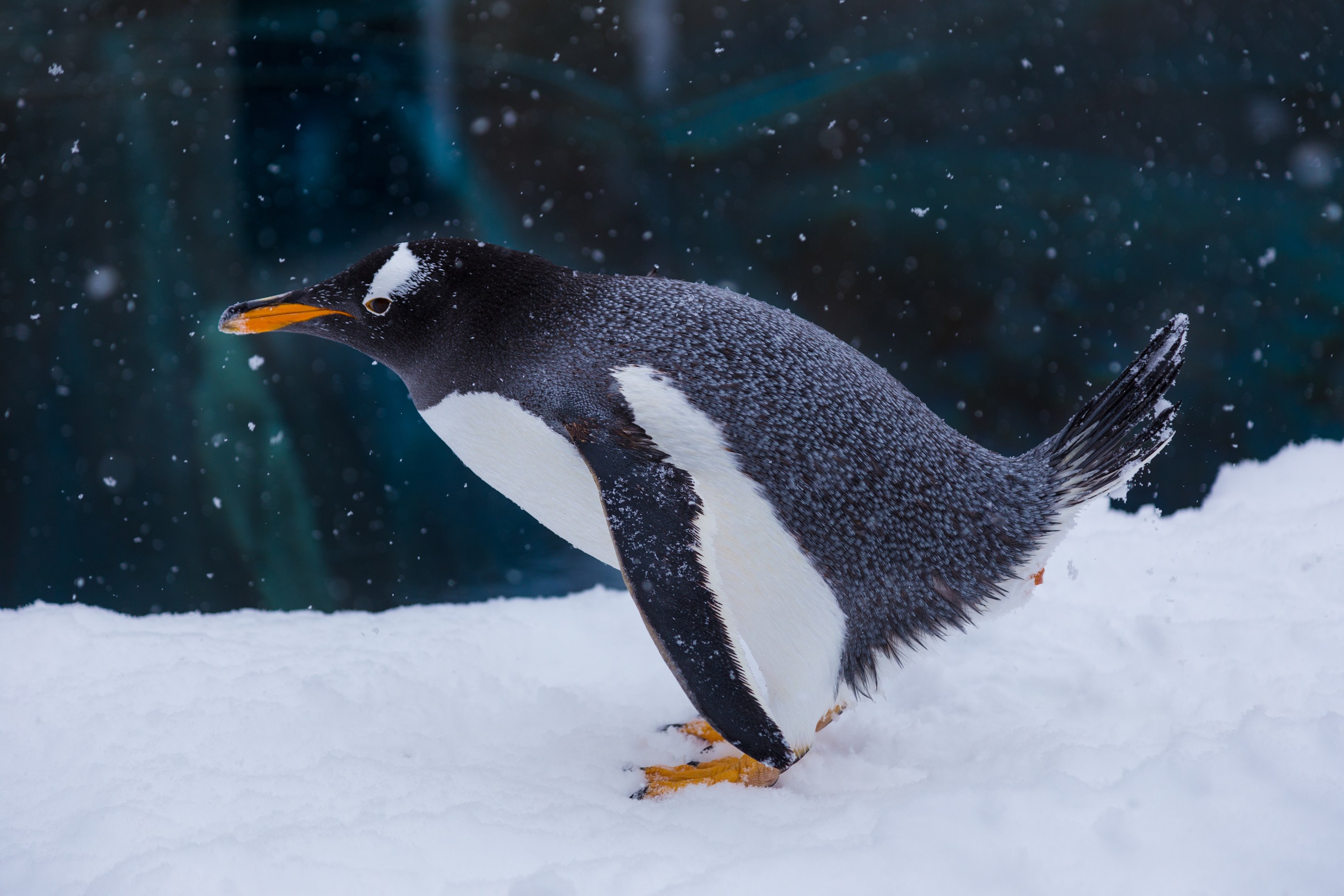
Penguins are messy, gathering in dense huddles where their guano (aka poop) piles up on the ice. In fact, their poop piles are so dense that they show up on satellite images. And the guano stains aren’t just in the spots where penguins let loose their bowels, but also where they track it when they waddle around on the snow. Moreover, a new study published today in the Journal of Geophysical Research Biogeosciences found that penguin guano has far-reaching impacts on the Antarctic landscape by nourishing snow algae that grow on the surface.
The study authors traveled through the blustery Drake Passage that links the Atlantic and Pacific oceans to reach the West Antarctic Peninsula, where they gathered samples of snow algae, some of which appears red and some of which appears green. Back in the lab, they extracted pigments and nutrients from each sample. The green samples proved richer in phosphate, which comes from penguin guano. It allows algae to load their cells with chlorophyll and boost photosynthesis. In contrast, the red algae were low in phosphate and instead derived their color from red pigments, which act as sunscreen when they go inactive during times of nutrient scarcity.
Read more: “What Satellite Photos of Penguin Poop Tell Us About Earth’s Health”
Here’s the real rub, though: Because darker colors absorb more heat, colored snow melts faster than white snow. In particular, red snow absorbs about 20 percent more energy from sunlight than white snow, while green snow absorbs about 40 percent more energy from sunlight than white snow. In other words, penguin guano is accelerating snowmelt, and, as penguins are nudged further south by a warming climate, snow algae will get greener along their route.
“Without accounting for these biological darkening effects,” explained senior author Alia Khan, a cryosphere biogeochemist at the University of Colorado Boulder, in a press release, “we are likely underestimating how rapidly coastal snowpacks are melting and how fast ice-free terrain will expand across Antarctica.”
Khan’s group is the first to reveal the link between penguin poo and the biorhythms of snow algae as well as the potential consequences for the melting and greening of Antarctica.
It’s an unfortunate connection that’s best summed up as follows: 💩💩💩. 
Enjoying Nautilus? Subscribe to our free newsletter.
Lead Image: udosstudio / Adobe Stock