Deep beneath the ocean where the African and South American tectonic plates meet lies the Doldrums Fracture Zone. Judging by its name alone, you might guess it’s not a particularly interesting area of the ocean floor, but a recent scientific expedition to the region revealed it’s anything but boring.
Scientists from the Schmidt Ocean Institute just completed a 35-day trip to the zone, located 800 miles off the northeast coast of Brazil, and discovered two new hydrothermal vent fields, teeming with bizarre-looking life-forms. Ghostly anemones, hungry crabs, and blind shrimp clustered around the rocky vents, feeding on specialized chemosynthetic bacteria. Far from the light of the sun, these bacteria rely on chemicals from the vents for their energy, forming the foundation of an alien-like ecosystem unlike anything on the surface.
In fact, studying life surrounding hydrothermal vents could offer clues as to how life may evolve on other planets. Both of the vent systems showed signs of serpentinization, a chemical reaction that occurs when rocks from the mantle are exposed to seawater, which has only been discovered at a handful of sites. “Serpentinization is a process in which seawater reacts with minerals in rocks, producing heat and chemical energy that allow life to thrive in the deep ocean without sunlight, so a better understanding of these systems could provide clues for finding life on other planets,” Schmidt Ocean Institute Executive Director Jyotika Virmani explained in a statement.
Read more: “The Marvelous Seamounts of the Southeast Pacific”
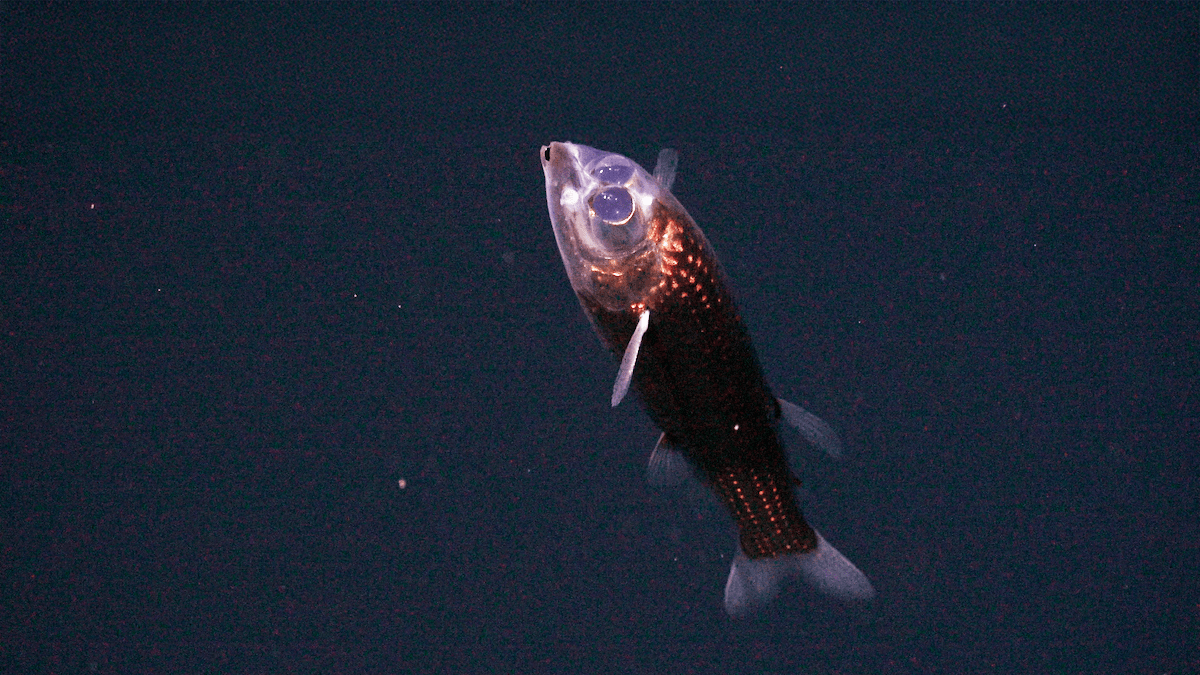
The team also came face-to-face (or submersible-camera-to-face) with some free-swimming deep-sea denizens. During the expedition they encountered a couple of haunting bigfin squid (whose tentacles can grow up to 26 feet long) and the odd-looking barreleye fish (Winteria telescopa), which they captured on camera for the first time in its natural habitat. The fish’s cylindrical telescoping eyes are encased in a fleshy transparent dome, which make it look a bit like a Pixar character, and help locate prey in the dim ocean environment (unsurprisingly, they’re extremely sensitive to light).
“Even in the Atlantic Ocean, where plate boundaries have been studied for decades, there are still places where the first close look can reveal something entirely new,” the expedition’s chief scientist, Aaron Micallef of the Monterey Bay Aquarium Research Institute, added. “This expedition showed that even in one of the most remote corners of the ocean, our planet remains alive, dynamic, and full of surprises.” 
Enjoying Nautilus? Subscribe to our free newsletter.
Lead image: Schmidt Ocean Institute