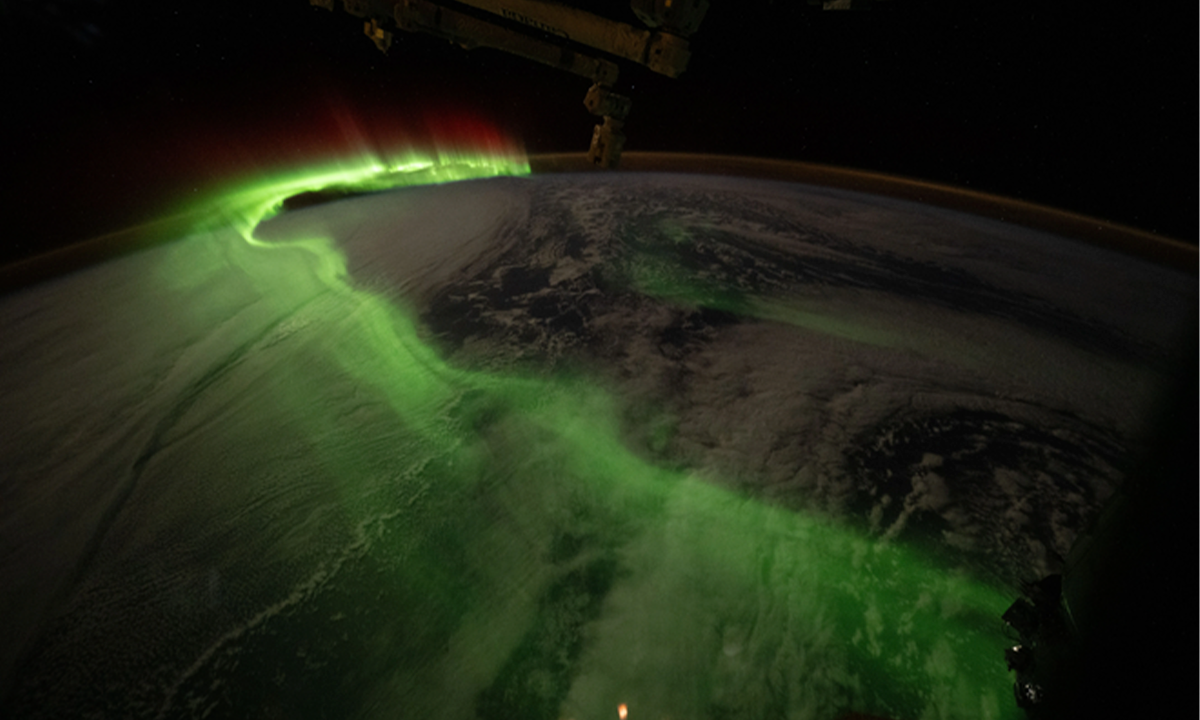
Beyond being a massive sphere of turbulent incandescent plasma, the sun has a lot of internal drama, too. For example, every 11 years its north and south poles swap places and the magnetic turmoil produces more sun spots, solar flares, and space weather. These periods of intense solar activity are called solar maximums, and we’re currently in one (which peaked in October of 2024). On our planet, these maximums spark more brilliant aurorae stretching from the poles closer to the equator, visible to more Earth-bound humans.
Read more: “The Northern Lights Make Music”
Of course, the best place to witness the northern and southern lights is from space. NASA astronaut Jessica Meir recently captured a time-lapse video of the aurora australis rippling through Earth’s magnetosphere above the Indian Ocean from a capsule on the International Space Station.
“As opposed to the previous aurora I’ve seen, this one danced and snaked its way directly below us, putting on quite a show,” Meir wrote in a post on X (formerly Twitter). “I am in awe of this ethereal and emotionally evocative phenomenon.”
If you can’t get to space for some reason, the best places to witness the northern and southern lights are as close to Earth’s magnetic poles as you can get. However, with the sun flinging out charged particles during its solar maximum, you may have a decent chance of seeing them from more middle latitudes as well.
Check NOAA’s aurora forecast to find out if the auroral light show is popping off near you. 
Enjoying Nautilus? Subscribe to our free newsletter
Lead image: NASA/Jessica Meir