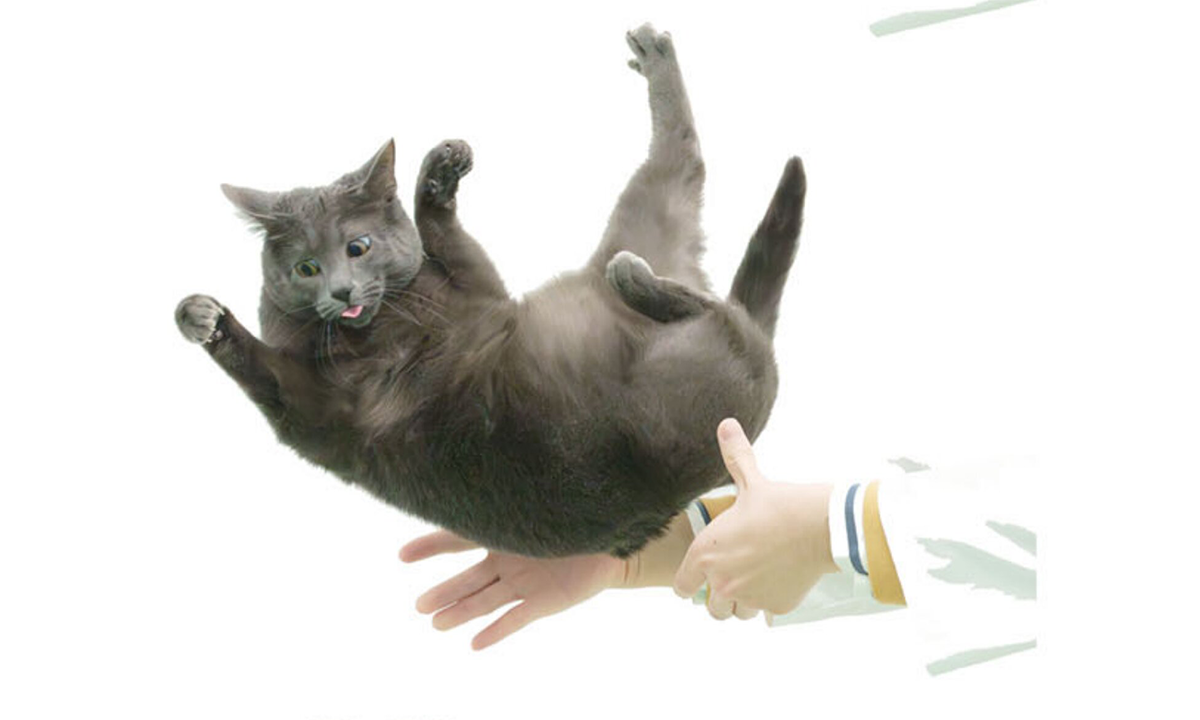
Falling cats always land on their feet” is up there with evolution by natural selection and law of gravity in terms of ironclad scientific truisms understood by the public, but it wasn’t always that way. The 19th-century French physiologist and early film pioneer Étienne-Jules Marey was the first to film felines dropped upside down and record how they twisted their bodies midair to land safely.
Marey’s short film kicked off a scientific debate that’s continued among physicists and physiologists for over a century. The question boils down to this: If cats have nothing to push off of, how can they manage to turn midair?
A new study published in The Anatomical Record zeroes in on feline anatomy to provide an answer.
To find out how cats manage this acrobatic stunt, veterinary physiologists from Yamaguchi University in Japan focused on their backbones. They performed a series of “destructive failure” tests on segments of the spines from five donated cat cadavers. (In other words, they twisted them until they broke.) They found that regions of the cat’s spine display different degrees of flexibility—the thoracic spine in the upper body was incredibly flexible, while the lower lumbar spine was relatively rigid.
Read more: “Can a Cat Have an Existential Crisis?”
In the less macabre portion of the experiment, they took a page from Marey’s book (or better put, filmography) and used high-speed cameras to film living cats reorienting themselves as they fell. First, the cats twisted their heads and forelimbs toward the ground, then their lower bodies followed, allowing all four legs to line up and cushion their fall.
“These results suggest that trunk rotation during air-righting in cats occurs sequentially, with the anterior trunk rotating first, followed by the posterior trunk, and that their flexible thoracic spine and rigid lumbar spine in axial torsion are suited for this behavior,” the study authors wrote.
Simply put, the stiffer lumbar spine acts as a stabilizer of sorts, anchoring the more fluid thoracic spine and allowing the cat’s upper body to twist midair. With the front half taken care of, the hind portion can follow suit.
It’s a satisfying answer to an age-old question, but is it satisfying enough to convince scientists to stop dropping cats? Probably not. 
Enjoying Nautilus? Subscribe to our free newsletter.
Lead photo by Higurashi, Y., et al. The Anatomical Record (2026).