In 2023, archaeologists excavating a burial mound near the town of Nördlingen in Bavaria, Germany hit pay dirt: a grave dating back to the Bronze Age containing the remains of a man, woman, and child along with a slew of artifacts. What really grabbed their attention, though, was a remarkably well-preserved sword with a unique octagonal hilt.
The blade was in exceptional condition for being 3,400 years old, retaining a metallic sheen and a bit of an edge, as well. There were no marks from impacts on it, indicating the sword may have been ceremonial. The hilt was decorated with a grooved zig-zag pattern with a pommel that featured an intricate geometric pattern inlay. Altogether, it was a fascinating specimen.
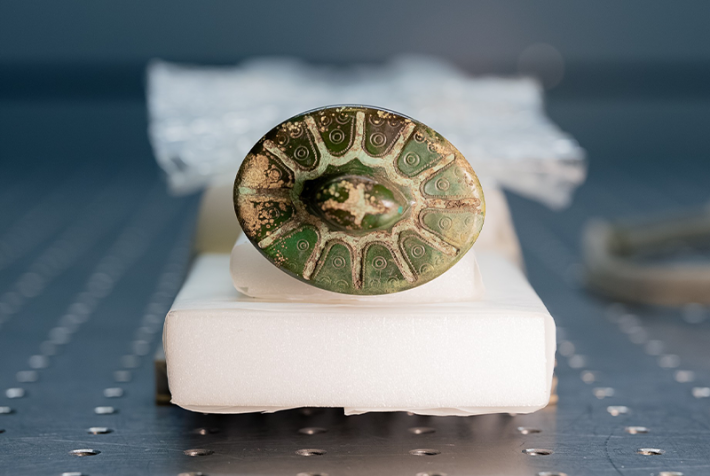
To investigate the incredible craftsmanship of this find, Johann-Friedrich Tolksdorf and Beate Herbold of the Bavarian State Office for the Preservation of Historical Monuments brought the sword to materials scientists Nikolay Kardjilov, Martin Radtke, and Manuela Klaus in Berlin.
“Such swords were very costly to manufacture,” Herbold said in a statement. “We wanted to find out how the handle was connected to the blade at that time and how the decorative patterns were incorporated at that time.”
To get a look inside the sword, the team created a three-dimensional image using high-resolution computed tomography and X-ray diffraction.
“The CT scan shows that the blade was clamped into the hilt with a tang, i.e. an extension of the blade, and riveted,” Tolkdorf explained. “The resolution of the CT scan is so high that we can even examine the material and the traces of the decorative work.”
Read more: “The Stick Is an Unsung Hero of Human Evolution”
Next, they took a closer look at the inlaid pommel, bombarding it with X-rays to reveal what metal the ancient craftsmen used to create the contrasting pattern.
“We irradiate the surfaces on the pommel with intense synchrotron radiation,” Radtke said. “This excites atoms in the material, causing them to emit element-specific X-rays, which we then measure. We can detect even the tiniest traces of elements.”
What they discovered was something of a surprise. Instead of tin, the soft, workable metal they expected to find, they uncovered delicate copper wiring.
“We are familiar with this type of inlay work using copper wires in bronze from other finds,” said Tolksdorf. “To make the reddish copper stand out better from the gold-coloured bronze, it may have been patinated, i.e. chemically blackened, for example with urine.”
Finally, the team performed internal stress analyses to gather information about the structure of the metal to reveal the ancient manufacturing processes that forged the blade. When their analyses are complete, they plan to publish their findings.
“We hope that we will also be able to reconstruct whether this sword was made in a specific workshop, for example—so far, we can only assume that it was manufactured in southern Germany, one of the two main areas where octagonal swords were prevalent in the Bronze Age in Germany,” Tolksdorf said.
From a forge in 14th-century Bavaria to an X-ray machine in 21st-century Berlin is an incredible journey for a sword. 
Enjoying Nautilus? Subscribe to our free newsletter.
Lead image: Das Schwert am Fundort © Archäologie-Büro Dr. Woidich/Sergiu Tifui