Each president brings their own unique flair to the White House: Richard Nixon had a bowling alley; Barack Obama had a basketball court; and now, Donald Trump’s ballroom appears to be moving closer to construction.
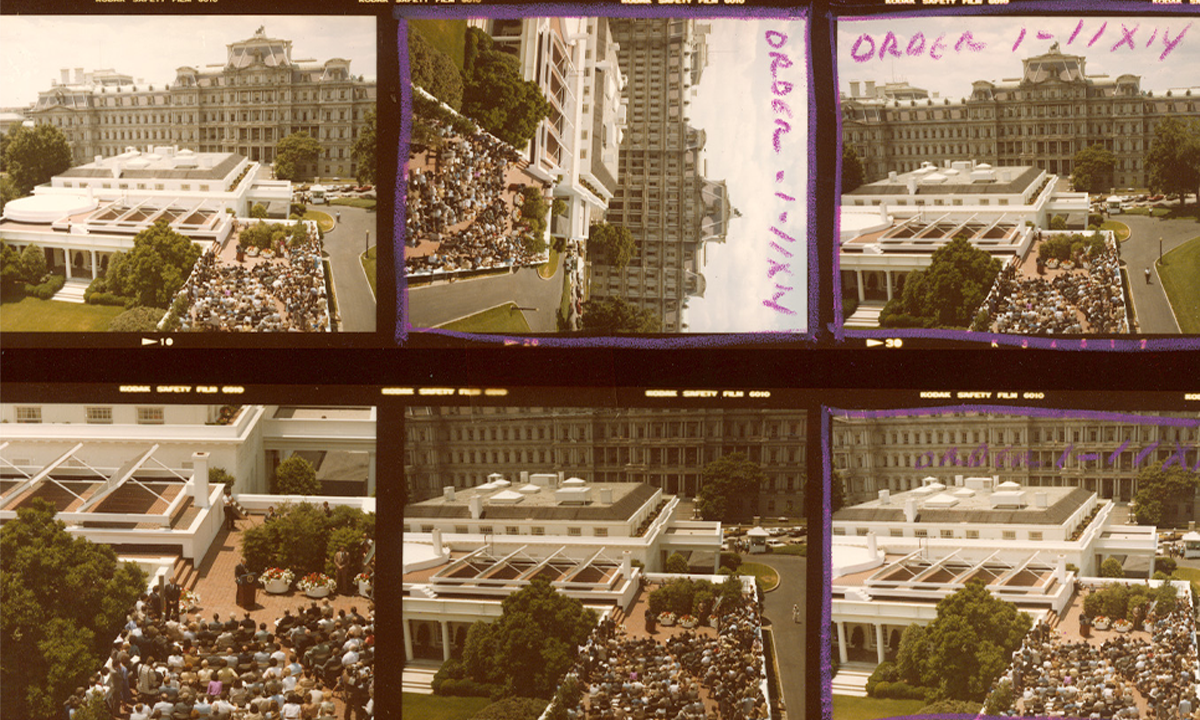
President Jimmy Carter’s custom White House addition, meanwhile, reflected his hope for the future. In 1979, Carter had 32 solar panels installed on the roof of the West Wing.
At the time, the country was embroiled in an energy crisis: After years of tension in the Middle East, the U.S. faced high oil prices. Carter and other officials advised people to curb their energy consumption to keep costs down.
Meanwhile, Carter looked to a promising alternative. At a June 1979 press conference, he promoted the White House’s new solar panels as a powerful symbol for a bright, renewable-powered future. At the time, solar was a fledging power source and remained costly and inefficient, and the White House’s panels were installed solely to heat water.
But Carter had a vision. “A generation from now, this solar heater can either be a curiosity, a museum piece, an example of a road not taken, or it can be a small part of one of the greatest and most exciting adventures ever undertaken by the American people: harnessing the power of the Sun to enrich our lives as we move away from our crippling dependence on foreign oil,” he said at the solar panel dedication ceremony.
Read more: “Can the US Build a Nuclear Powered Future?”
At this press conference, Carter described a daring solar goal. He hoped that, by the year 2000, the U.S. could source 20 percent of all energy from the sun. Carter felt that tax credits and money devoted to research could help achieve that lofty aim. Ultimately, Carter poured a record amount of funding into energy development, and his push for renewables is now seen as ahead of its time.
The following president, Ronald Reagan, had a different attitude. In 1986, the Reagan administration had Carter’s solar panels ripped off during work on the White House roof—an apt metaphor for his opinion on renewable energy.
By that time, Reagan had slashed the funding for research into renewables at the Department of Energy—which Carter had recently established—and cut tax incentives for wind turbines and solar energy. The panels rejected by Reagan eventually ended up at Unity College in Maine, where some were used to heat the school’s cafeteria water.
History repeats itself: On his second day in office this term, President Trump began to attack the Inflation Reduction Act (IRA), which promised hundreds of billions directed toward clean energy and climate. And this past July, the One Big Beautiful Bill Act gutted many of the IRA’s key investments. More recently, the Trump administration has slowed approvals for wind and solar projects around the country.
As companies hurry to use federal tax credits before they expire or become trickier to claim, the U.S. is forecast to add record amounts of batteries and renewable energy through 2027. But afterward, we can expect this progress to stall—unless, like Carter, a new president shakes things up. 
Enjoying Nautilus? Subscribe to our free newsletter.
Lead image: Jimmy Carter Library and Museum / Wikimedia Commons