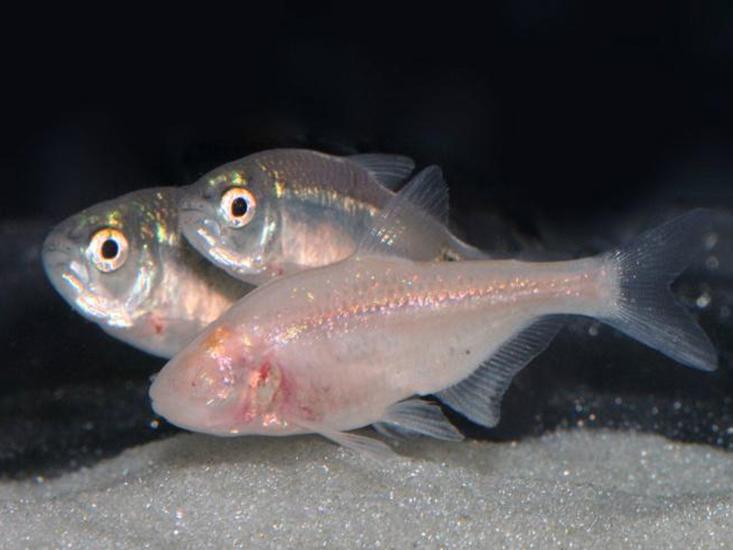
Deep in some pitch-black, underwater caves in Mexico, there lives a peculiar little pinkish-white fish. Only about four inches long, this albino has taste buds on the outside of its lower jaw, sleeps very little, and, most interestingly, has no eyes.
This blind fish (Astyanax mexicanus) evolved relatively recently from a surface fish that does have eyes and lives in the nearby river systems. At some point between a half a million and five millions years ago, some surface fish got caught in underground caves due to dramatic geological events. “Suddenly surface fish were taken underground in large numbers,” explains William Richard Jeffrey, an evolutionary developmental biologist and professor at the University of Maryland. “Those that could survive underground did, and they produced the cavefish we see now.” The fish population caught in the caves evolved and lost their eyes and pigmentation in what is called “regressive evolution,” the loss of a specific characteristic—the same way that apes, including us, ended up without tails.
Despite the gross differences in their anatomies, the blind cavefish and its sighted relative are actually the same species and can interbreed. In fact, as embryos cavefish do have eyes like the surface fish, but those eyes never mature.
It makes sense that the version of the fish that lives in total darkness would not depend on seeing to navigate. But that raises the question of just how they get around, which they do just fine. “When they are swimming around, you don’t really notice they don’t have eyes, because they aren’t bumping into each other, they aren’t bumping into walls,” said Shane Windsor, a lecturer at the University of Bristol that studies bio-inspired fluid dynamics. He used to keep some of the fish at his desk in his lab, and marveled that his visitors did not notice their missing eyes right away.
The blind cavefish’s location mechanism is about 50 times more effective than the standard method available to other fish.
The key to the cavefish’s navigational ability is a sensory system called the lateral line, a feature common to all fish. It’s made up of receptors known as neuromasts, and it runs down the side of the fish near the spine, wrapping around their eyes and jaw. These receptors allow fish to to sense pressure changes in the water surrounding them, revealing nearby stationary and moving objects. The Mexican blind cavefish, along with a few other types of fish, also have superficial neuromasts that cover their entire body. Research suggests that the lateral line system might be especially sensitive in the cavefish.
Windsor explains that the sensory system enables fish to navigate using what is called hydrodynamic imaging. When the fish moves through the water, it creates a flow field, like the bow wave in front of a boat. As the fish gets closer to an object, the presence of that object changes that flow field. The fish’s lateral line system can then sense how the flow around its body has changed, giving the fish feedback about the objects that are close by.
According to a new study, there is an additional method that the Mexican blind cavefish, in particular, uses to help visualize its surroundings: It produces bursts of suction by rapidly opening and closing its mouth, creating a flow of water. The objects in the fish’s path disrupt the flow pattern and the fish then senses those changes. This is why fish in unfamiliar surroundings open and close their mouths twice as frequently.
Roi Holzman, a researcher at Tel Aviv University in Israel and lead author of the study, says that this mechanism is about 50 times more effective at helping them “see” than the standard hydrodynamic imaging available to other fish. He explains that the suction bursts and the hydrodynamic imaging work in tandem, similar to how submarines use both passive and active sonar.
The development of active sonar in cave fish is not a one-off event. There are multiple populations of this species found throughout Mexican caves, all of which evolved separately, but in similar ways, from the surface fish. This is what attracted Martina Bradic, a postdoctoral researcher studying evolutionary genetics at New York University. “Repeatability is extremely important for the scientific method,” she says. “What we really want to observe is multiple repeated events, such as this one, [so] that we can actually make an inference about how things happen.” This little unusual fish is not just some biological oddity; it may be able to teach us about evolution as a whole.
Simone M. Scully is a science and culture journalist based in New York City and an editorial intern at Nautilus. Follow her on Twitter at @ScullySimone.