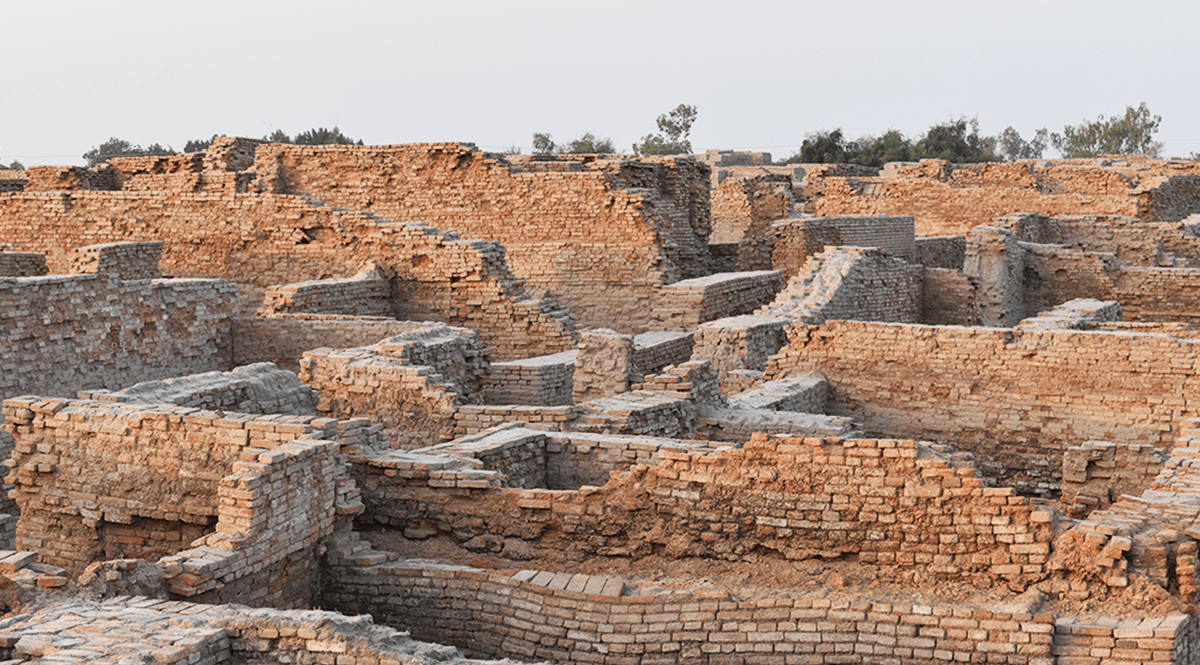
While the ancient Egyptians were busy building pyramids, the Harappans of the Indus River Civilization were becoming master urban planners. The cities they constructed, starting around 2600 B.C., included some surprisingly modern design elements. Mohenjo-daro and other Indus River settlements were laid out in a grid pattern, granting all houses access to an elaborate sewer system that lined the public streets. Now, new research published in Antiquity reveals investments in public infrastructure may have allowed the citizens of Mohenjo-daro to narrow the wealth gap.
British archaeologists led by Adam Green of the University of York estimated wealth inequality in Mohenjo-daro using the same metric economists use today: the Gini coefficient, which measures how resources are dispersed compared to an ideal equal distribution. Lower Gini coefficient scores indicate a more egalitarian distribution, while higher scores reflect greater wealth inequality. Because the denizens of Mohenjo-daro weren’t kind enough to leave their tax returns lying around, the team used the size of homes as a proxy for wealth.
Read more: “Make Concrete Roman Again!”
After crunching the numbers, they determined that the city had an overall Gini coefficient of 0.44 during its seven-century history, almost twice as egalitarian as Knossos in ancient Greece. “While ancient Egyptians were building pyramids for god-kings, and the Greeks were constructing massive palaces at Knossos, the people of the Indus were building something entirely different,” Green said in a statement.
Zooming in on sites where they could more clearly discern timelines, they discovered something even more interesting—Gini coefficients declined over time, despite the city becoming more prosperous. This seemed to contradict longstanding assumptions that the gap between the rich and the poor inevitably widens as overall affluence increases.
According to Green, this isn’t because the citizens of Mohenjo-daro were built different, it’s because they built differently. “Instead of gold-filled tombs and huge temples, Mohenjo-daro focused on sophisticated brick-lined drains and organized street layouts,” Green explained. “Instead of allowing the perks of society to accumulate with a tiny elite, the city’s amenities were widely distributed amongst the everyday households.”
In other words, “sewer socialism” has been around for a long time. 
Enjoying Nautilus? Subscribe to our free newsletter.
Lead photo: Adam S. Green