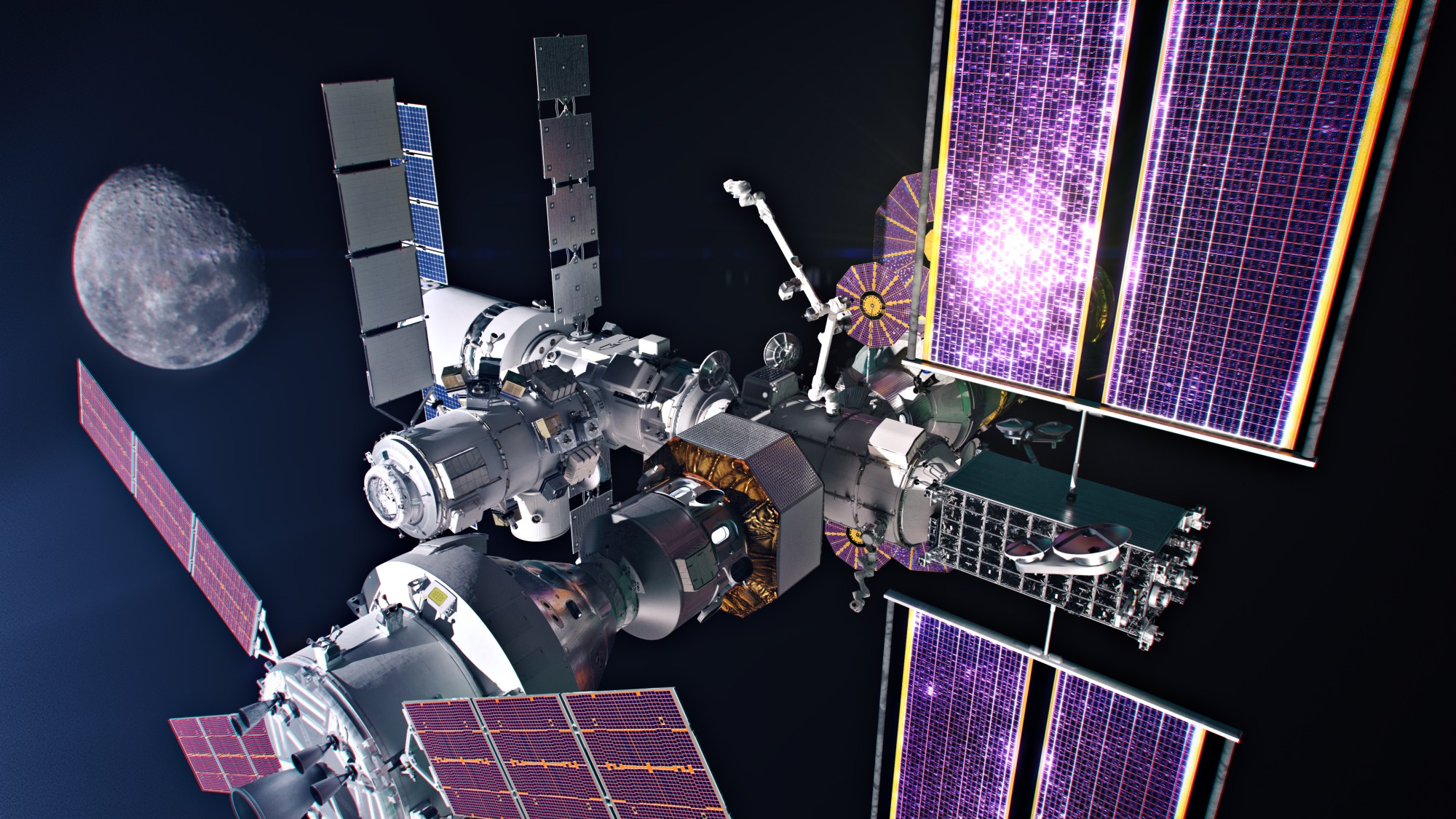
If all goes to plan, in 20 years, NASA will open the moon’s first spaceport. For that to happen, we’re going to need a highly advanced, highly precise lunar air traffic control system. To get ahead of the planning, researchers from Texas A&M University, the NASA Johnson Space Center, and Purdue University have detailed how such a celestial highway system could work.
In a study published in Acta Astronautica, the researchers lay out “rules of the road” for multiple spacecraft to share the same elliptical route in space, known as the Near Rectilinear Halo Orbit (NRHO). This synchronized orbit, a path for docking with the Gateway spaceport, will pass within 1,000 miles of the moon’s north pole, before swinging around some 40,000 miles away from its south pole.
What makes this route so special?
According to Diane Davis, an associate professor of space engineering at Texas A&M, the Gateway NRHO is “a nearly stable and highly elongated orbit around the moon that provides an uninterrupted line of sight for communications to Earth.” Moreover, it “requires little propellant to maintain.”
There’s a catch, though—and it’s a big one: Every moment a spacecraft spends in the NRHO, it will be subject to a gravitational tug-of-war between Earth and the moon. What’s more, lunar missions are likely to involve multiple spacecraft arriving, orbiting, and leaving at similar times. All of which means precision maneuvering is essential. Otherwise, there’s a risk of collisions and being sent way off course—without the rocket fuel needed to get back.
The solution is to get everything moving together, rather than each spacecraft focusing exclusively on its own path around the moon. By sharing data and continually calculating the position of the Gateway, spacecraft can follow a “string of pearls” formation that keeps everybody at a safe distance. The thousands of computer simulations run by the team were able to factor in realistic navigation errors, imperfections in thruster boosts, and other disturbances.
Using up slightly more fuel to stay on course was a worthwhile payoff in terms of the predictability of the orbits, the researchers found. “The future of lunar exploration depends as much on the traffic management as it does on the rocket science,” said Davis.
It’s going to take a few decades to construct the Gateway spaceport, but it’s nice to know we a plan for have a space air traffic control system at the ready. No word yet on the quality of the in-flight meals or entertainment. 
Enjoying Nautilus? Subscribe to our free newsletter.
Lead Image: NASA