In most fruit fly species, females lay eggs on rotting fruit, which hatch into tiny larvae inside the fruit and transform into the little telltale flies. But in a paper published recently in Current Biology, one of the most unusual species of fruit fly reveals the origins of a whole other lifestyle.
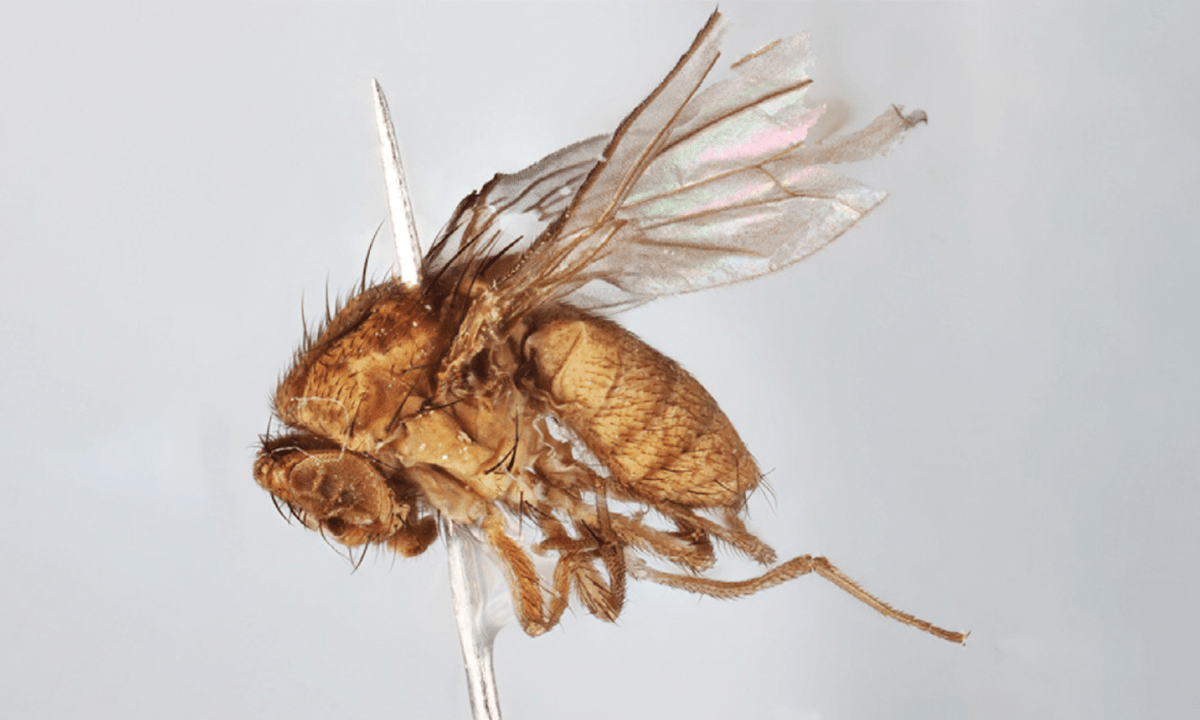
Drosophila enhydrobia is well-named: It lays eggs on aquatic plants in African streams, after which its larvae are entirely aquatic. “We’re talking about a fruit fly that has completely turned its lifestyle upside down. From feeding on yeast and rotting fruit, it has become a specialized predator in running water,” explained study leader Marcus Stensmyr, a biology researcher at Lund University in Sweden, in a press release.
Because the last living D. enhydrobia was reported in 1981, researchers turned to museum collections to determine its place in the fruit-fly family tree. A team of biologists from Lund University and Université Paris Saclay in France recovered a complete genome from a 40-year-old specimen using “museomic” methodology, the latest techniques for extracting historic DNA.
Read more: “What Google Could Learn from a Fruit Fly”
Its genome places the odd D. enhydrobia within the known subgenus of fruit flies in Asia that live alongside streams in riparian areas. It suggests that the aquatic lifestyle of D. enhydrobia wasn’t an evolutionary leap, but rather an extension of the semi-aquatic habits of its ancestors.
When it transitioned to life in the water, D. enhydrobia lost certain genes needed for life on land. In particular, its genes for chemical sensing were reduced in number, leaving a smaller set available for adaptation to aquatic life. But the remaining genes showed intensified selection. “It’s as if it has fewer tools in the toolbox, but the tools that remain are all the more finely tuned for this particular environment,” said Hamid Ghanavi, a biologist at Lund University.
When viewed up close, larval D. enhydrobia have unique adaptations for aquatic life. Little hooked pads along their abdomens allow them to cling to submerged rocks. On their bellies are branched openings, or spiracles, typical of insects for taking in air in lieu of lungs. However, compared to the well-known terrestrial Drosophila melanogaster with 5 to 7 spiracle openings, these aquatic fruit fly larvae have about 100, likely acting as gills for underwater oxygen exchange. And instead of feeding on detritus like other fruit-fly larvae, D. enhydrobia use specialized mouth hooks to nab aquatic insects.
Basically, the fruit flies living in bubbling African streams took a watery, predatory fork in the road. 
Enjoying Nautilus? Subscribe to our free newsletter.
Lead image: Ghanavi et al., Cell Press, 2026