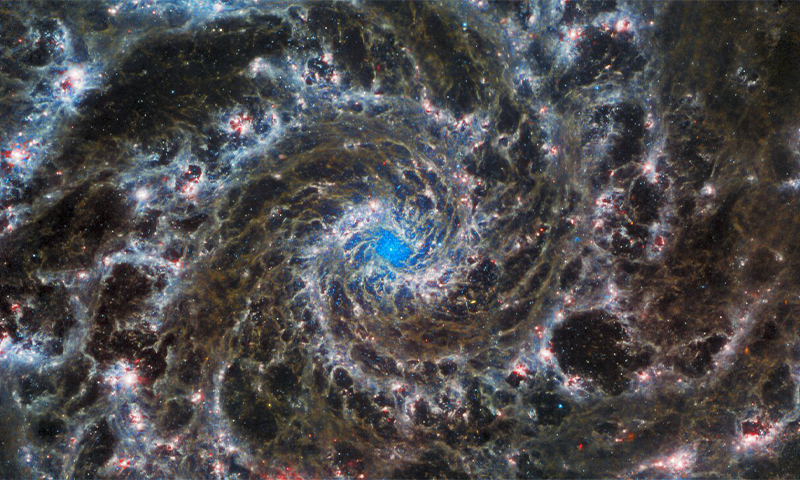
This eerie space scene lives up to its name—the Phantom Galaxy. Officially known as M74, it has a diameter of around 95,000 light-years, nearly the size of our Milky Way. In this image, the spiraling arms made up of threads of dust and gas draw the eye toward the glowing central star cluster—a view typically obscured by gas. These stars are estimated to be around 8 billion years old, just past middle-aged as far as stars go in our universe. Among other twisty galaxies, M74 has some of the most crisply defined arms.
This ghostly galaxy was first observed in 1780 by the French astronomer Pierre Méchain, who worked with renowned comet hunter Charles Messier. M74 lives some 32 million light-years from our planet, and we can view it nearly directly—so astronomers often look into its haunting depths to learn more about spiral galaxies. This shot, released in 2022, was captured by the James Webb Space Telescope.
As part of a global research collaboration called Physics at High Angular resolution in Nearby GalaxieS (PHANGS), Webb has been wielded to probe neighboring star-forming galaxies like M74 with its powerful infrared imaging to unlock the secrets of stellar births. In recent years, PHANGS scientists have taken a closer look at the Phantom Galaxy’s mysterious features—for one, it contains more than 1,600 gaping holes measuring up to 3,600 light-years in diameter. These rips potentially formed from bursts of energy shot out by dying stars or by the howling winds released by infant stars. These holes may perforate other galaxies, too, some of the PHANGS researchers suggest.
This team has also posited that infant stars may remain swaddled in their cosmic baby blankets composed of dust and gas for some 5 million years. This conceals them from visible-light telescopes such as the Hubble Space Telescope, which produced earlier, less crisp, images of M74. But thanks to the sharp infrared vision from James Webb, we can continue to glean insights on the earliest stages of stellar lifespans. 
Lead image: ESA/Webb, NASA & CSA, J. Lee and the PHANGS-JWST Team.