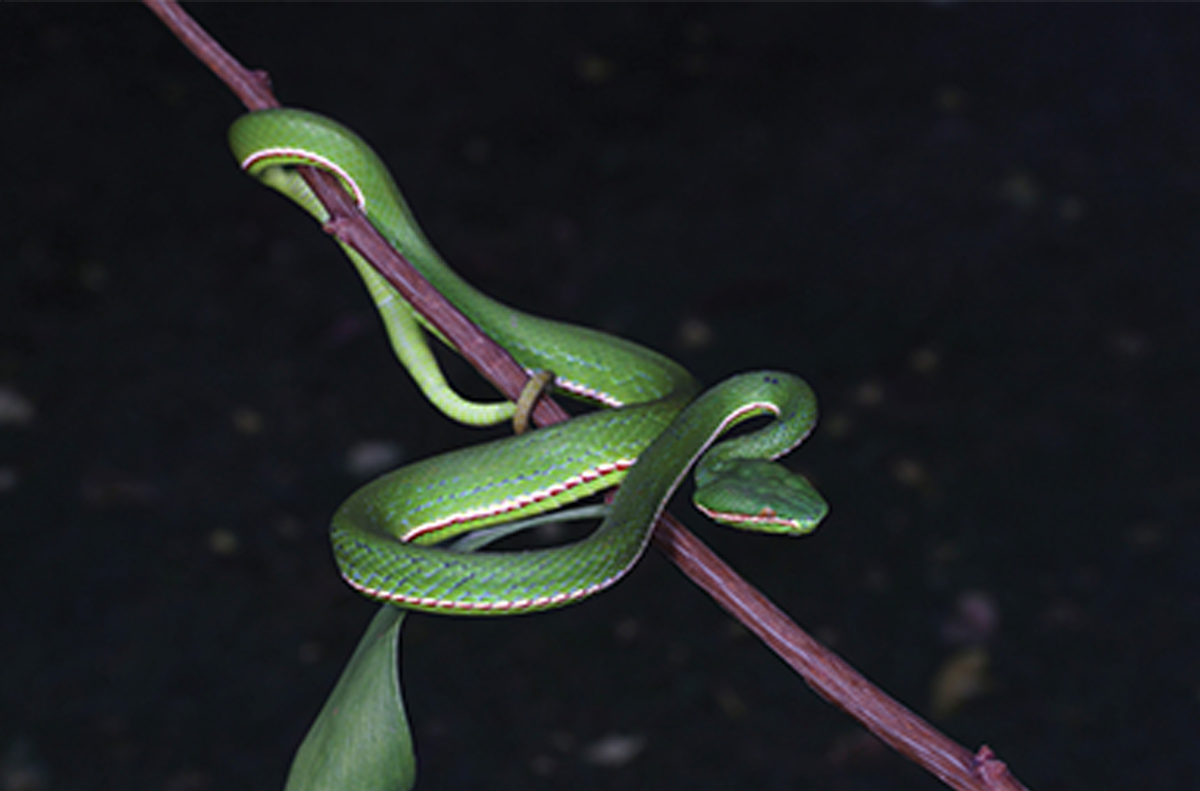
China’s Giant Panda National Park is home to more than just its namesake. The park, which is the size of Massachusetts, consists of dense forests where red pandas, snow leopards, and more than 5,000 other species live a life protected from human activity. Now we can add one more to the list. Researchers from the Chengdu Institute of Biology identified a new species of green pitviper, describing it for the first time in a paper recently published in Zoosystematics and Evolution.
The species, a member of the genus Trimeresurus that comprises over 40 species of pitvipers, was given the common name Huaxi green pitviper and the scientific name lii. “The specific name lii honors Li Er, the ancient Chinese philosopher better known as Laozi,” the research team explained in a statement. “His teachings emphasize the harmonious coexistence between humans and nature, a principle that perfectly aligns with the conservation mission of the Giant Panda National Park where this species was discovered.”
Read more: “The Animals That Turn Bodily Fluids into Weapons”
This previously undocumented pitviper is a cryptic species, mistaken for its relative the bamboo pitviper (T. stejnegeri) for decades. Genetic testing, as well as a closer look, revealed the vipers to be their own distinct species. Both males and females have vibrant green bodies and a viper’s characteristic triangular head, but also display remarkable sexual dimorphism. Males have a red and white stripe running down their sides and amber eyes, while females have a yellow stripe and orange-yellow eyes. Unlike similar viper species, the scales on the heads of both sexes are perfectly smooth.
T. lii is also venomous, something one member of the team experienced firsthand (literally). Gang Wang of Chengdu Normal University was bitten on the ring finger by a male of the species. By the time he reached the hospital two hours later, Gang was experiencing stabbing pains and swelling in his arm up to the elbow. He was treated with a polyvalent antivenom capable of counteracting toxins from several viper species—luckily, that included this new addition. Gang’s symptoms subsided, and a week later, he had fully recovered.
Testing the effects of envenomation isn’t exactly standard operating procedure when describing a new snake species, but sometimes the data just jumps out and bites you. 
Enjoying Nautilus? Subscribe to our free newsletter.
Lead image: Cai, B. et al. Zoosystematics and Evolution (2026).