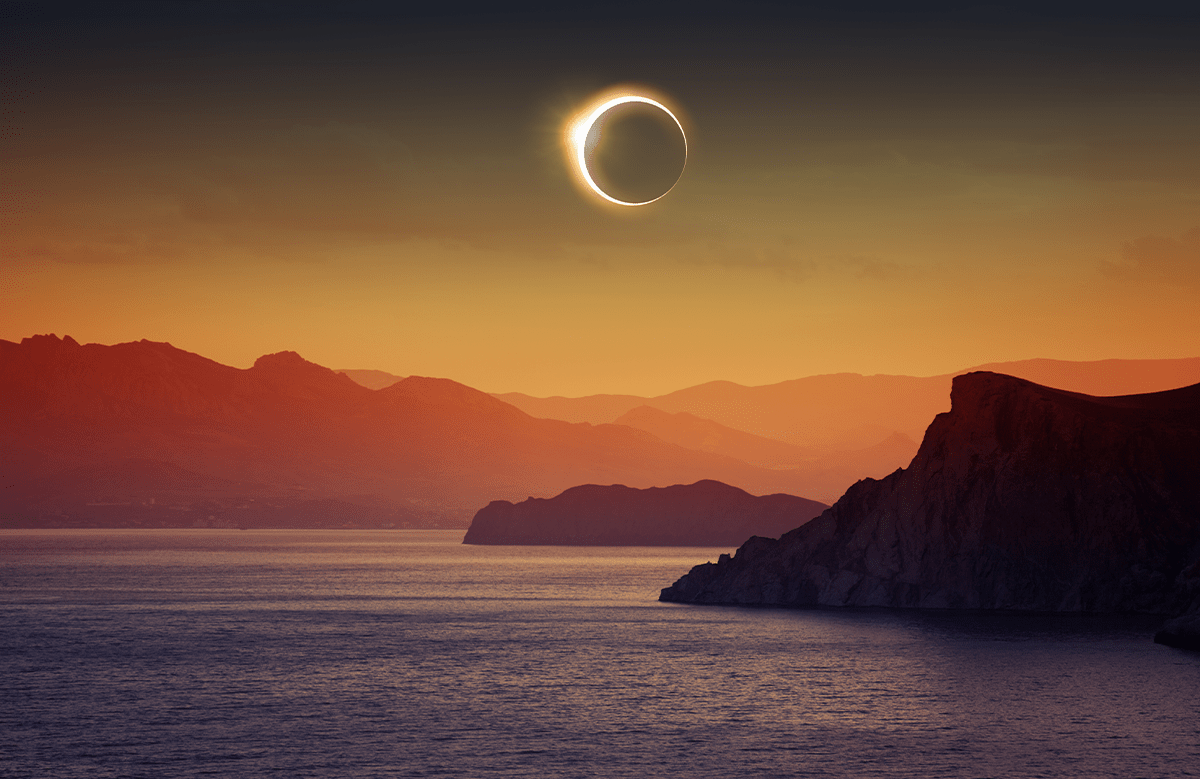
Ilike many other people living in and visiting the United States in 2024, stood still and gawked at the sky in amazement just before 2 p.m., local time, on April 8. For about 10 minutes on this day, I held this upward looking pose with my family and a few friends surrounding me, pausing only to smile at my wife and kids, sharing our combined amazement. We were in the path of totality for the solar eclipse that streaked from southwest to northeast across Mexico, more than a dozen U.S. states, and southern reaches of Canada. It felt as though the Earth stood still and quiet.
It turns out that my sense of wonder and peace wasn’t just internal. It turns out Johns Hopkins University postdoc Benjamin Fernando, who witnessed the eclipse from a city in Ohio, was as transfixed by the experience as I was. “I noticed that all of a sudden everything went really quiet,” he recounted in a statement. “So I was curious as to whether that was going to be replicated in the seismic data.”
This past weekend, Fernando presented an interesting seismic analysis at the Seismological Society of America’s annual meeting. Fernando studied seismic noise levels across the U.S. and Canada as the shadow of the eclipse raced from southwest to northeast and found that the eclipse shadow was accompanied by a seismic hush. Mainly in cities squarely in the path of totality, seismic activity rose just prior to the eclipse, faded as the sun moved behind the moon, and rose again after the sun emerged from behind the lunar outline.
Read more: “How a Total Eclipse Alters Your Psyche”
The several hundred detectors from which Fernando pulled data record seismic activity that can result from human activities, like traffic jams, large concerts, mining, and construction projects as well as from the tectonic dynamics of our planet.
As I viewed the 2024 eclipse—as when I was lucky enough to view the 2017 total solar eclipse that arced from the Pacific Northwest to South Carolina—I was overcome with a sense of stillness and wonder. The surrounding environment echoed this feeling as nocturnal animals took their cue, crickets gently chirping and birds softly warbling their dusk choruses. On April 8, 2024, I was in a hilltop cemetery in a rural part of Missouri, a place that I would imagine is almost always devoid of human-caused seismic activity. Indeed, the seismic peace that Fernando recorded occurred only in cities, not in such rural areas.
But it’s somehow comforting to know that the intimate awe and privilege that I felt at being fortunate enough to witness the alignment of the Earth, moon, and sun was reflected across the human population—especially where people are most densely packed. As we joined together to temporarily cease some of our daily, Earth-shaking activities, that pause even registered in the machines that record our planet’s frequent rumblings. 
Enjoying Nautilus? Subscribe to our free newsletter.
Lead image: IgorZh / Adobe Stock