
Hadrosaurs might not be the most popular dinosaurs among children, but they were extremely popular with natural selection. These duck-billed dinosaurs were some of the most common types of herbivores living during the Cretaceous period, and as such, they’re well-represented in the fossil record. Remarkably, we’re still learning new things about them and their eponymous bills.
For more than a decade, paleontologists puzzled over a series of bony projections around the front rim of the upper jaw of Tethyshadros, a genus of duck-billed dinosaur first discovered in Italy’s Villaggio del Pescatore. At first, they were believed to be a set of comb-like teeth, but now a new analysis published in Royal Society Open Science is revealing that they were far more complicated.
Read more: “This Bizarre Jurassic “Squid” Swam the Ancient Seas of Wyoming”
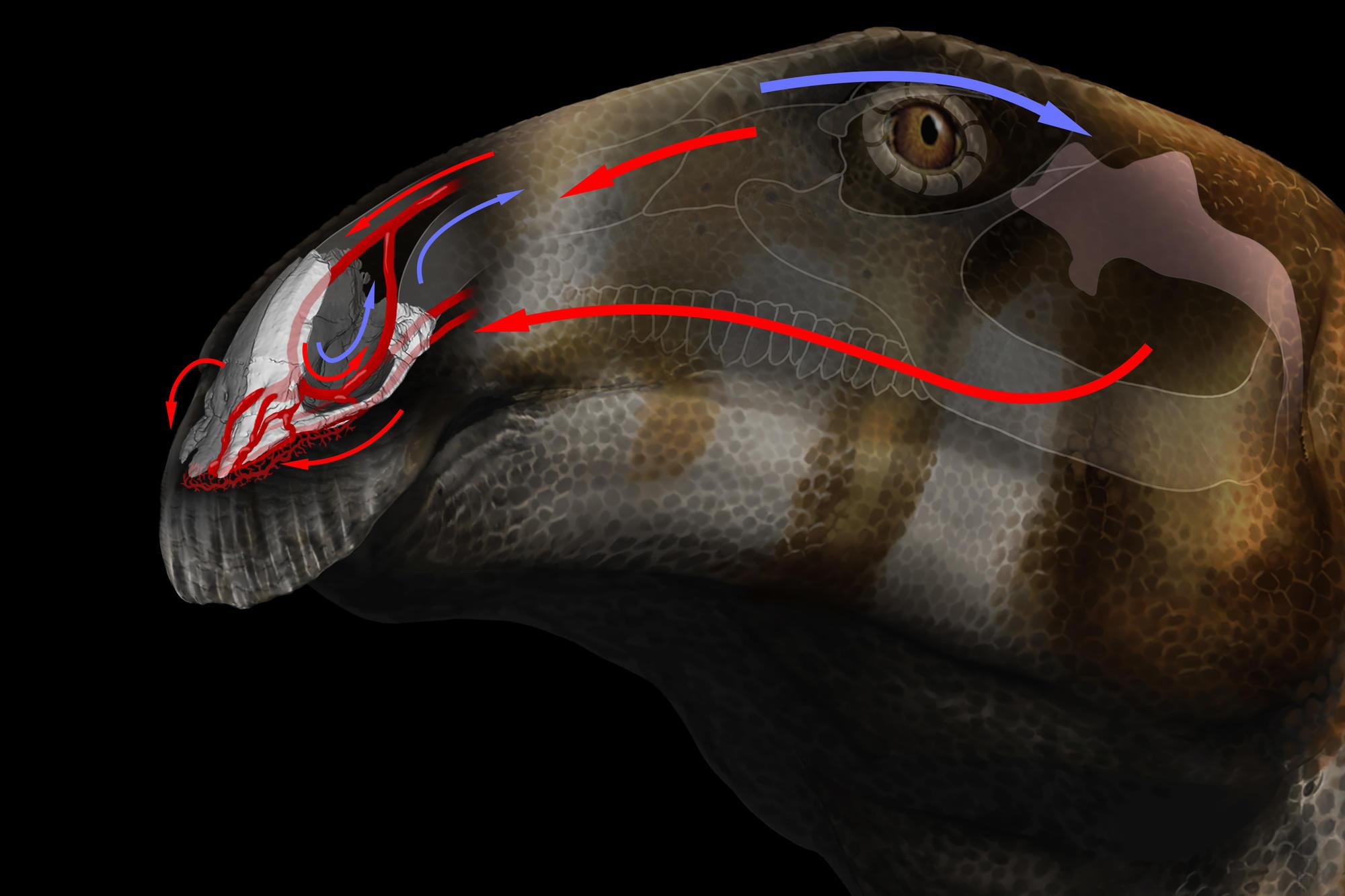
An international team of paleontologists conducted extensive micro-CT scans of the upper and lower jaw from a specimen named “Antonio,” the holotype of the genus. They determined that the mysterious spikes weren’t teeth at all—they weren’t even visible from the outside. Instead, they were a kind of scaffold supporting the dinosaur’s beak.
Made out of keratin (the same substance as fingernails), the beak had a complex network of minuscule bony channels feeding into it which housed nerves and capillaries. “What looked like a bizarre toothed or spiked beak may actually be the bony footprint of a much more complex living organ,” study author Marco Muscioni of the University of Bologna explained in a statement.
According to the team, it’s likely Tethyshadros’ beak functioned as a Swiss Army knife of sorts. A network of nerves wired it as a useful sensory organ for foraging, blood vessels indicate it could have helped radiate heat from its brain, and it was still sturdy enough to withstand the wear and tear grazing on gritty vegetation (in fact, it bears some resemblance to a cow’s hoof).
“Tethyshadros continues to surprise us,” study author Federico Fanti of the University of Bologna said. “The Villaggio del Pescatore fossils are among the most complete dinosaurs ever found in Europe, but new technologies are showing that even specimens we have studied for years can still preserve completely unexpected information.” 
Enjoying Nautilus? Subscribe to our free newsletter.
Lead Image: Davide Bonadonna