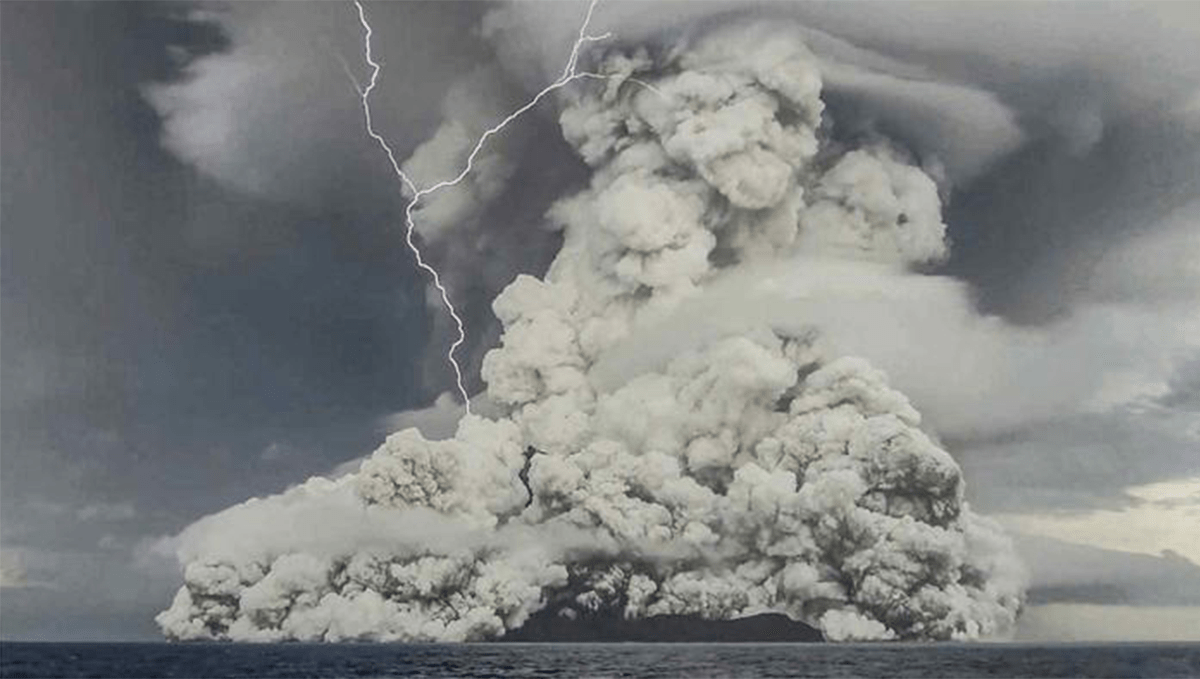
When the underwater Hunga Tonga-Hunga Haʻapai volcano off the coast of Tonga violently erupted in January of 2022, the force of the explosion was more powerful than the largest nuclear bomb. The blast sent a shock wave rippling across the globe that was heard as far away as Alaska, and its plume of smoke and ash stretched 36 miles above the Earth. At the time, scientists cautioned that we’d be dealing with its effects for years to come, especially the enormous quantities of water vapor it launched into the atmosphere. Now, new research published in Nature Communications details one unexpected effect—the Tonga volcano cleaned up some of the greenhouse gases it belched out.
Examining data from advanced satellite imagery, an international team of researchers discovered a high concentration of formaldehyde in the volcano’s plume shortly after eruption. This was a major clue that the methane from the eruption was being rapidly broken down, with the formaldehyde as an intermediary. “Because formaldehyde only exists for a few hours, this showed that the cloud must have been destroying methane continuously for more than a week,” study co-author Maarten van Herpen from Acacia Impact Innovation BV said in a statement. “It is known that volcanoes emit methane during eruptions, but until now it was not known that volcanic ash is also capable of partially cleaning up this pollution.”
Read more: “Are We Ready for the Next Massive Volcano?”
While this was a new phenomenon, it was also familiar territory for the researchers. They discovered a similar chemical process taking place over 10,000 miles away in 2023. When sand from the Sahara desert gets blown into the Atlantic Ocean, it mixes with seawater to form iron salt aerosols. When these aerosols are excited by sunlight, they produce highly reactive chlorine atoms that can help break down methane. Because the underwater Tonga eruption blasted seawater along with ash, the researchers think a similar process is taking place.
“What is new—and completely surprising—is that the same mechanism appears to occur in a volcanic plume high up in the stratosphere, where the physical conditions are entirely different,” said study co-author Matthew Johnson from the University of Copenhagen. Methane, which usually takes around 10 years to naturally decompose in the atmosphere, is responsible for around a third of global warming. The researchers say these new findings could help inform efforts to curb methane emissions.
Of course, chlorine’s activity in our atmosphere isn’t limited to breaking down methane. As a major reactive component of the now-banned chlorofluorocarbons, chlorine ions can wreak havoc on the ozone layer that protects us from the sun’s ultraviolet rays. In fact, the Tonga volcano also caused a short-term erosion in the ozone layer in the Southern Hemisphere.
Not exactly nature healing itself, after all. 
Lead image: Courtesy of Tonga Geological Services