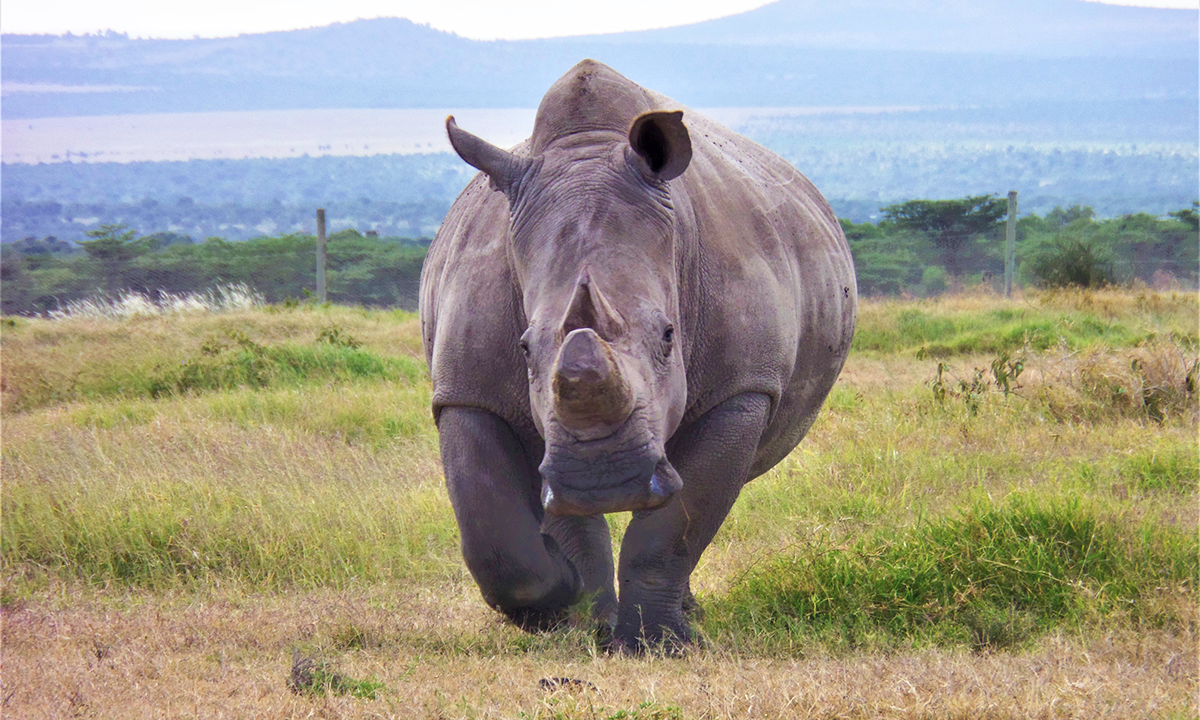
Since the last Northern white rhino male died in 2018, the species has been considered functionally extinct. Only two white rhino females remain on Earth, Najin and her daughter Fatu, and neither is reproductively fit enough to complete a natural pregnancy. And so, the international consortium BioRescue is racing to prevent the extinction of the Northern white rhino (Ceratotherium simum cottoni) via assisted reproduction.
In particular, experts have been extracting egg cells from Fatu and cultivating embryos in the lab using frozen sperm from now-deceased males. The latest tally of embryos produced is 39, a testament to modern technology. But there’s no guarantee of success in shepherding these embryos to the hoped-for outcome of new individual rhinos. In fact, so far, surrogacy by their smaller cousin, the Southern white rhino (C. s. simum), has failed.
In a new study, researchers from Germany, Italy, and the Czech Republic surveyed individuals in their countries to gauge public attitudes about assisted-reproduction technologies (ART) as part of biodiversity conservation. Public support may prove instrumental in costly investments in in-vitro fertilization and stem-cell induction to make ovarian tissue. “The application of ART in wildlife conservation may challenge conventional views on reproduction and extinction and raise ethical considerations, for example, concerning animal welfare,” they argued.
Read more: “The Last of Their Kind”
Samples of participants proportional to the populations of Germany, Italy, and the Czech Republic completed an 8-question survey about their knowledge and attitudes of the biodiversity crisis, including questions in which they were asked to rate the acceptability of using ART to rescue Northern white rhinos.
The results showed that people generally favored more traditional conservation approaches, such as creating protected areas, over new high-tech strategies like ART. But in all three countries, more than 70 percent of respondents agreed that “governments should invest public money to support research into advanced assisted-reproductive technologies for conserving species extinct in nature,” leading the researchers to conclude that broad support exists in the European Union for assisted reproduction when used alongside other conservation approaches.
Whether ART will be enough to save the Northern white rhino, though, is still TBD. 
Enjoying Nautilus? Subscribe to our free newsletter.
Lead image: Karimi Ngore / Wikimedia Commons