Animals are known to change seasonally with their environments. For example, an Arctic fox that sports a snow-white coat in winter sheds to wear a brown-gray summer coat. These changes are triggered by daylight cues that alter the action of foxes’ pigment-producing genes.
While operating on a different time scale, some butterflies also undergo seasonal changes in their coloration. And a recent study in Functional Ecology shows that color changes are just the tip of the iceberg—in at least one butterfly species, they’re accompanied by shifts in behavior and visual perception.
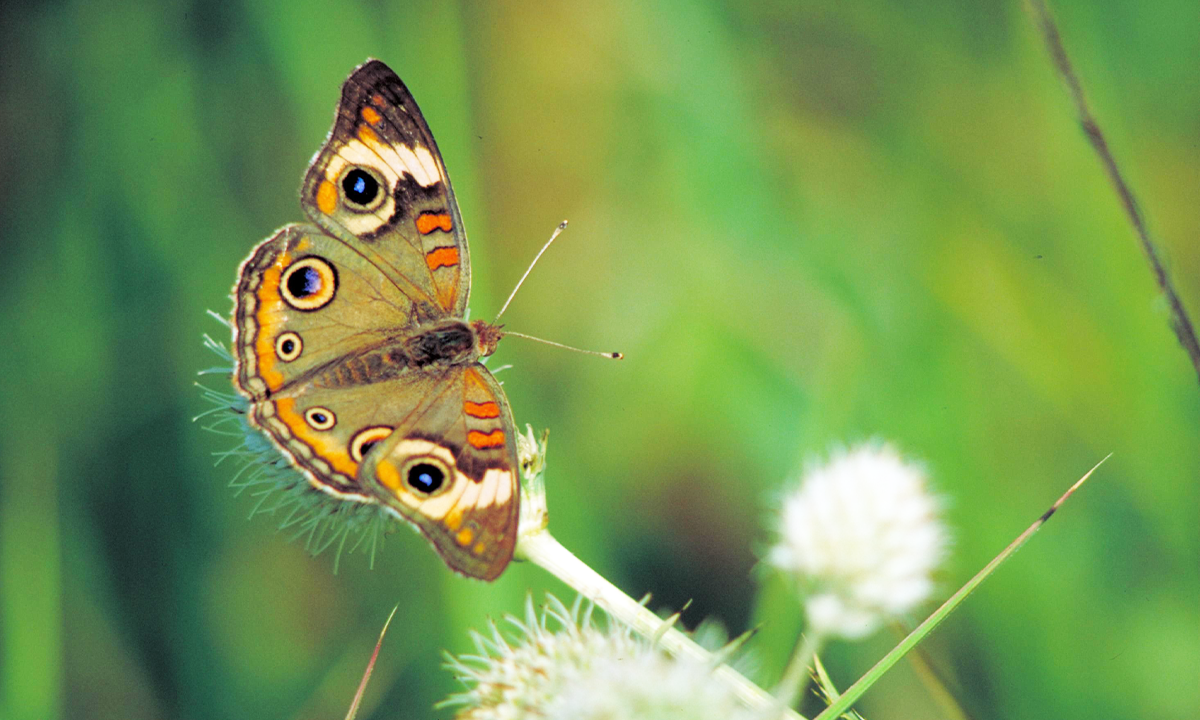
Researchers from the University of Arkansas and Cornell University studied seasonal changes in buckeye butterflies (Junonia coenia) from Arkansas tallgrass prairies. Because these butterflies live for just a couple of weeks as adults, the changes occur across generations. Buckeyes hatching in summer sport notably lighter-color wings than butterflies hatching in fall. The summer individuals were also known to have higher activity levels and to disperse further than the fall-hatched ones.
Read more: “Do Butterflies Challenge the Meaning of Species?”
From May to November across three years, the scientists assessed buckeye butterfly coloration, wing pattern, behavior, and activity level. From butterfly heads collected once per month, tissue was removed and sampled for RNA (to determine expression of genes). The results showed differential expression of several genes across seasons. As days got shorter and cooler in September, buckeyes emerged with darker wings and spent more time basking in the sun. Those observable changes were accompanied by shifts in gene expression related to eye pigmentation, circadian rhythms, and temperature stress.
While it’s too early to specify how those genetic shifts manifest in butterfly perceptions, it’s fair to say that there’s more going on seasonally than what meets the eye. “Not only are common buckeye butterflies interacting with their world differently depending on the time of year, but they probably see the world differently at these times of year, too,” University of Arkansas biologist and co-author Grace Hirzel said in a statement.
Whether or not other animals experience seasonal sensory changes in tandem with changes to their bodies and physiology remains to be determined. But such sensory shifts may explain observed changes in behavior. “Changes in sensory system development like we found in the buckeye may be a common strategy used by many animals to survive shifting seasonal conditions,” added Hirzel. 
Enjoying Nautilus? Subscribe to our free newsletter.
Lead image: Dr. Thomas G. Barnes, U.S. Fish and Wildlife Service / Wikimedia Commons