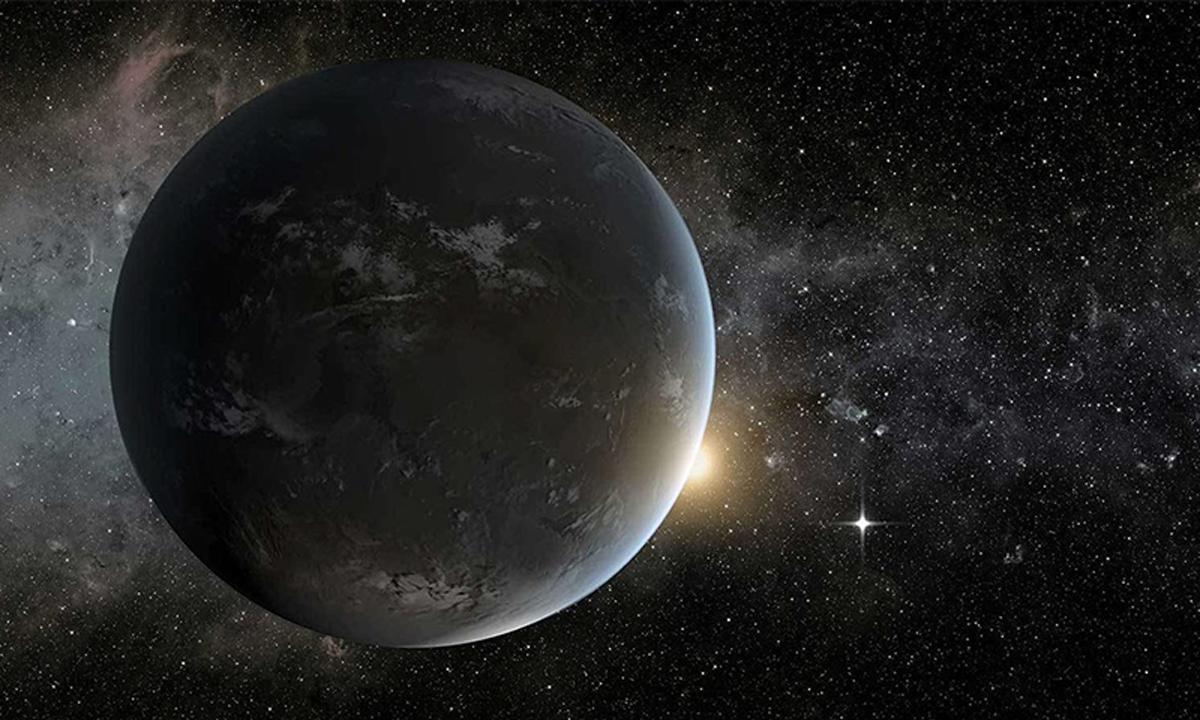
Thousands of our sun’s smaller cousins that aren’t too far from Earth might host worlds amenable to life.
These K-dwarfs are a bit fainter and colder than the sun, and they’re strewn throughout space. In our neck of the woods, there are twice as many K-dwarfs than stars that more closely resemble our sun. K-dwarfs also survive much longer than sun-like stars, shining for some 15 to 45 billion years. This offers “a long-term, stable environment for their planetary companions,” explained Sebastián Carrazco-Gaxiola, an astronomy Ph.D. candidate at Georgia State University, in a statement. Our 4.6-billion-year-old sun, meanwhile, is now predicted to have reached roughly middle age.
Carrazco-Gaxiola led the first in-depth survey of thousands of K-dwarfs, which he recently presented along with his colleagues at an American Astronomical Society meeting. He and his team examined more than 2,000 K-dwarfs that are within 130 light-years of Earth—just a hop, skip, and jump in cosmic terms.
They collected detailed measurements of the rainbow of colors, also known as spectra, released by these stars. This data came from high-tech instruments called spectrographs at the Cerro Tololo Interamerican Observatory in Chile and the Fred Lawrence Whipple Observatory in Arizona. They sit on opposite ends of the planet, offering a comprehensive view of K-dwarfs spanning the sky.
Read more: “We Might Not Be So Strange”
The spectra measurements enable astronomers to figure out these stars’ age, spin rate, temperature, and location, among other important details that hint at the environments on their nearby planets. For instance, some regions of the Milky Way contain enough metals to form rocky worlds like ours, while others don’t.
Ultimately, these results “identify 529 mature, inactive K-dwarfs as prime targets for terrestrial planet searches, providing a crucial resource for exoplanet habitability studies in the solar neighborhood,” the researchers wrote in a preprint paper posted on arXiv. Mature stars emit relatively stable levels of radiation that enable worlds to maintain atmospheres, and stars with lower magnetic activity produce fewer flares and other phenomena that can cause chaos on surrounding planets.
In the search for habitable worlds, researchers face a staggering amount of cosmic real estate to peruse—the Milky Way hosts more than some 100 billion stars, so this data can help single out some promising places to look.
K-dwarfs have long deserved their time in the sun, according to Carrazco-Gaxiola’s presentation, as they’ve been “neglected for exoplanet searches.” Now, these stars could bring us closer to exciting extraterrestrial discoveries. 
Lead image: NASA Ames / JPL-Caltech / Tim Pyle