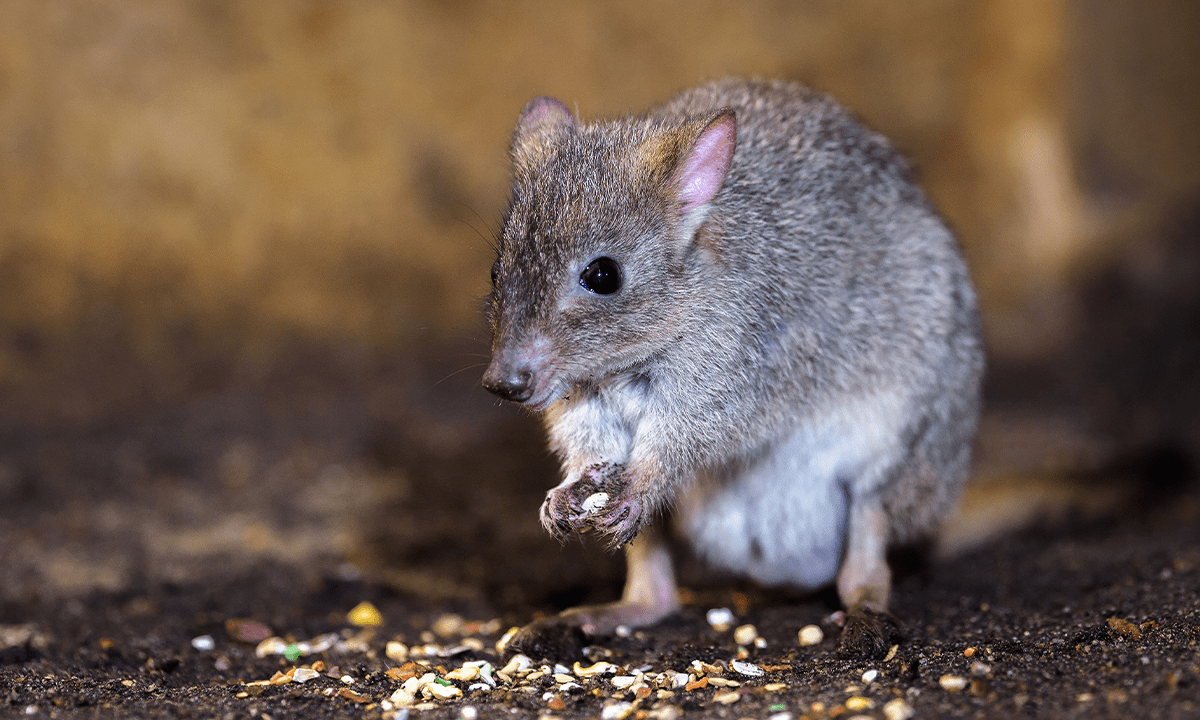
Australia has some tough nuts to crack. But to some species of rat kangaroo, busting into the extremely hard seeds of the sandalwood and quandong trees down under is all in a night’s work. Commonly called “bettongs” (genus Bettongia), these nocturnal marsupials scurry around at night foraging on these seeds, as well as roots, leaves, grubs, fruits, and fungi. In a new study published in the Zoological Journal of the Linnean Society, researchers compared the jaws of the four living bettong species to understand their remarkable seed-cracking powers.
“Understanding animal dietary needs and their associated adaptations is invaluable information for conservation of threatened species,” said study co-author and comparative anatomist Rex Mitchell, a Flinders University postdoctoral fellow, in a statement.
Two of the living species (B. lesueur and B. penicillata) break into the tough-shelled seeds to get at the soft meat inside. Although they otherwise eat very different diets, researchers expected to find convergent cranial adaptations in those two seed-cracking species—similar adaptations in their skulls and muscles to solve the shared biomechanical challenge of biting through such hard materials. Animal diets are typically reflected in the shapes of their crania, jaws, and teeth.
Read more: “How Rodents Spread Across the Earth”
Based on scans of 161 bettong skulls from museum collections, the research team conducted a 3-D comparison of shapes. The burrowing bettong (B. lesueur or ‘boodie’) had a shorter face than the other three species, an adaptation you’d expect in an animal exerting higher bite forces. A shorter, sturdier face offers a mechanical advantage, as more muscle force can be converted to bite force. So, the boodie’s nut-cracking superpower is its short snout.
The other seed-cracker, the brush-tailed bettong (B. penicillata or ‘woylie’), had a longer face, more like the two species that don’t eat tough-hulled seeds. However, the woylie had more chisel-like premolars set in a reinforced position on the jaw. So, the woylie’s nut-cracking superpower is a tooth anatomy adapted to withstand the forces of cracking open seeds. The woylie likely needs a longer snout to accommodate its large nasal passages that are used to sniff out truffles, one of the animal’s preferred foods.
The study authors said they were surprised to find such distinct jaw superpowers in the two bettong species that eat hard-hulled seeds. Rather than converging on a common solution to the biomechanical challenge, in an evolutionary sense, they had each come up with their own. “This points to the independent acquisition of seed predation and associated adaptations in B. lesueur and B. penicillata,” the scientists wrote in the paper.
The bettong skulls demonstrate that there’s more than one way to crack a hard problem! 
Enjoying Nautilus? Subscribe to our free newsletter.
Lead image: Petr Hamerník / Wikimedia Commons