Humans aren’t alone in their penchant for warfare. Ants have been known to launch full-pitched battles against competing colonies, and even abscond with slaves to serve their queens. That’s one reason biologist and Nautilus contributor, Mark Moffett was surprised to come across two different species of ants playing nice in the Arizona desert.
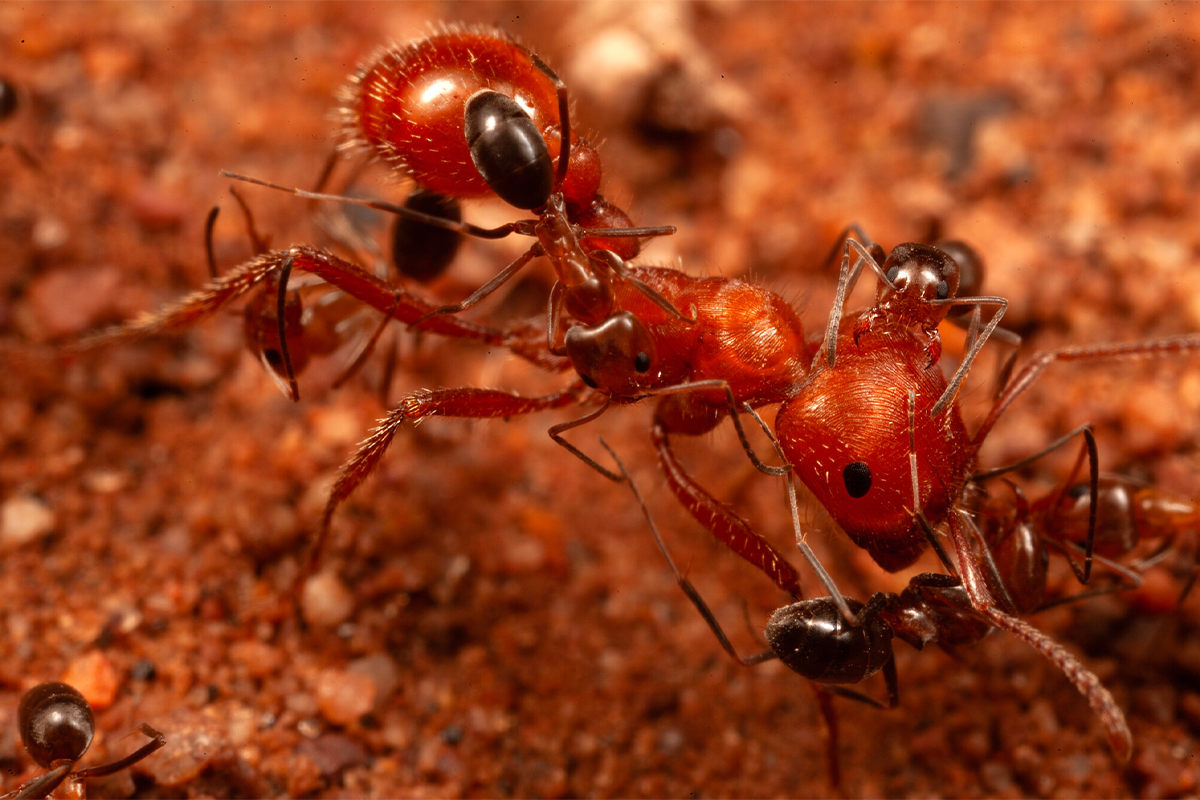
He watched as larger harvester ants (Pogonomyrmex barbatus) froze in place near the entrance to the colonies of a much smaller species of cone ants, flexing their legs to assume an elevated posture while the cone ants scurried over their bodies. The cone ants seemed to be licking and nipping at the harvester ants, a peculiar behavior that suggested they were “cleaning” them. “This new ant species is the insect equivalent of cleaner fish in the ocean,” Moffett explained in a statement. “The potentially dangerous harvester ants even permit the visitors to groom between their open jaws.”
Read more: “The Collective Power of Ants”
For days, Moffet watched the behavior—the first observed case in ants—and described the unique relationship in a paper published in Ecology and Evolution. The cleaning sessions were initiated by the harvester ants, which seemed to be soliciting cone ants for a scrubbing that lasted anywhere from 15 seconds to five minutes. The sessions ended when the harvester ants violently shook the smaller ants off their bodies.
How did this odd partnership come about?
Moffett isn’t sure, but he has some ideas. For cleaner fish and their clients, the relationship tends to be mutually beneficial: The clients get dead skin cells and ectoparasites stripped off their bodies while the cleaner fish get a free meal. A similar dynamic could be at play with the ants.
Harvester ants tend to eat seeds that are rich in fats, and the cone ants might be feeding on the detritus attached to their exoskeletons. While harvester ants regularly groom one another, the more nimble cone ants could be better at scouring hard-to-reach spots. It’s also possible the two ants are sharing beneficial microbes, making the cone ant pile-ons a back-and-forth that results in a healthier microbiome for both species.
Whatever the reason, it proves that peace is possible—in the ant world, at least. 
Lead image: from Moffett., M.W. Ecology and Evolution (2026).