More than a century ago, the “Lombard effect” was coined to describe how humans raise their voices to be heard over loud noises. Now, ocean waters have become so noisy as to warrant investigating the Lombard effect for other species—for example, whales. More than 60,000 tankers, cargo carriers, and other boats pass through the Strait of Gibraltar annually, generating a din of 132.24 decibels (dB), a noise level that rivals the calls of fin whales, per a 2025 study.
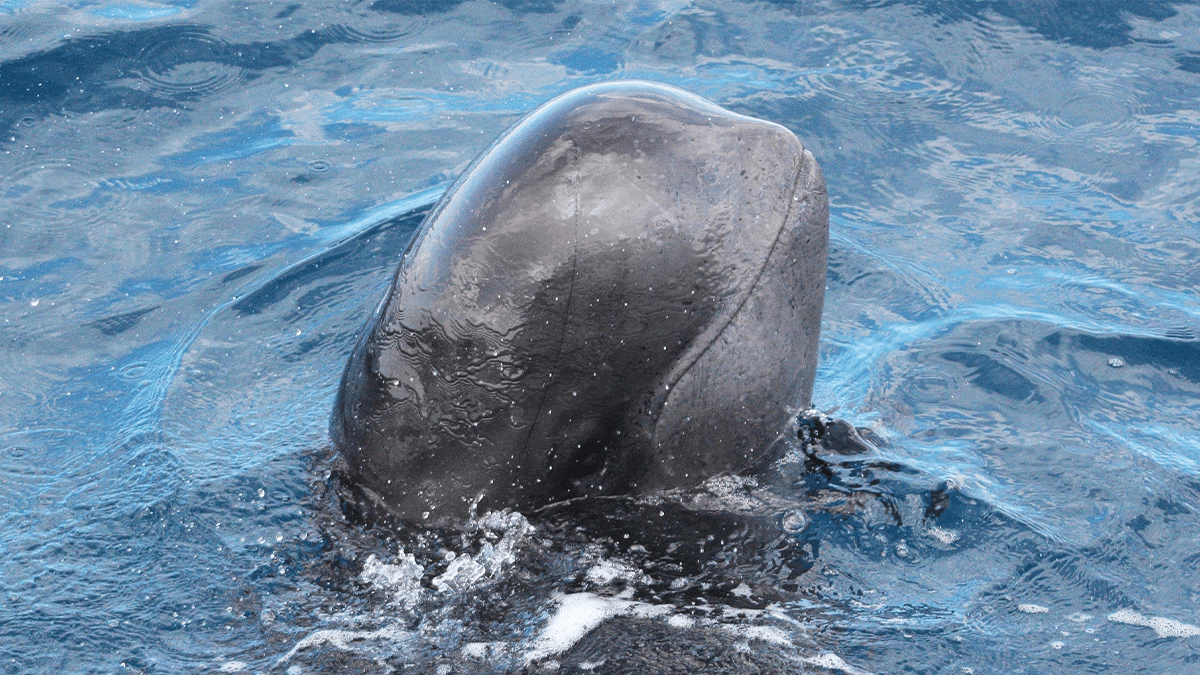
A new study published in the Journal of Experimental Biology assessed whether a critically endangered pod of about 250 long-finned pilot whales (Globicephala melas) in the Strait of Gibraltar demonstrated the Lombard effect. Led by Aarhus University in Denmark, with colleagues from Spain, Portugal, the United Kingdom, and the United States, the researchers collected data over three years.
The data originated from 24-hour recorders attached by suction cup to the backs of 23 pilot whales. The devices not only recorded underwater sounds but also measured whale movements and depths. The resulting 1,432 whale calls were categorized by frequency and duration: low-frequency calls; short, pulsed calls; high-frequency calls; and two-component calls. (Whales use the lower-frequency calls to communicate over distance since they carry farther.)
Read more: “Swimming in Noise”
The recording devices also picked up lots of underwater noise from the daily ship traffic. Background noise levels ranged from 79 to 144 dB, which the study authors equated to a noisy restaurant. The long-finned pilot whales compensated for the ship noise by making louder calls, but mostly in the high-frequency range. “Long-finned pilot whales increase their call output level in response to noise, but only partially compensate for increasing noise,” wrote the study authors.
The reality is that a marine mammal can only make louder calls within the limits imposed by its physiology. The amplitude and duration of calls naturally decrease when whales dive as their internal air spaces get compressed. Pilot whales regularly make deep dives of about 2,000 feet, and then use the low-frequency vocalizations to reunite with their pods as they surface. But this study indicates that they’re already shouting as loud as possible.
“For the critically endangered pilot whale subpopulation in the Strait of Gibraltar, these partial compensation mechanisms are likely to be insufficient for maintaining effective communication,” the study authors argued.
So to truly hear what they’re saying, we humans need to turn down the noise. 
Enjoying Nautilus? Subscribe to our free newsletter.
Lead image: AnnMarie / Adobe Stock