You’ve heard of the dark side of the moon, but NASA is also looking to explore a dark spot on the moon that it thinks may be a giant underground cave system.
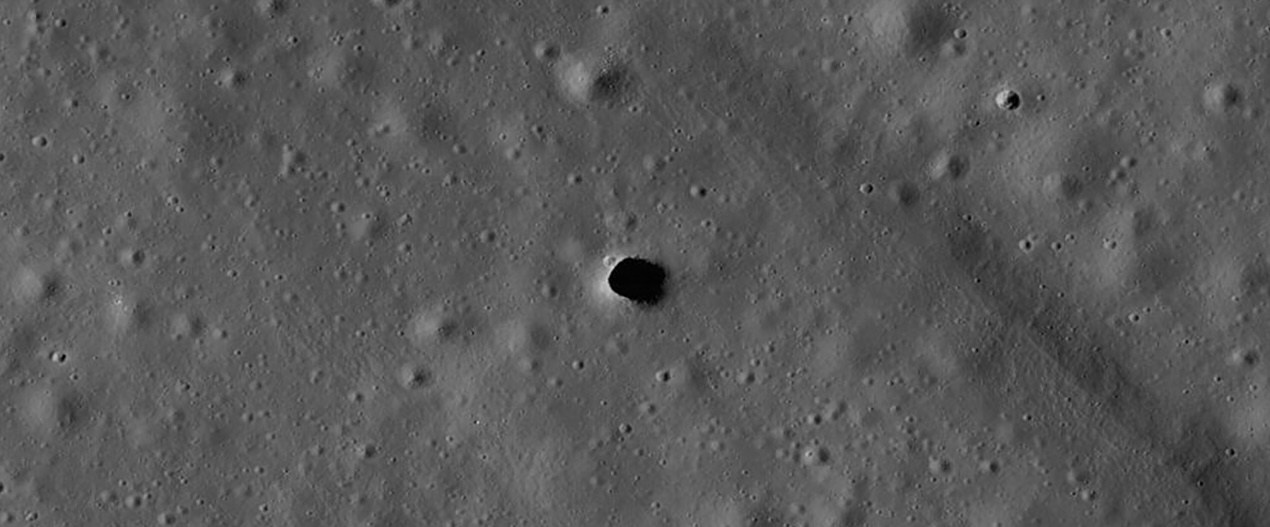
An image of the spot, known as the Marius Hills Pit (MHP), was snapped by the Lunar Reconnaissance Orbiter (LRO). Based on initial estimates, it’s thought that the hole could be nearly 300 feet wide and about 150 feet deep.
But it’s what this hole might lead to that really interests experts. The thinking is that the pit could be an entrance to a subterranean network of caves and lava tubes, created by lava flows on the moon from billions of years ago.
Not only does that make the MHP of great interest geologically, it also means it could provide valuable shelter against the radiation and extreme temperatures that astronauts are otherwise exposed to on the moon. In other words, it could make for a prime lunar base location.
Earlier this month, NASA decided to go ahead with an investigation of the MHP proposed by the Planetary Science Institute. The mission is going to be called the Geophysical Instruments for Marius Lunar Pit Investigation, or GIMLI, and it will combine a payload of seismic sensors, ground-penetrating radar, and a gravimeter (for measuring gravitational fields) to detect what’s underneath the pit.
Delivered by an as-yet-unspecified lander, the GIMLI equipment will still prove useful even if there isn’t a cave or lava tube network connected to the MHP. The readings the instruments take should give researchers more clues about how the pit originally formed, providing us additional information about the ancient history of our planet’s nearest neighbor.
“Confirming a substantial lava tube would give us an insight into how volcanism operated on the moon,” Gareth Morgan, the Deputy Principal Investigator on the GIMLI program said in a statement. “Lava tubes are a common feature of basaltic volcanism on Earth, so identifying them on the moon means we could use knowledge of such terrestrial caves to better understand lunar history.”
Two other payloads for a future lander have also just been selected by NASA: the Lunar Environment Monitoring Station – South Pole instrument suite for monitoring the lunar environment and any potential hazards, and the Depth Imager with Spectral and Color Optics for detecting ice on the surface of the moon.
All of these projects have been designed to lay the foundations for the return of humans to the moon. So perhaps one day, astronauts won’t just be calling this dark spot on the moon Marius Hills Pit, they’ll also be calling it home. 
Enjoying Nautilus? Subscribe to our free newsletter.
Lead Image: NASA/GSFC/Arizona State University