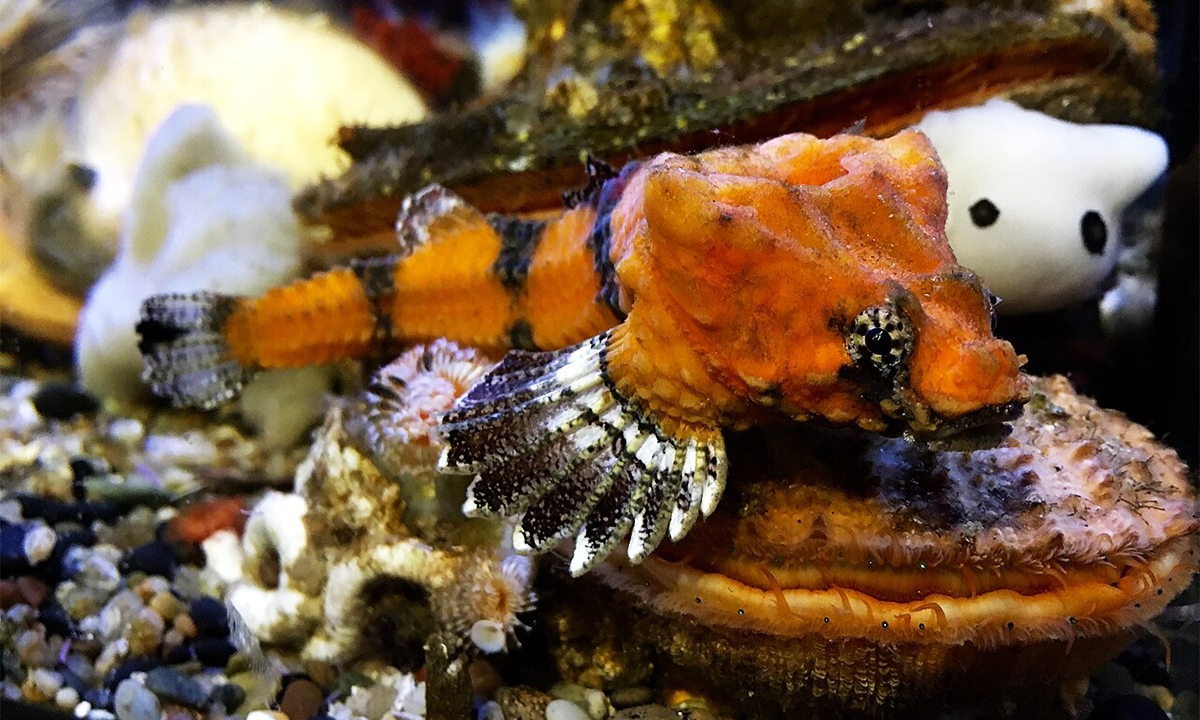
In their watery ocean worlds, fish have some weird features that are used to do some odd things, which we rarely witness. In “studying how strange fish do strange fish things,” biologist Daniel Geldof, while a master’s student at Louisiana State University, decided to investigate the rockhead poacher (Bothragonus swanii), known for the big cavity in its skull. In his master’s thesis, Geldof described the unique anatomy of this cranial pit that might explain its function.
Rockhead poachers are found along the Pacific coast from Alaska to Central California, often seen in pools in the intertidal zone when tides are out. Early naturalists thought that the head pit might enhance camouflage in rocky pools, where their gray, bony armor blends in well. Or the head cavities might serve as part of a system to produce their characteristic buzzing sounds. Geldof explained in a statement that “the goal of my entire thesis project was to figure out why” rockhead poachers have the unusual head anatomy.
Read more: “The Unexpected Music of a Coral Reef”
Using a 5,000-pound Heliscan MKII X-ray microscope at LSU, Geldof created 3-D models of rockhead poacher heads from fish specimens already collected. In the incredibly detailed models, he traced nerves traveling from the fish’s brain and found that a branch of the lateral line nerve—implicated in motion sensing—enters the cranial pit. And so, it likely plays a role in sensing the movement of water relative to the fish.
But Geldof also noticed that the fish’s first set of ribs waswere larger and flatter than normal, positioned close to the pit, and moored in muscles and tendons. He hypothesizes that the rockhead poachers use their modified ribs as drumsticks to strike the base of the cranial pit in rapid succession to create the buzzing sounds. The drumming likely propagates signals through the ground, where the fish typically rest, to communicate with other rockhead poachers in the area.
“The ocean, especially in shallow and rocky areas where the rockhead poacher lives, is unbelievably loud and acoustically complex,” said Geldof. “This fish is efficiently using its tiny body so it can still be heard under a unique set of conditions.”
Essentially, then, the “hole truth” is that the mysterious pit appears to be multifunctional, serving in both sensory reception and substrate-based communication. 
Enjoying Nautilus? Subscribe to our free newsletter.
Lead image: Rhinopias / Wikimedia Commons