
The crab-eating frog survives by holding its pee (sort of). By retaining urea, the nitrogenous waste compound expelled in urine, this frog prevents water loss via osmosis, which allows it to survive prolonged periods in saltwater. This neat little trick makes it one of the only known amphibians capable of living in a brackish environment. Until now.
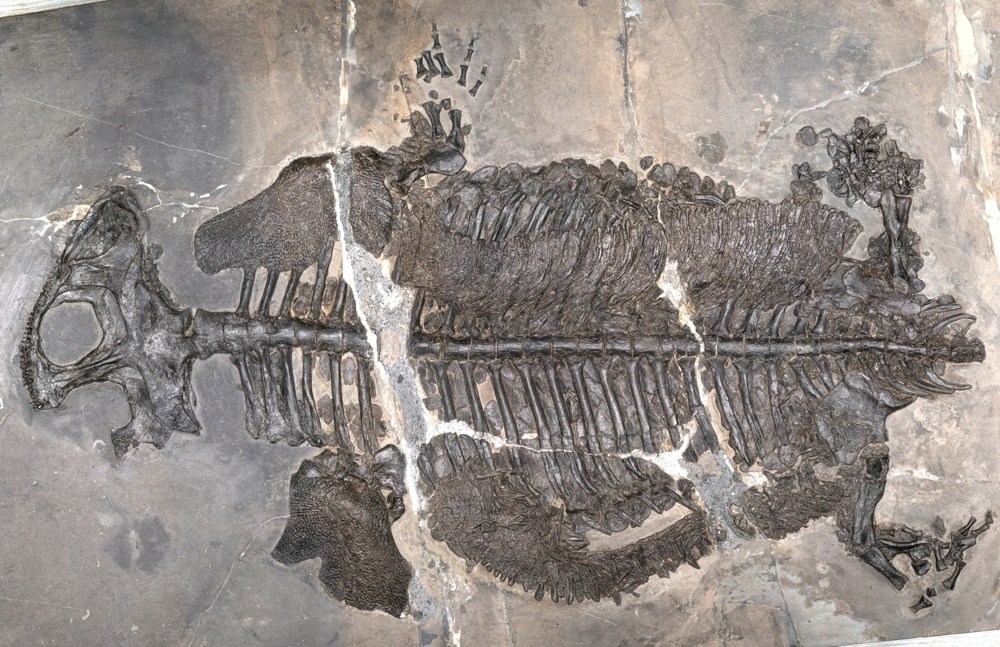
New research by a team of Chinese and American paleontologists details the discovery of the first fully marine amphibian in China’s Guizhou Province. Their analysis is based on two nearly complete skeletons dating to around 240 million years ago during the Triassic period. According to the team, the species (Gerrothorax maritimus) was around three feet long, disc-shaped, and likely an oceanic bottom-dweller. Its most remarkable feature was bony armor on its back, likely a defense against the many ichthyosaurs swimming in the Triassic oceans.
Read more: “How ‘Useless’ Science Unraveled an Amphibian Apocalypse”
“This area is part of an ecosystem that we’ve been looking at and trying to reconstruct,” study author Ryosuke Motani of the University of California, Davis said in a statement. “We’ve been mostly studying marine reptiles and the fish from this place, but now we also have this amphibian and it’s a sort of very unusual member of the lineage.”
How do they know the amphibian lived in the ocean?
For starters, they were found in sediments typically associated with a vast prehistoric sea. Additionally, geochemical analysis of the fossils revealed they contained ratios of strontium isotopes consistent with marine life.
But the fact that the specimens had all four limbs intact was the biggest clue. According to the team, if the carcasses had washed down to the ocean, it’s likely they would have lost an arm or a leg in transit (as backed up by research into dead sea turtles). Even dying in the open ocean would have led to some telltale injuries, which is why they believe it lived on the seafloor. There it likely laid waiting for prey to come by so it could suction the prey into its sizable mouth.
Of the more than 8,000 extant species of amphibians only around two percent are known to even tolerate saltwater (and even the crab-eating frog suffers from weight loss after too much exposure to brackish waters). So how did G. maritimus survive?
Amphibians drink and breathe through their skin, but G. maritimus’ bony armor probably prevented both biological processes. Instead, it likely used its mouth to respire and imbibe, relying on its gills and digestive tract to handle the salt overload.
Sure beats holding your pee. 
Enjoying Nautilus? Subscribe to our free newsletter.
Lead Image: Ryosuke Motani, UC Davis