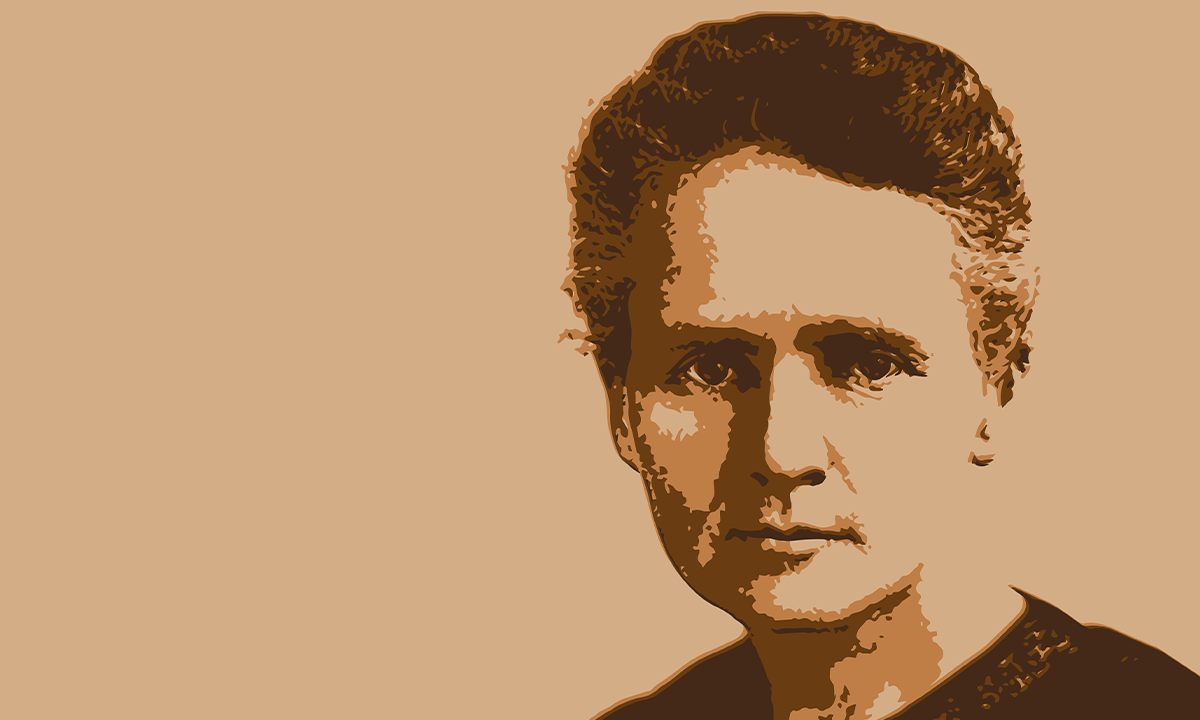
Marie Curie is an icon of science. She was not only the first woman to win a Nobel Prize, in 1903, she is still the only person to win two science Nobels in different fields—her 1903 win was in Physics while her 1911 medal was in Chemistry. But before either of those honors (but not long before) she notched another first. She was the first woman in France to be awarded a doctorate in the sciences. That accomplishment came on June 25, 1903, a mere six months before she would win her first Nobel Prize, for the very thesis research that she defended before her graduate committee in Paris that late-June day.
She achieved all of these remarkable accomplishments despite the odds being stacked against her. Her family in her native Poland was disadvantaged from the start. There were lost fortunes and properties on both her mother’s and father’s sides after participating in movements to free their homeland from the control of Imperial Russia. After her being born Maria Skłodowska in 1867, Curie had to navigate the sexism that ruled her day. She wasn’t even allowed to attend university in Poland as women were prohibited from pursuing higher education.
But Curie persisted, attending the somewhat surreptitious Flying University in Krakow, before eventually emigrating to France in 1891 and enrolling in the University of Paris, which had only started allowing women in the 1860s. Barley scraping by with earnings from tutoring in the evenings, she studied feverishly and obtained her first degree in physics in 1893. By 1903, she had earned a second degree, met and married Pierre, had her daughter Irène, discovered that thorium was radioactive, discovered polonium, discovered radium, and coined the word “radioactivity.”
Read more: “Celebrating Women Scientists”
Then, in June, Curie (months pregnant and suffering from extreme fatigue, btw) successfully defended her thesis, which contained detailed descriptions of the above discoveries. She would be recognized in December (even more pregnant) by the Royal Swedish Academy of Sciences, along with her husband Pierre and Henri Becquerel, who originally discovered radioactivity.
Not only does Curie’s story exemplify the contributions of women to science, it illustrates the benefits of supporting young scientists in the early stages of their careers. Curie is one of only a handful of researchers who won scientific Nobels for work done as a graduate student. With the health of federal research budgets currently precarious, at least in the United States, I hope there are more such stories to come. 
Enjoying Nautilus? Subscribe to our free newsletter.
Lead image: pict rider / Adobe Stock