Young chimpanzees differ from human children in a key way—the hairier creatures seem to take physical risks earlier on.
People tend to behave most recklessly during adolescence, according to data from around the world, and boys are more prone to risk-taking than girls are. To learn more about this phenomenon, scientists have set up experiments where they ask young people to take economic risks. But it’s unclear how exactly physical risk-taking, like during sports or active play, unfolds during childhood and adolescence. It’s obviously unethical to conduct experiments where people can get hurt, but watching one of our closest living relatives in the wild could offer helpful hints.
Compared with humans, chimp infants appear to act as daredevils earlier in life, according to a paper published today in iScience.
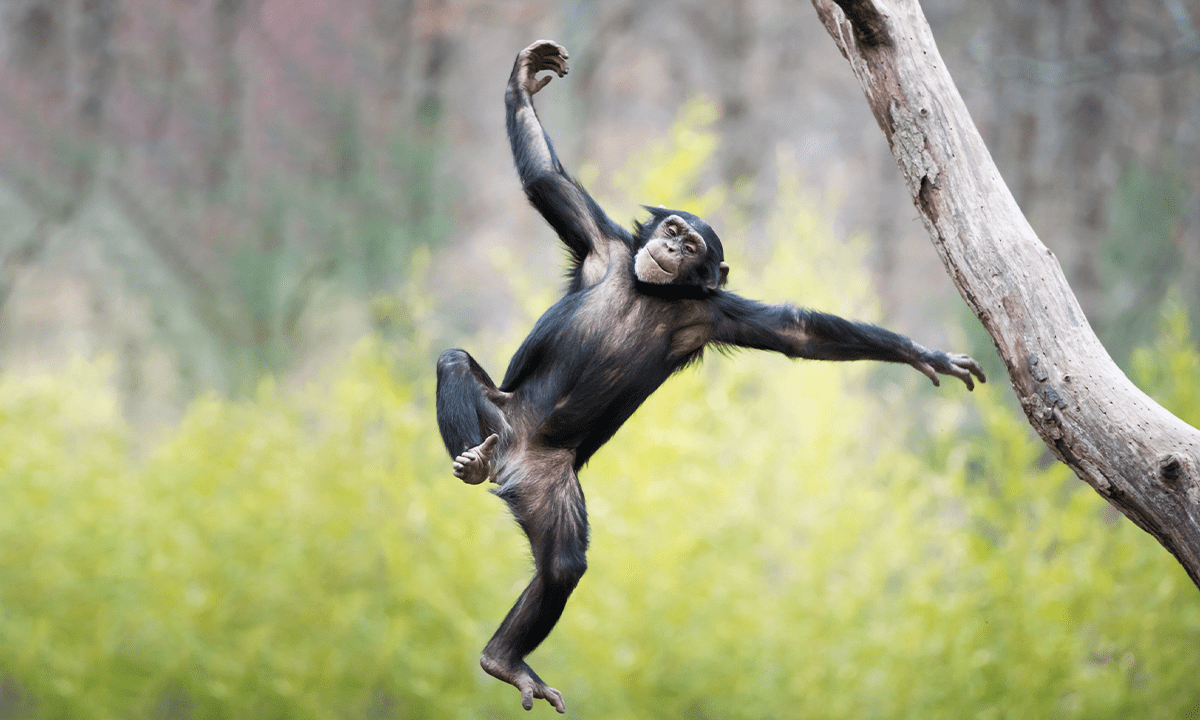
Scientists gleaned this insight from recordings of 119 chimpanzees out in the wild at Kibale National Park in Uganda. They measured risky behavior through instances of “free flight”—for example, purposefully falling from a branch, or fully letting go while moving between branches. The team observed that chimp infants were three times more likely to live dangerously than chimp adults, while juveniles were 2.5 times more likely and adolescents 2.1 times more likely. Chimps are considered infants until they’re around 5 years old, juveniles between 5 and 10 years old, and adolescents from 10 to 15 years old.
Read more: “Dude, Where’s My Frontal Cortex?”
The careless abandon traced in these chimps seemed to gradually decrease with age, the researchers noticed, and it wasn’t linked to an individual’s sex or distance from the ground. Chimps spend most of their days traversing trees to find meals, and the type of play witnessed by the scientists might help them learn about the perils of falls while they’re less vulnerable to injury. It could also give them an opportunity to refine their locomotor skills.
The researchers, from the University of Michigan and James Madison University in Virginia, suspect that varying parental supervision could help explain this difference between chimps and humans. After all, we’re the only surviving great ape species in which multiple members of the community, beyond the parents, offer plenty of care for our young. But among chimps, this responsibility is left to the mother. Infant chimps begin moving about independently relatively early on in their lives, compared with people, and their mothers can’t always chase them from tree to tree.
“Chimps just don’t have the capabilities that we do to restrict behavior,” explained study co-author Lauren Sarringhaus, a biologist at James Madison University, in a statement. “On the whole, it’s very different for humans.”
Across the globe and among a diversity of cultures, people tend to keep young children under close watch for most of the day, whether from older children, parents, or other adults nearby. Rather than an innate tendency in teens to seek out thrills, people may take more risks during adolescence because they’re finally free from nearly constant supervision.
The contrasting ape evidence suggests that these caregiving practices have influenced patterns of physical risk-taking in people. “Considering the close evolutionary and developmental similarities between humans and chimpanzees, we hypothesize that if oversight were relaxed, physical risk-taking in humans would increase before adolescence,” the authors wrote.
Most likely, very few parents are willing to test that hypothesis. 
Enjoying Nautilus? Subscribe to our free newsletter.
Lead image: Abeselom Zerit / Shutterstock