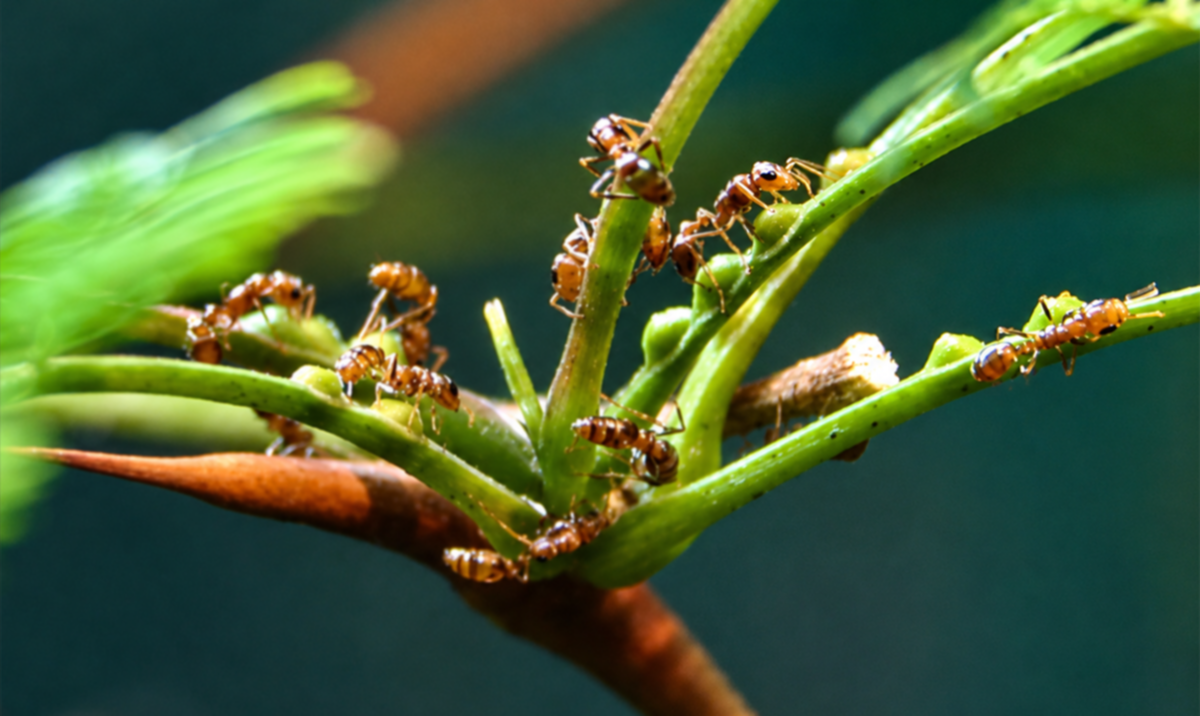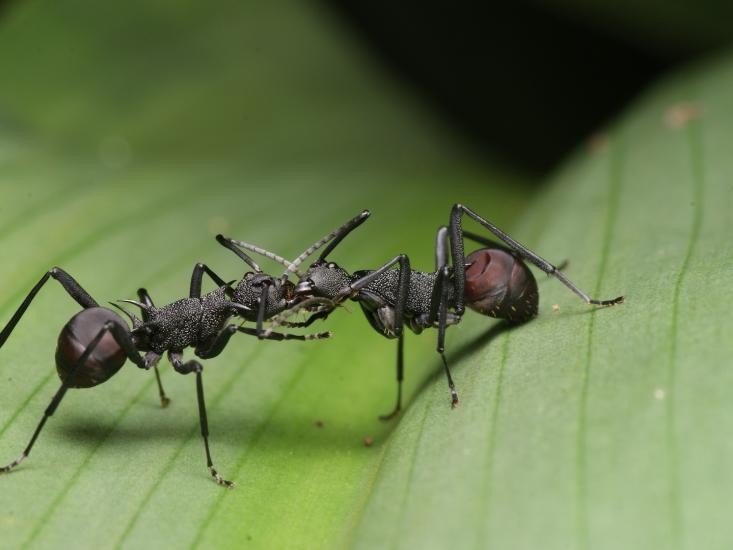
Queen ants fight dirty. With their powerful jaws, they clamp down on each other, ripping through exoskeleton and vital flesh—a fight to the death. The spoils of victory include the deceased’s entire colony. The queen with the broader head and stronger jaws is most likely to win.
When we think of animal weapons—antlers, tusks, horns, and spurs—we usually think of fights between males. And the study of animal weapon evolution has indeed mostly focused on males, particularly on their winning the right to reproduce (called sexual selection). But females deploy lethal weaponry, too. Theirs just arose from different evolutionary pressures—by competition over ecological resources, food, breeding and nesting sites, and by the need to protect offspring.
As a result, the broadness of a fighting queen ant Messor pergandei head is 5 to 15 percent wider than of a non-fighting queen head, according to Ken Helms, evolutionary ecologist with the University of Vermont. Similarly, female dung beetles evolved horns to win dung balls, an egg-carrying vessel; female soay sheep evolved horns to compete for food during lambing season; and female reindeer evolved antlers to secure prime foraging sites for calving.
Weapons are costly: Besides requiring resources to develop, they’re conspicuous to predators and provocative to same-species rivals.
Female weapons are “rarely due to sexual selection,” said Anders Berglund, professor of ecology and genetics at Uppsala University in Sweden. Of course, weapons can be indirectly used to access mates. Two females of a species could compete with each other to access food that they then use to attract mates and produce offspring. But winning mates is rarely the primary evolutionary driver for weaponry in females.
This distinction only began to come to light in the late 1970s, almost a century after Darwin published his theory of evolution. The delay is in part because of how Darwin framed the evolution of weapons, suggesting it was primarily due to competition for mates, writes Joseph A. Tobias, a lecturer in the Department of Zoology at Oxford University. Biologists for a long time followed Darwin’s legacy, ignoring competition over other resources, says Dustin Rubenstein, evolutionary ecologist at Columbia University.
Male weapons are also just more extreme, making them a more attractive research target. “All of the really, really extravagant weapons are in males,” says Douglas J. Emlen, entomologist at the University of Montana and author of Animal Weapons. “So there is a very good reason that so much interest (including my own) has focused on them.”
Females rarely evolve elaborate weapons because they have the burden of producing eggs, an energy intensive process, says Berglund. Weapons are costly: Besides requiring resources to develop, they’re conspicuous to predators and provocative to same-species rivals. Males can usually afford the expense because sperm are relatively cheap to make. Egg-bearing females, on the other hand, “have to be more economic in producing weapons than males typically are,” Berglund says.
Ankur Paliwal is an editorial intern at Nautilus.