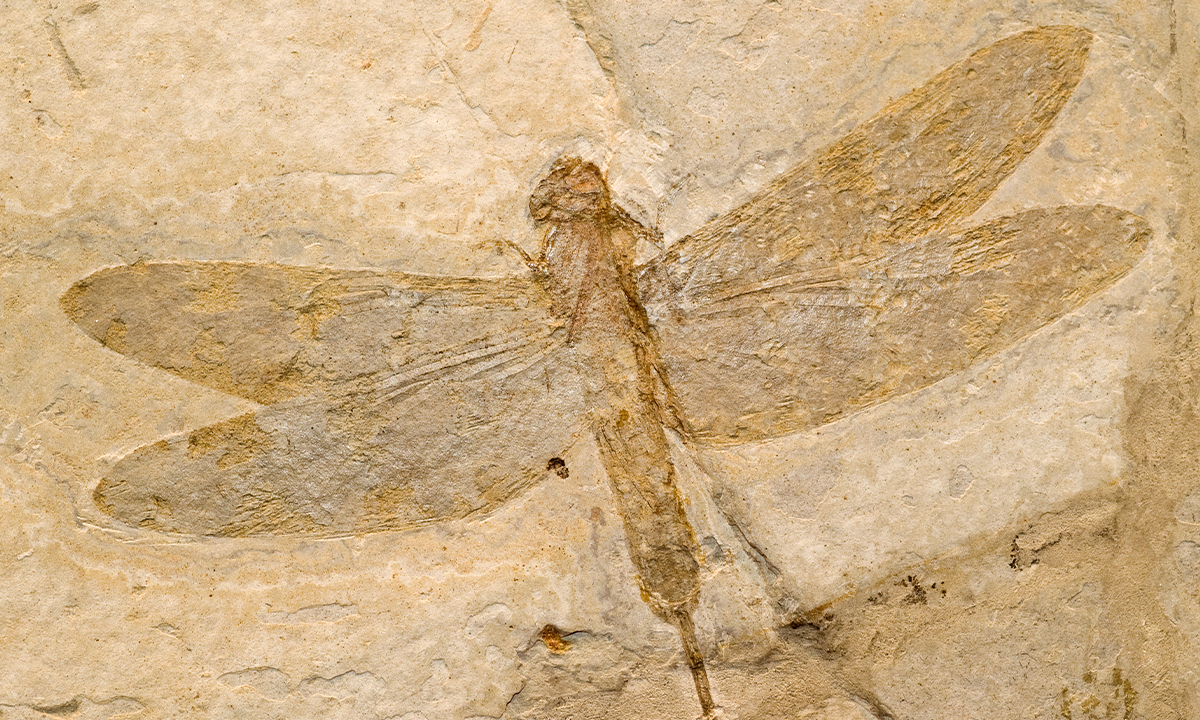
In reconstructing ancient ecosystems from fossils, paleontologists can deduce the sizes and shapes of the animals and plants that inhabited them. In some cases, the color of organisms can even be estimated from fossilized pigment structures. But because vocal organs from vertebrate animals, such as the air sacs of frogs or larynxes of mammals, are rarely preserved in the fossil record, one aspect of ancient life that’s largely eluded scientific description is what ancient ecosystems sounded like.
There is an exception, however: arthropods. The sound-making organs of some insects are made of hardened chitin that, unlike in vertebrate animals, fossilizes under the right conditions. And so, in a new preprint study, researchers from the United Kingdom, China, Austria, and the United States were able to describe the noises that insects made during the Jurassic period.
Read more: “Why I Traveled the World Hunting for Mutant Bugs”
Male crickets, katydids, and their relatives (suborder Ensifera) produce their characteristic trilling by scraping a chitinous toothed structure (“file”) over serrated wing veins, in what’s called stridulation—think of a person playing the washboard with thimble-covered fingertips. The shape of a cricket’s file and the texture of the “plectrum” on its wing determine the frequency and volume of its call, which is why the researchers examined 20 Ensifera fossils, representing nine species, collected in Inner Mongolia, China, that coexisted during the Jurassic.
Based on the insects’ file shapes, wing sizes, and data on modern cricket stridulation, they were able to reconstruct the wing vibrations and acoustic signals of the ancient crickets. The fossil species trilled at frequencies as low as about 5 kilohertz (or the equivalent of a high-pitched whistle) up to as high, in one case, as ultrasonic (more than 20 kilohertz). “Jurassic ensiferans were communicating with a broad range of frequencies from low audio to moderate ultrasound,” wrote the study authors, who hypothesize that mammal predators influenced the wing adaptations that produced ancient cricket calls.
It actually sounds pretty familiar, though. Because the diversity of cricket noises from some 165 million years ago aren’t all that different from what you’d hear on a warm summer night today. 
Enjoying Nautilus? Subscribe to our free newsletter.
Lead image: marcel / Adobe Stock