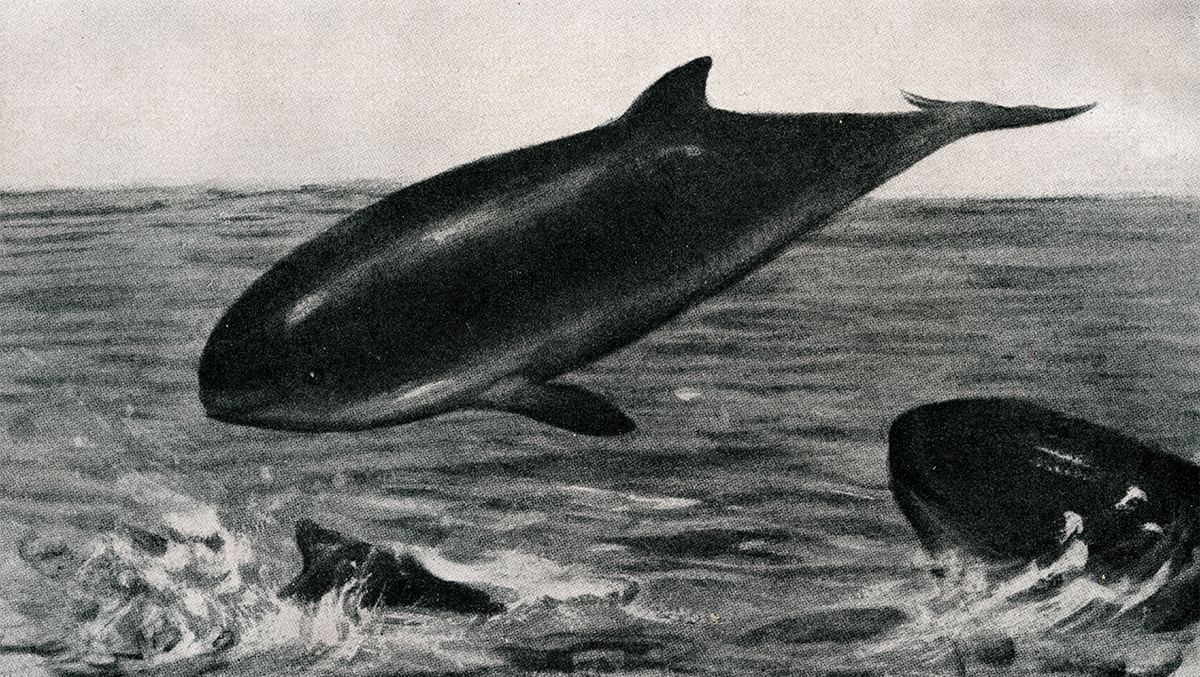
These days, there are many ways to survey a population of marine animals—by SCUBA, by boat, by drone, and by satellite. But sometimes, the most old-fashioned way still does the trick. Case in point: A recent study in Ecology and Evolution relied on newspapers, the original printed variety, to get a handle on porpoise distributions.
The only marine mammal resident in the Baltic Sea, the Baltic Proper harbor porpoise (Phocoena phocoena), has declined over the past couple of centuries due to fishing, contamination, and noise pollution. With an estimated 500 individuals remaining, it’s currently listed as Critically Endangered.
Researchers from Denmark and Sweden, which flank the Baltic Sea, screened the National Library of Sweden’s archive of digitized newspapers from the 1700s to the early 1900s to ascertain historic porpoise distributions. Using “tumlare” (Swedish for porpoise), “marsvin” (Danish for porpoise), and related keywords, they found 1,490 mentions of porpoises. After verifying the porpoise locales, they mapped the mentions of what they estimate to have been 1,455 individual porpoises.
Read more: “The Unseen Deep-Sea Legacy of Whaling”
The study authors qualify in a press release that these aren’t scientific surveys. “They are everyday observations, but considered together they show a very different Baltic Sea,” said Magie Aiken, first author and postdoc at the Swedish Museum of Natural History. “Although the accounts may lack the precision of modern scientific observations, they provide a unique resource to track the presence and distribution of species that would otherwise be inaccessible,” argue the researchers.
Based on the newspapers, porpoises lived along the entire Swedish coastline all the way north into the Gulf of Bothnia, where they’re now rare. They likely migrated there from Denmark’s coast to forage along Sweden’s shores during the warmer seasons. According to the news dataset, porpoises were also in German, Lithuanian, and Latvian waters, ringing the Baltic’s northern perimeter. In fact, in a single hunting season in 1880, the take of harbor porpoises from the Little Belt Sea of Denmark was reportedly 800 individuals.
Looking back further into the archaeological record, harbor porpoises were even more widespread around the Baltic. Clearly, human activities have taken their toll on this faltering population, as today it only occupies about a third of its original range. To reverse this trend, the study authors recommend “proactive protection and management.”
With all good luck, the conservation needs of this imperiled porpoise population will someday make front-page news. 
Enjoying Nautilus? Subscribe to our free newsletter.
Lead image: Juulijs / Adobe Stock