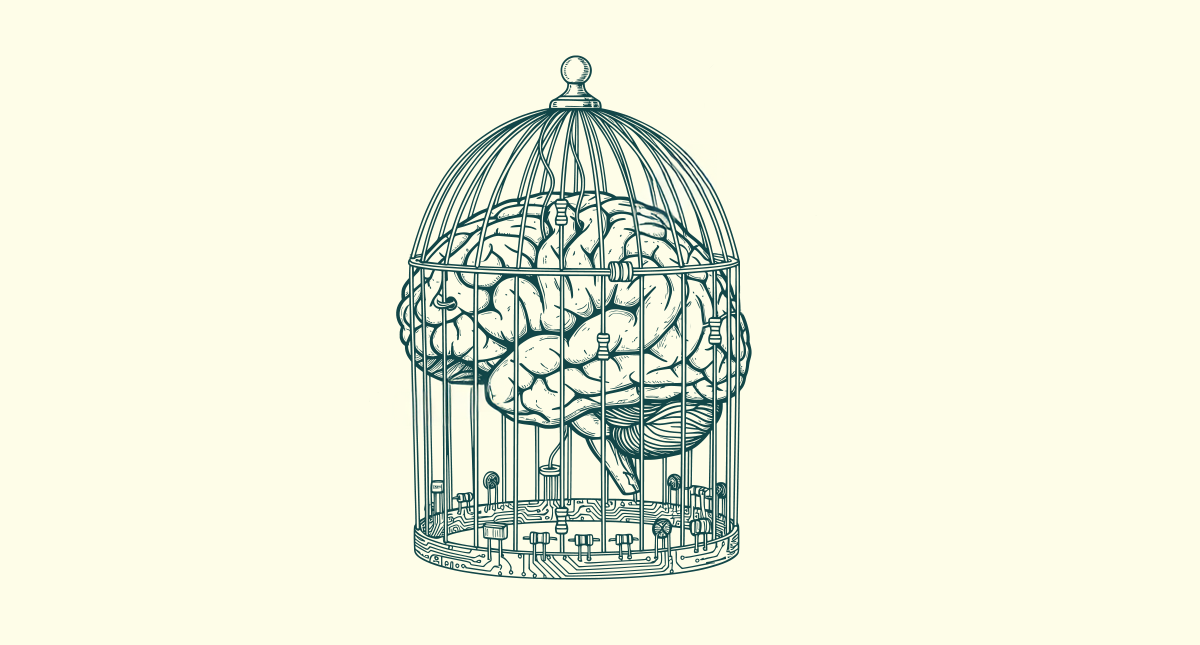
There was a time when throwing up during pregnancy wasn’t just seen as a frustrating symptom. Instead, some doctors considered this fetus-induced queasiness as the harbinger of a lifelong, debilitating condition for the unborn child—and they called this condition “idiocy.”
Back in the late 1800s, beliefs about this so-called “poverty of the mind” were rapidly evolving. Vomiting during pregnancy was just one of many hypothesized causes, with everything from neurotic parents to the weather considered possible culprits at one time or another. At the extreme, some medical professionals even saw idiocy as a moral failure—a sign that children, or their parents, had “so far violated the natural laws” that their bodies were no longer fit to house the “powers of the soul.”
It is easy to condemn these early theories from where we stand today, decades of medical and psychological research later. But doing so would be a disservice to the complex and surprisingly recent history of what we now understand as intellectual disability.
“The history is an incredibly sobering one,” says David Wright, historian at McGill University in Canada. “But try to understand the past in its own terms … not to ignore the terrible things that occurred, but also try to understand the context in which they occurred.”
Wright grew up in Ontario, Canada, with a sister, Susan, who was born with Down’s syndrome. His family’s experiences navigating Susan’s condition motivated him to study the history of the asylums—or as they were later called, “institutions”—where people with intellectual disabilities were sent to spend their lives in medicalized settings.
Read more: “A Mental Disease by Any Other Name”
“My sister was born in the 1960s, and my mother was encouraged to send her to an institution,” he says. “That is what one did, right? That would be better for her, that’d be better for the family, that’d be better for society.”
Wright’s mother declined, as did a growing number of parents facing the same decision in that era. Although these institutions were still the norm, shocking exposees by journalists, photographers, researchers, and advocates had started to call their use into question. Harrowing accounts of life on the inside revealed frequent cases of physical, sexual, and emotional abuse: Heavily-sedated people walking through the halls in drug-induced stupors. People sleeping on concrete floors, naked, sometimes in their own excrement. By the time Niels Erik Bank-Mikkelsen, director of the Danish Service for the Mentally Retarded, visited the Sonoma State Hospital in 1967, he described it as “worse than any institution I have seen … In our country, we would not be allowed to treat cattle like that.”
Despite these disturbing accounts and growing public skepticism, society’s longstanding reliance on these facilities meant it took more than three decades for most of the last long-stay residential institutions in North America to close. “These were full of thousands of people,” Wright explains. “You couldn’t just discharge them all.”
What the hell is going on here?”
That’s what historian and writer Simon Jarrett found himself wondering when he arrived at one such institution, back in the 1980s. He’d been working with people with intellectual disabilities for years, but never in an institutional setting like this one. In need of a job, he decided to try a role as a nursing assistant, not knowing quite what he’d encounter.
“There were guys … who’d been in there since they were 5 years old,” Jarrett recalls. “They had gone in in the 1910s or the 1920s and they were just going to live out their whole lives there. And I thought, ‘How did this come about?’”
That initial question became the seed for a decades-long career exploring the history of intellectual disability, especially the centuries before long-term residential institutions became the norm. By digging into old court proceedings, caricatures, jokes, and other documents describing the daily lives of “idiots,” “half-idiots,” and “imbeciles,” Jarrett’s research has shown that society has not always been so quick to hide people with disabilities from view.
“They were part of the conversation,” he says. “The institution simply wasn’t an option for disabled people prior to this big asylum movement that happened in the 19th century, so the locus of care for people was in the home and the neighborhood—the community.”
Particularly striking are the “Old Bailey” criminal court proceedings, which describe countless examples of people sticking up for “idiot” neighbors, friends, or family members who had been accused of minor crimes in a London court from 1674–1913.
Take the story of Ann Wildman, for example, who was tried for stealing “nine yards of black silk ribbon” in 1762. Multiple community members stepped forward in her defense, including her mistress, who argued that “she was very silly, but had behaved honestly before” and promised to take her into her charge if her name was cleared.
The trial of Peter Cunniford, accused of stealing a coat in 1759, tells a similar story. Cunniford’s brother, in-law, employer, former roommate, and two colleagues all testified to his character, emphasizing that he was “next kin to an idiot” but also hard-working, well-behaved, and, most importantly, “honest.” Both Wildman and Cunniford were eventually acquitted, as were many other people who presumably had intellectual disabilities tried around the same time.
Of course, life before institutionalization was far from perfect for people with intellectual disabilities. There were no formal supports available, some people were teased or bullied, and many lived in very poor conditions. But Garrett emphasizes that quality of life was worse for almost everyone back in the 18th century, not just those with intellectual disabilities—a kind of “equal opportunity terrible,” as he puts it.
Stories like those in the Old Bailey trial records are important, because they suggest that people with intellectual disabilities were not necessarily outcast or marginalized. In fact, for centuries, the designation “idiot” was not used as an insult, but as a legal term, reflecting whether a person was mentally fit to manage their own property, get married, or be held criminally responsible for their actions.
For Garrett, the Old Bailey trials are also significant because they are evidence that people with intellectual disabilities were often able to work and live at least semi-independently in their communities. Some, like Wildman and Cunniford, were described by witnesses as valued workers and productive members of society.
This way of thinking seems to have been eradicated by decades of institutionalization, as Garrett experienced firsthand when institutions started to close and people were resettled back in their communities.
“Everyone in the hospital told us it wouldn’t work: ‘Well, they’ll all walk into the road and get knocked over by a car. They’ll fall out of a window, because they’d never been upstairs,’” he recalls. “[But] they did incredibly well … the only thing that happened was they all burnt their mouths on the food, because they weren’t used to having hot food.”
It’s clear that somewhere between the 1700s, when the bulk of the Old Bailey trials took place, and the late 1900s, when institutions finally shut their doors, society’s understanding of intellectual disability underwent a radical shift. What’s less clear is exactly what led to this misguided notion that people with intellectual disability had to be contained and controlled, rather than integrated.
Garrett attributes the move toward institutionalization to a wider change in mindset sparked by the French Revolution around the end of the 18th century. The radical overthrowal of the social hierarchy that took place in France led both reactionaries and progressives internationally to see people with disabilities as problematic—but for very different reasons.
The reactionaries were horrified that the poor, whom they saw as an “imbecile class,” had overthrown the wealthy elite in France. As a result, Garrett says elites “became very frightened, suspicious, hostile toward anybody that displayed extreme signs of difference from anyone else, because these people were a threat.”
The progressives, on the other hand, had started to envision a better future, promoting utopic visions of a society free of illness, disease, and, in the most optimistic accounts, even death. “For them, the [intellectually] disabled person … was not one who belongs in this new society,” Garrett says.
Adding to this were other factors, including the growing authority of the medical profession, scientific attempts to investigate idiocy and its causes, and Enlightenment beliefs that humankind could be improved. According to Wright, financial considerations also played a role, as many “respectable” families did not have the funds to provide private care for their loved ones.
Wright says the institution was introduced in this context as a promising solution, as an “investment of society.” The idea was to provide modern medical care and, where possible, treatment for people suffering from disabilities and mental illness. Institutions were often framed as temporary, educational facilities where children could spend a few years gaining self-care skills, developing basic literacy, or learning a trade, before eventually reintegrating into society.
“It’s a very progressive, self-congratulatory approach,” Wright explains. “An argument that [people with intellectual disabilities] are amenable to educational and social improvement in a way that past generations, who were foolish and unscientific, never appreciated.” At least in theory, institutions were introduced as a path toward social progress.
The problem, Wright explains, is that these facilities failed to deliver the utopian results they promised. Residents did not typically “improve” in the ways that proponents of institutionalization had hoped. Moreover, in the cases where children with intellectual disabilities were able to be discharged, “some families refused to take them back.” Many parents, especially those near the poverty line, simply didn’t have the resources to care for the loved ones they’d previously sent away.
Read more: “Yes, You Can Catch Insanity”
While more and more children entered these facilities, very few ever left them. In this sense, Wright says these institutions “became victims of their own success”—too popular to house the droves of people entering them. Huge swaths of residents were needed to work the fields that produced the food some of these institutions ran on, creating a self-perpetuating cycle where more and more residents were needed to feed the growing number of mouths housed in an institution’s walls. Over time, facilities became overcrowded, funding dwindled, and conditions rapidly deteriorated.
In perhaps the darkest moment of disability history, progressive ideals about “improving” humankind started to take a new, more extreme shape toward the end of the 1800s, as eugenicists promoted deeply unethical beliefs about controlling human genetics to produce a more intelligent, productive, “ideal” human race. In line with this vision, institutions kept women and men in separate wings to prevent them from reproducing. Some started sterilizing residents—a practice that continued as late as the 1970s in some parts of North America. In California alone, almost 300 people with intellectual disabilities were sterilized during the 20th century, under this deeply flawed mandate to produce the “perfect” society.
Eugenics-driven sterilization efforts disproportionately impacted people at the margins of society, including people with disabilities but also immigrants, the poor, and people of color. Black people were especially impacted, because they were seen by the white elite as “idiotic and imbecilic” by default—a perception reinforced by racial biases in the intelligence tests that were used to assess “feeblemindedness.”
It’s undeniable that conditions for people with intellectual disabilities have improved in the decades since. We no longer sterilize people or prevent them from reproducing. Most people with intellectual disabilities live at home or in smaller community facilities, rather than in overcrowded institutions hidden from society’s view. In the United States, legislation currently ensures people with intellectual disabilities have the right to go to school and live life, just like anyone else. With support, they can now learn alongside their peers, grow up, get jobs, and be part of society.
But Mary Hartley, president of the disability advocacy organization The Arc of Greater Pittsburgh (Achieva), warns that this legislation may be in jeopardy. “There have been multiple discussions, if not threats, from United States federal offices about these hard-fought rights,” she says. “We really can’t afford to go back at all … it is deeply, deeply concerning.”
On June 18, 2026, the U.S. Department of Justice published a legal opinion that questions a seminal disability rights decision from the Supreme Court, Olmstead v. L.C., delivered in 1999. Olmstead was a landmark moment, as it recognized the institutionalization of people with disabilities as a form of discrimination under the Americans with Disabilities Act (ADA). In the decades since, it has allowed people and their families to advocate for the support they need to live life in their communities, rather than cordoned off from society.
The recent opinion presents a reanalysis of the 1999 documentation to conclude that Olmstead “held nothing more than that unjustified institutionalization of individuals with mental disabilities can constitute discrimination on the basis of disability.” While this recognition of discrimination is often used to “demand certain treatment services from states,” the legal opinion argues this right to services “is not granted” by current legislation and is thus “unlawful.”
While an opinion statement alone isn’t enough to change the law, The Arc has warned it cannot be taken lightly. “[R]ights mean less when the federal government refuses to enforce them,” reads a statement on the organization’s website. “This opinion seeks to undermine one of the strongest protections people with disabilities have from being pushed into institutions when they can and want to live in the community.”
The publication of the government’s opinion on Olmstead follows several other concerning developments, including the largest ever funding cuts to Medicaid, the governmental financial support that makes community living possible for people with intellectual disabilities, and a planned reorganization of the offices responsible for special education that could make it more difficult for parents to demand supports for their kids—and to hold schools accountable when they don’t provide them. Collectively, these developments threaten to undermine decades of advocacy work to ensure people with disabilities are integrated, rather than institutionalized.
As a parent of a son with autism, these threats hit close to home for Hartley. “I’m deeply, deeply concerned about … the health and safety of people with disabilities,” she says. “History has shown when people are segregated, the one thing you can count on is abuse … When other people don’t have eyes on you, can’t report something, that’s when abuse happens, that’s when neglect happens.”
These legal, policy, and financial threats underscore how fragile the line separating historical injustices from current realities can be, and how easy it is to overlook the flaws of the present when scrutinizing the past. “We’re talking about how marvelous we are, because we’re moving [people] back [into community],” Garrett says. “But there’s much more of a conditional acceptance now than there was before. You have to conform … to be an acceptable person in the community.”
Wright agrees: “I don’t think we can look at our society today and say, well, ‘Look how far we’ve come in terms of providing supports and integration.’ I don’t think we have. I don’t think society largely cares. I don’t think it’s a priority.” 
Lead image: vectorial / Adobe Stock