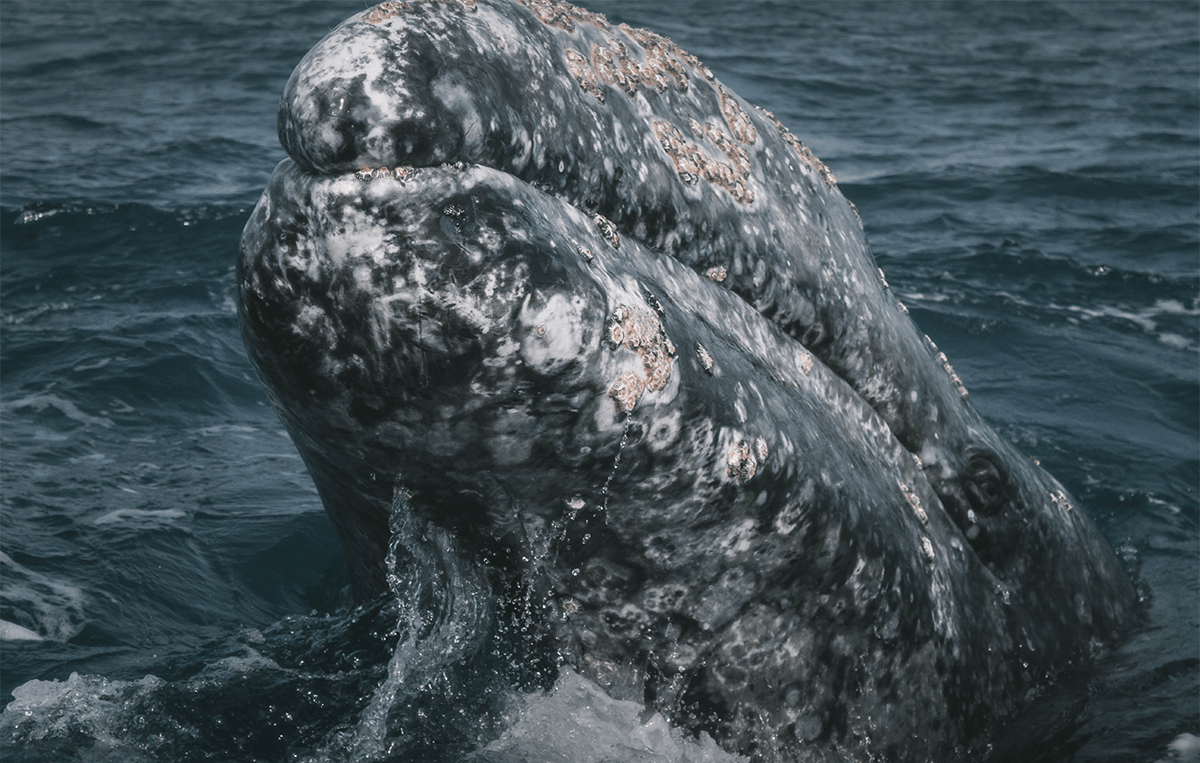
Gray whales used to have it easier. They summered in the Arctic, fattening their massive bodies with abundant krill that favor icy, deep waters. As winter approached, they headed southward, counting on their full bellies to sustain them for the thousands of miles to breed in Baja Mexico’s tropical lagoons, rarely feeding along the way.
Lately, however, Eastern North Pacific gray whales (Eschrichtius robustus) have been turning up in San Francisco Bay, a new outpost on their migration routes. Since 2018, in fact, they’ve been sighted annually. With prey densities declining from climate change in the Arctic, they’re likely seeking a pit stop to refuel on their way to Mexico.
In a recent study, biologists from the Marine Mammal Center and California Academy of Sciences explored the fate of 114 whales spotted in the San Francisco Bay from 2018 to 2025. Using survey data, coupled with citizen science photos, they catalogued the whales entering and leaving the Bay.
Read more: “Why Ships Kill Thousands of Whales Every Year”
Their findings were sobering. “At least 18 percent of the individuals identified in San Francisco Bay later died in the area,” said study co-author Bekah Lane of the Center for Coastal Studies in a press release. “Our broader analysis of local strandings both inside and outside San Francisco Bay found that over 40 percent of these whales died of trauma from vessels.”
Seventy gray whales were found dead during the study period, of which 30 had suffered blunt or sharp force injuries from boat strikes. Because gray whales barely clear the ocean surface when swimming, boaters may fail to notice them. Compounding the problem, the San Francisco Bay gets a lot of ship traffic, which funnels through the Golden Gate Strait, an entry corridor shared with the gray whales.
Based on other studies, whale strikes by boats can be reduced by implementing speed restrictions and changing routes. While ships may still collide with whales in the bottleneck of the Golden Gate Strait, slower speeds make the strikes less likely to be fatal.
As the Arctic climate continues to warm, Eastern North Pacific gray whales are going to keep needing to supplement their nutrition during such arduous migrations. Some subgroups have started foraging south of the Arctic, adapting to consume other prey like ghost shrimp and herring fish eggs. But many will continue seeking snack stops in the San Francisco Bay.
The key is to find ways to make sure this isn’t their last meal. 
Enjoying Nautilus? Subscribe to our free newsletter.
Lead image: Dary Maltseva / Adobe Stock