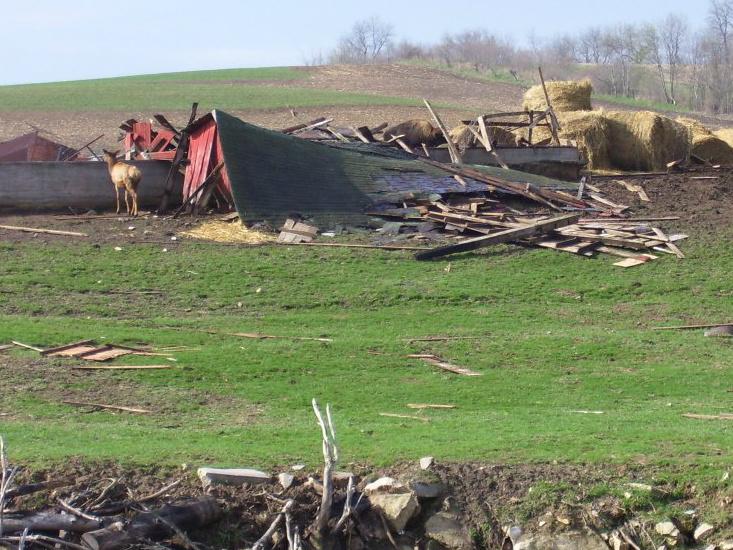
It’s an odd quirk of the human mind that we tend to think we’re less likely to be affected a particular threat—be it the flu, a car accident, or a flood—than anyone else. Like the fictional town of Lake Wobegon, where all the children are above average, this is a patent impossibility: Everyone can’t be less likely than the average person to catch a cold. But we persist in what psychologists call “unrealistic comparative optimism.” Even when we have actually encountered a threat, or been in close proximity to one, this warped sense of the probability field persists, as a report published last year shows (pdf).
In the study, researchers had a chance to test how people’s comparative optimism changed after a low-probability, high-impact event: a tornado that ripped across Iowa City in 2006, causing $12 million in property damage. And their results were faintly comical: Everyone they polled, from students to randomly selected Iowa City residents to people whose neighborhoods had been damaged, felt both soon after the tornado and a year later that they were less likely to be affected in the future than the average person. In fact, six months after the events, people in damaged neighborhoods were actually more optimistic that they would not be affected again than were those living in intact areas. After a year, their optimism returned to the usual level—but still, as always, holding that they were less likely to be affected than others.
Why do we think this way? Psychologists posit that such overly positive assessments are a way of building up our senses of self. We make these assessments not just when asked about our own vulnerability but also when asked how certain we are we’ve got a question right—when we say we’re “100% certain,” for instance, we’re usually 80% right—and when assessing how good we are at common tasks, compared to other people. Furthermore, though the researchers do not discuss this particular phenomenon, once you’ve survived something, your assessment of the danger you were in, or the painfulness of the process, goes down. If you got through a catastrophe once, our brains seem to assume, you could get through it again, even if in the moment you feared for your life. This peculiar and somewhat frightening effect has been studied in the context of attitudes about torture; for a look at how having pain inflicted on people actually makes them more callous, check out this great article by science writer John Pavlus.
When it comes to natural disasters, though, this sort of magical thinking may actually be mostly harmless. Being hurt by a tornado is so unlikely, the researchers note, that even these optimistic respondents were actually overestimating the potential threat by more than 10 times. They estimated the likelihood of a tornado affecting them in the future as a bit over 1 in 10, while the real chance that one would strike their area in a given year was less than 1 percent.
Veronique Greenwood is a former staff writer at DISCOVER Magazine. Her work has appeared in Scientific American, Popular Science, and the sites of Time, The Atlantic, and The New Yorker. Follow her on Twitter here.