Tinder—in case you’re not active in the young-person dating pool—is a dating application that shows you pictures of other Tinder users in your area. If you are not interested in meeting the person you see, you swipe their picture to the left. If you are interested, you swipe right. If two people right-swipe each other’s photos, the app suggests they get together. (If there is not mutual interest, nothing happens.) Tinder became a quick success in 2013, spawning several copycats, from apps that help your job search to others that help find the right pet, all using the simple swiping interface.
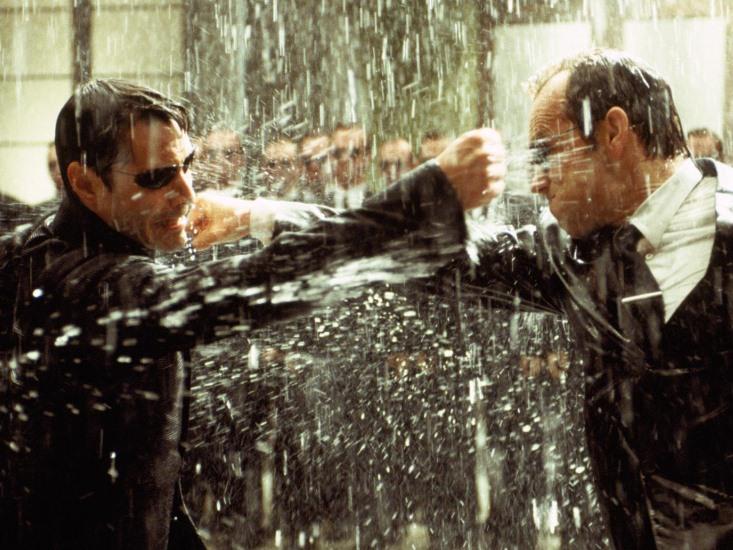
In the visual design of the app, Tinder’s founders capitalized on a bit of human psychology: It seems natural that a positive feeling should be indicated with a rightward swipe rather than a leftward one. In theater directing1, rightward motion is believed to be perceived by the audience as good, and leftward bad, and studies have backed it up. In the film “The Matrix,” most of the time Keanu Reeves’ character gets into a fight, he’s moving left to right on the screen, and his enemy is doing the opposite. Almost every video game ever made that scrolls to one direction has the player’s avatar moving left to right. (Jungle Hunt is the only side-scroller game I know of that has exclusively right-to-left scrolling; in some others, you go both directions.) Studies even show that referees call more fouls on players moving left in their visual fields.
Why might this be? Is it just an accident of history, like which side of the road we drive on? Could it be because most people are right-handed?
It turns out that it has to do with the direction of writing. The right-is-good association is only true for people literate in a rightward-directed writing system like English and Russian. When the studies are done (pdf) for pre-literate children, the effect is not there, and for speakers of Hebrew or Arabic, two right-to-left languages, we get the opposite effects. I searched for “Israeli action movie” on YouTube and the first hit showed me a trailer featuring many shots of the protagonist running right to left on the screen. I haven’t seen any scientific study of films in Arabic and Hebrew, but it might find this to be a reliable trend.
It is likely that the Tinder’s American developers chose the rightward-swipe because it felt natural to them as a function of their language. However, the Israeli version of Tinder also uses a right-swipe for interest, as does the more ambitious app Verona, which tries to connect Israelis with Palestinians. Perhaps the developers thought it best to just stick with the right-is-good tradition of most countries. The directional preference is a pervasive but mild effect, not so strong that good action in the wrong direction is incomprehensible. That’s good news for speakers of Hebrew and Arabic: The Matrix doesn’t make much sense if Keanu Reeves is playing the bad guy.
Reference:
1. Dean, A. & Carra, L. (1989). Fundamentals of Play Directing (5th ed.). Wadsworth Publishing.
Jim Davies is an associate professor at the Institute of Cognitive Science at Carleton University in Ottawa, where he is director of the Science of Imagination Laboratory.