This story was originally published by Knowable Magazine.
Ready for a Whopper with a side of Orwell? Earlier this year, Burger King announced the rollout of Patty, an AI chatbot imbedded in headsets that tracks if cashiers neglect to say please and thank you and chimes in when a soda fountain is running low.
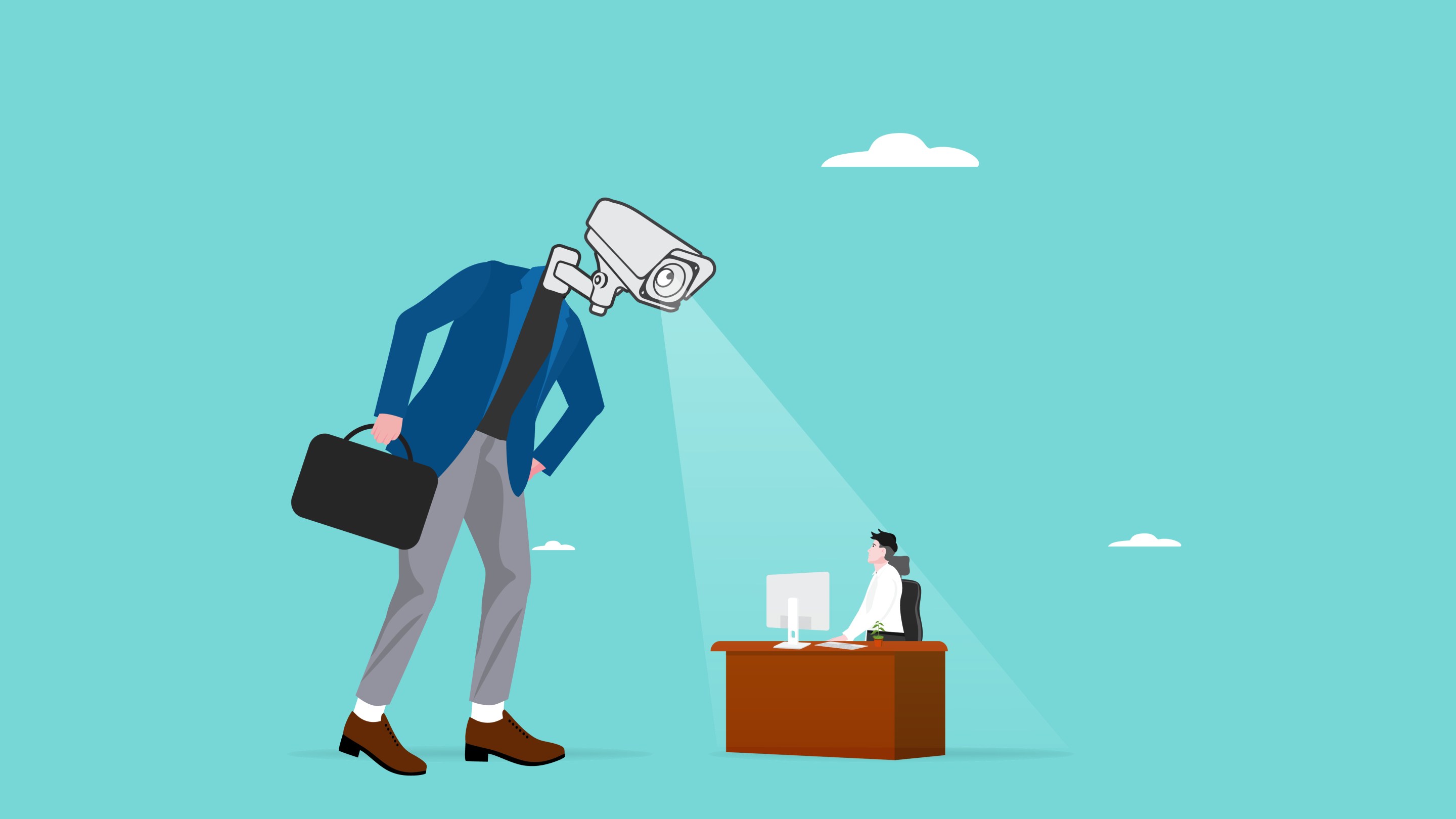
Advances in AI, cameras, sensors and tracking software have given employers unprecedented power to monitor employees. They now observe the physical location of workers, the length and content of phone calls, keystrokes per minute, and even the tone and pitch of conversations with customers.
Now, as companies search for new ways to watch their workforce, researchers are taking a close look at the consequences of constant surveillance.
Employee monitoring has become standard practice in multiple industries and workplaces. Drivers delivering packages or pizzas are increasingly being watched by AI-powered surveillance systems. Many employees in Amazon warehouses are continuously tracked through handheld scanners, badge swipes and workstation software.
Technologies that keep tabs on employees hold a strong appeal for corporate leadership, says Cornelius König, a psychology researcher at Saarland University in Germany. Leaders may believe that close surveillance can help identify top performers, increase efficiency or improve safety, he says.
In practice, though, such benefits are elusive. When König reviewed studies on employee monitoring in the 2025 issue of the Annual Review of Organizational Psychology and Organizational Behavior, he found little to suggest that electronic surveillance improved performance. “My general take is that [monitoring] isn’t going to matter as much as employers assume,” he says.
Despite the lack of evidence, the global market for employee-monitoring technology is expected to exceed $4 billion in 2026, largely due to major companies in North America. A New York Times investigation in 2022 found that eight out of the 10 largest private US employers, including United Parcel Service, Amazon and UnitedHealth Group, tracked productivity metrics of individual workers, often in real time.
US postal workers are also closely watched. Delivering mail “feels less like public service and more like working inside a quiet surveillance state,” said a Reddit user in 2025. “We’re tracked down to the second. Every scan. Every step. Every stop. They monitor our GPS in real time. They can pull up on us unannounced. We get questioned for things as human as needing the restroom or checking a package twice.”
Any employer of any size can get into the monitoring business. Amazon Web Services sells thousands and thousands of software programs for employee monitoring, says Michele Molè, an employment law researcher at the University of Groningen in the Netherlands. Adding a monitoring app to the workplace can be as easy as downloading Spotify, he says. But instead of music, employers get a stream of data about how each employee is behaving every minute of their day.
Companies that hope to increase their workforce’s performance through monitoring face a basic obstacle in human nature, König says. Workers might briefly up their game, but they tend to revert to their normal routines. “They become habituated,” he says. In his review, he pointed to growing evidence that even body cameras worn by police — an especially high-profile, high-stakes example of surveillance — don’t significantly change the behavior of either the police or the public over the long term.
When workers do respond to monitoring, there can be unintended consequences. A 2020 study found that electronically monitored truck drivers were less likely to exceed daily limits for driving hours, but they also were more likely to crash.
König is far from the only skeptic. “There’s really very little evidence that the mere implementation of monitoring employees is, in itself, going to increase productivity or performance,” says Daniel Ravid, a management researcher at the University of New Mexico.
Ravid conducted a 2022 meta-analysis that combined the results of studies involving more than 23,000 subjects in laboratory experiments and workplace settings, including workers in call centers and offices and police on patrol. Taken together, the studies found no correlation between levels of monitoring and employee performance.
That’s partly because some employees find workarounds to monitoring, even if that means tapping their keyboard periodically while they’re reading a book at lunch. “People are incredibly creative and adaptable, and they’ll find ways to reassert their freedom when it’s threatened or taken away,” Ravid says.
Ravid’s meta-analysis found that any type of monitoring — subtle or obvious, incidental or invasive — tended to increase workplace stress. “I think anything that undermines a sense of dignity is also going to undermine employee attitudes,” he says.
A 2024 study of more than 3,500 workers in Canada underscored the potential downsides of monitoring: Employees who perceived that they were being surveilled on the job reported that they felt more pressure and stress and less autonomy and privacy at work.
In an age of “datafication,” it’s not surprising that companies would look for new metrics to evaluate employees, says Kirstie Ball, a management researcher at the University of St. Andrews in Scotland. “The systematic gathering of data about people and what they’re doing is part and parcel of modernity,” she says. “Surveillance becomes a means of getting things done.”
But not every company knows how to make good use of all those data points, Ball says. “There are many pitfalls along the way. Are you measuring what you think you’re measuring? Are you interpreting the data correctly according to the purpose that you gathered it, or are you looking at it just because you can?”
Employee surveillance without any coherent plan to use the data has become a commonplace scenario in modern companies, König says. Many workplaces end up collecting data simply because they have the technology, not because surveillance supports the company’s overall business strategy. “They end up with terabytes of data on a drive somewhere but don’t know what to do with it.”
Modern surveillance is an inherently electronic exercise, but companies can’t just install an app and expect results, Ravid says. “If managers think that they have a perfect way to measure performance because they have advanced technologies, they’re wrong,” he says. “They still need human insight and conversations to contextualize that data.”
Laws protecting employees from overly invasive surveillance generally haven’t kept pace with technology, says Molè, who wrote the 2026 book Monitored at Work. While the European Union has strong employee privacy laws, with additional legal protections in nations like Italy, Spain, France and Germany, workers in the US have far fewer safeguards and are more likely to be placed under a microscope.
In 2023, three current or former Amazon delivery drivers in Colorado filed a class action lawsuit against Amazon claiming that they were under excessive AI-assisted surveillance and that delivery quotas made it difficult to take necessary breaks. “The drivers were forced to pee in bottles,” Molè says. “This is not happening in Europe.” Amazon called for arbitration, noting that drivers work directly for outside delivery service providers who have contracts with the multitrillion-dollar company, not Amazon itself. The case is ongoing.
Other legal issues can lurk in the fine print that comes with monitoring software. Bosses who download monitoring apps they can’t customize are essentially letting outside companies take control of their employees’ data with little oversight or knowledge of how the data could be used. “We need more labor laws that target providers of technologies,” Molè says. Surveillance companies should be required to work directly with companies and their employees to clearly explain the technologies and tailor each product to meet specific needs and reach specific goals, he says.
Theoretically, monitoring could be a part of a healthy company culture that encourages success, Molè says. “People under monitoring should have a sense of being valued, and the monitoring should be truly meaningful for improving everyone’s working conditions and methods,” he says. “Good monitoring is based on mutual trust.” Companies that thoughtfully build their own system for tracking employee outputs instead of superimposing some “creepy and odd” tool found online are more likely to see actual benefits, he adds.
Success is certainly possible. Headbands that track brainwaves may seem invasive, but an Australian mining company found that such technology helped reduce fatigue-related accidents to almost zero. A 2024 study of remote workers on Upwork found that the productivity of top-performing workers dropped nearly 20 percent after they were allowed to turn off monitoring software without explanation, suggesting that the software had some benefits.
But productivity didn’t fall when that high-performing group was told they had the opportunity to go without supervision because of their impressive output, underscoring the importance of good management — leading the researchers to conclude that spending money on good managers could yield better results than spending it on monitoring software.
Transparency can go a long way to improving workplace culture, Ravid says. His meta-analysis found that, compared with workers who are surveilled without much explanation or consent, workers who have a clear understanding of how they are being monitored and how the data will be used also have a greater sense of fairness and job satisfaction.
New technologies will continue to join the ranks of Burger King’s Patty and other monitoring devices in the modern workforce. But if companies don’t change their basic approach, the results will likely be the be the same: suspicion and confusion for employees and few tangible benefits for employers. 
This article originally appeared in Knowable Magazine, a nonprofit publication dedicated to making scientific knowledge accessible to all. Sign up for Knowable Magazine’s newsletter.
Lead image: Vanz Studio / Adobe Stock