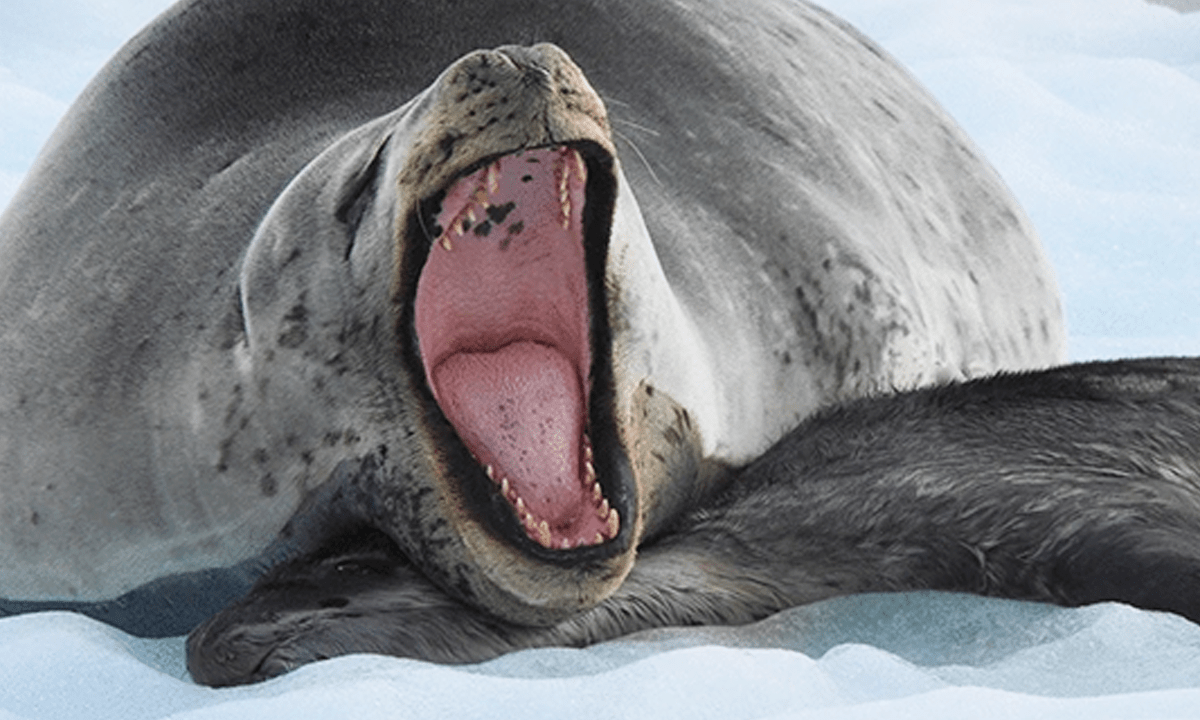
Leopard seals have a bit of a reputation for being aggressive. Virtually alone at the top of the Antarctic food chain, these territorial apex predators feast on penguins, squid, and other seals, and have even been known to attack humans. Now, new research is shining a light on the softer side of the pinnipeds.
For the first time, scientists observed mother leopard seals caring for their deceased offspring. It’s a rare phenomenon known as “postmortem attentive behavior,” or PAB. Chimpanzees, whales, elephants, and other mammals have been observed participating in this behavior, but it had not previously been documented in leopard seals.
Post-doctoral researchers Emily Sperou and Renato Borras-Chavez from the University of Rhode Island watched leopard seals in Patagonia, Chile, and published their findings in Polar Biology. They observed some mothers with dead pups nuzzling them, carrying them in their mouths, displaying territoriality around their corpses, and even transporting them between ice floes. “This was a unique behavior to witness,” Sperou said in a statement.
Some of the mothers observed exhibited PAB long after their pups had died. In fact, one mother attended to her pup’s corpse for 20 days—one of the longest observed bouts of PAB ever recorded.
While the question of whether or not this heartbreaking behavior constitutes something we humans would recognize as “grief” is probably best left to philosophers, the debate about whether this trait is an adaptive one is still open among biologists. The authors of this paper come down squarely on one side. “It's actually a maladaptive trait,” Sperou said. “This behavior is not beneficial for the animal.”
Read more: “How Animals Understand Death”
The researchers point to a potential chemical culprit—the hormone oxytocin. Post-birth, oxytocin reinforces maternal bonding, and once the spigot is turned on, it might not be so quick to turn off—even when their offspring dies. In other words, PAB might represent a kind of empathy carryover that makes seal moms unable to let go of their dead pups.
Some scientists have also theorized that PAB in other marine mammals, such as whales and dolphins, is a consequence of having a larger brain that’s evolved for social interaction. In this model, mothers with dead offspring are more so social creatures going through the motions of protecting their offspring even after they’ve expired. 
Enjoying Nautilus? Subscribe to our free newsletter.
Lead image: Sperou, E.S., et al. Polar Biology (2025).