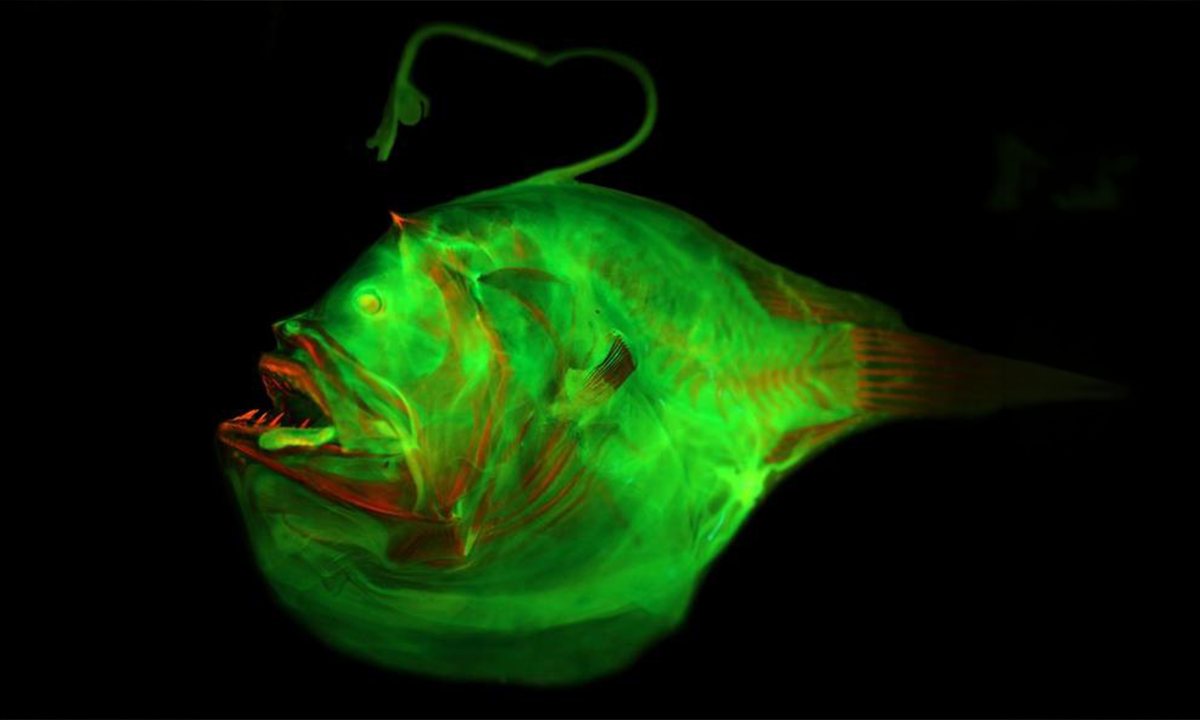
With transparent dagger-like teeth lining its gaping mouth, the black seadevil is one of the most terrifying looking creatures on Earth—and that’s before you take into account the glowing appendage dangling from its forehead.
The seadevil is an anglerfish, and like almost all other species of anglerfish, it comes equipped with its very own fishing lure. This structure, which gives the anglerfish its name, is a specially modified dorsal fin that can serve a variety of functions. New research published in Ichthyology & Herpetology goes on a deep dive of the evolutionary history of these fascinating tools—and the fish that innovated them over tens of millions of years.
Despite often being associated with inky depths, anglerfish occupy a wide variety of ocean habitats, including shallow coral reefs. Still, information about how they use their lures has been somewhat murky. “For this particular group of fishes, there’s limited observational data,” study co-author Matther Davis of St. Cloud University in Minnesota said in a statement. “Many have never even been filmed or observed alive.”
To chronicle their evolutionary journey, Davis and University of Kansas biologist Alex Maile examined anglerfish specimens held in natural collections and fossils to map lure types onto an evolutionary tree. According to their research, the first anglerfish lures were simple mechanical structures used to attract prey that evolved around 72 million years ago.
Read more: “Seahorse Love Works in Mysterious Ways”
Around 34 to 23 million years ago, anglerfish moved deeper in the ocean. There, the absence of light led them to develop bioluminescent lures, capable of attracting more than just food. “The conventional idea was they’re using this to attract prey,” Maile said. “We think it’s actually serving a dual purpose, especially in the deep sea, where you’re taking a lure, adding a glowing element to it, and now you can attract food, but you can also attract a potential mate.”
They found an explosion of anglerfish diversity that coincided with the evolution of bioluminescent lures, supporting the hypothesis that these early lures were also used for mating and other intraspecies communication. As bioluminescent lures evolved, the stalks that held them grew longer, presumably to hide the hungry anglerfish from prey.
Anglerfish also developed chemical warfare, the researchers say. Around 49 million years ago, batfishes evolved appendages that shoot out and secrete chemicals that can lure clams, mussels, and worms out of the sand so the fish can feed on them. Frogfishes followed suit, discovering the same trick 5 million years ago. “Frogfishes hang above a current and secrete chemicals, letting the current carry them,” Maile said. “Prey follow up the current, and the frogfish ambush them.”
While chemical luring remains poorly understood, the researchers say it’s a good topic for future research. In the meantime, there’s no telling what anglerfish will get up to next. In tens of millions of years, anglerfish 4.0 might just develop electricity. 
Enjoying Nautilus? Subscribe to our free newsletter.
Lead photo courtesy Matthew Davis