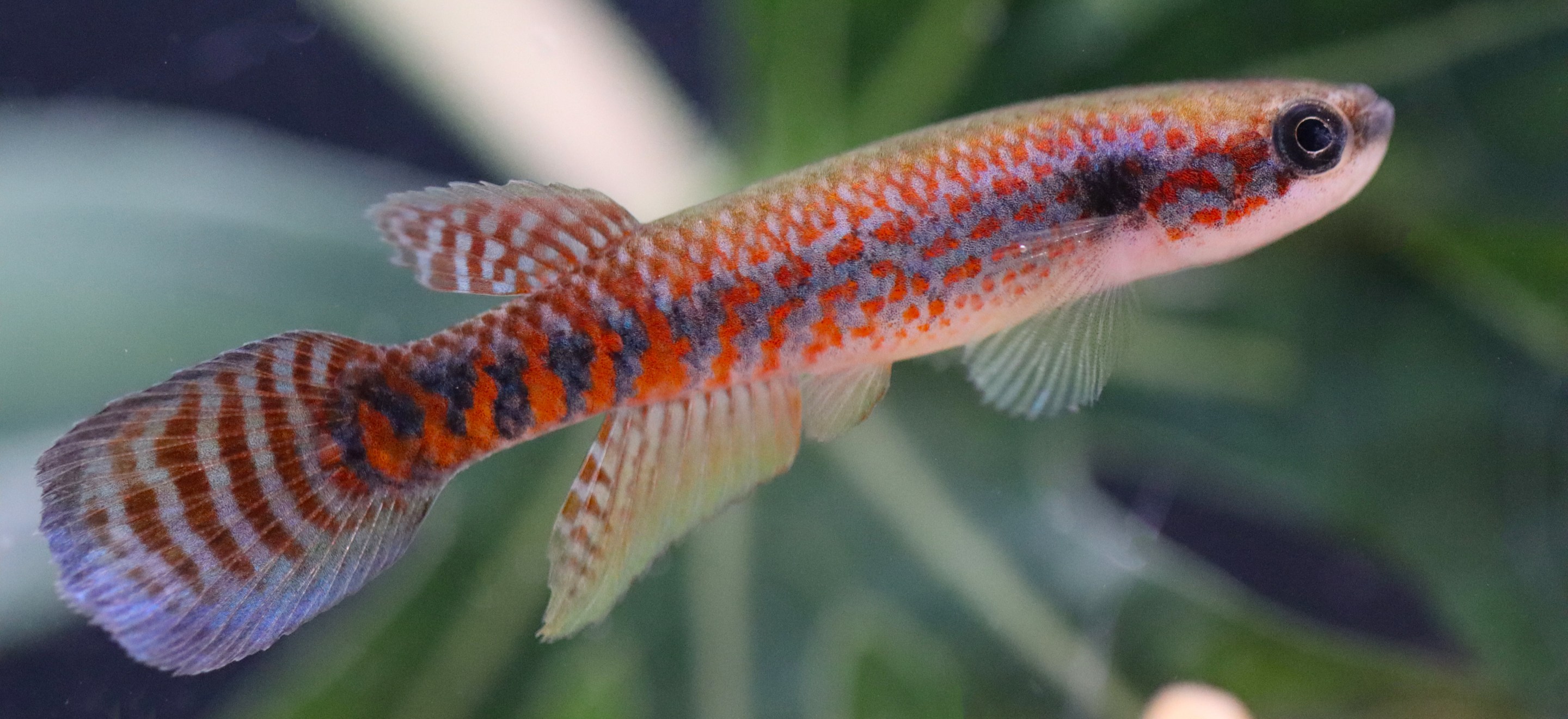
The good news? The dazzling Laimosemion laranja killifish was just discovered in the Brazilian Amazon. The bad news? The team that discovered it is already recommending that it be placed on the official endangered list.
L. laranja was uncovered during a project to catalog freshwater fish in the rivers of the Rio Cajari region in Amapá State. Its brightly colored appearance caught the attention of researchers and inspired part of its name: “Laranja” means both orange the color and orange the fruit in Portuguese. The name also acknowledges the Laranjal do Jari municipality where the discovery was made.
Read more: “Editing the Pesky Bones Out of a Popular Farmed Fish”
“We wanted to choose a name that would highlight a characteristic of the fish while also fostering a sense of connection with the people of the region where it was discovered,” study author Yuri Abrantes, from the Universidade Federal do Rio Grande do Norte, explained in a statement. (A study on the finding has now been published in Zoosystematics and Evolution.)
Even by killifish standards, the new species is small: The males are larger than the females, and the longest one identified by the researchers was about 1.1 inches in length.
As well as being smaller, female L. laranja are less striking in their appearance. They don’t have the bold orange chevron-shaped bars on their rear half like the males do, and they have fins that are yellowish or greenish rather than the brighter orange and blue.
Body proportions, scale counts, and skeletal features were all examined to identify this as a new species, with the most obvious indicator being the count of eight scales in a row across its body—something no other close relative has. The team also analyzed the mitochondrial DNA of the fish, which acts as a sort of genetic barcode. The number of differences in this barcode help scientists distinguish one species from another.
As for conservation efforts, L. laranja has been found in just three small forest pools so far, covering an area of about 10 square miles. Its habitat is under threat from deforestation, mining, urban expansion, and plastic pollution. That means the fish meets the criteria for endangered species, as defined by the International Union for Conservation of Nature (IUCN).
“[The discovery] was something special, as we saw an opportunity to contribute to increasing our knowledge of Amazonian biodiversity and to draw attention to the conservation of areas that are still poorly explored but highly threatened,” Abrantes said.
Thankfully, this fish may have been identified just in time to save it. 
Enjoying Nautilus? Subscribe to our free newsletter.
Lead Image: Yuri Abrantes